Nürnberg
Along with Vienna it was a significant ‘crossing-point’ for us on our tour.
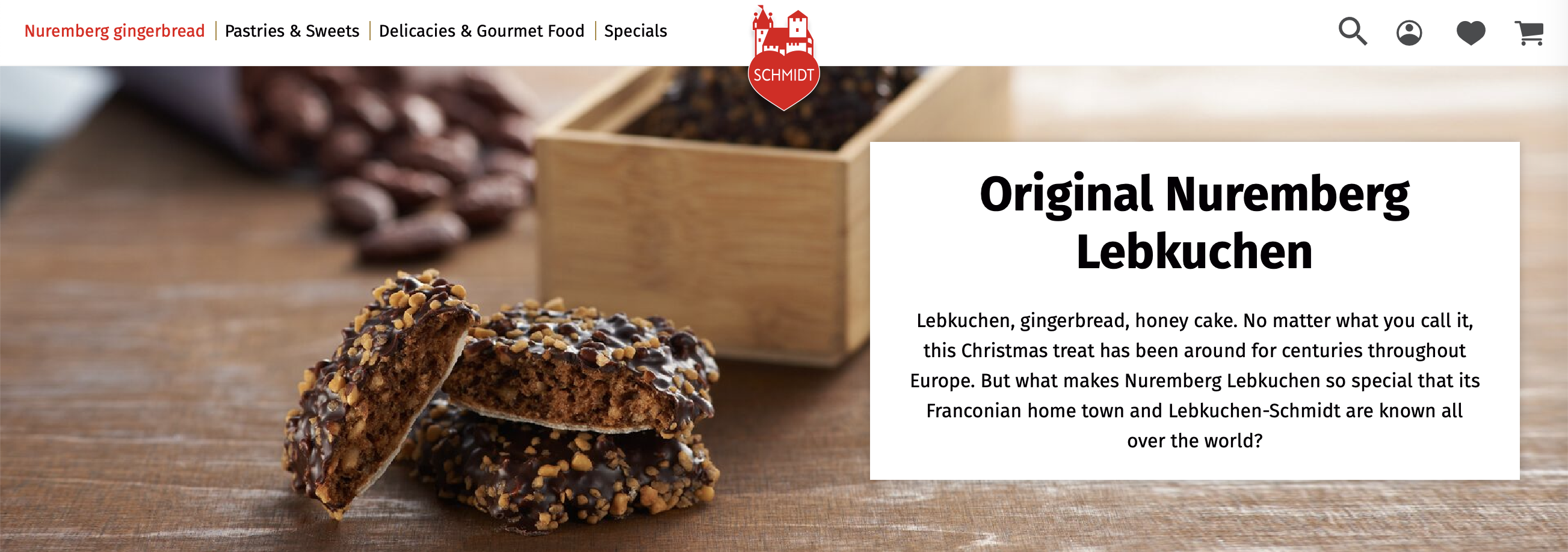
My personal links with the city started young as ‘adopted-uncle’ Helmut Kalbitzer sent the family Nürnberger Lebkuchen every Christmas.
At home we had many prints of artistic work by Albrecht Dürer.
In 1987 I visited in support of a UK student group involved in a partnership.
The links had thus made me very aware of the history of the city – its historic & cultural significance & its ‘manipulation’ by Nazi propaganda & destruction by air raids & artillery cannon.
The hosts in ’87 provided a very thorough introduction to many of the above aspects and issues.
Therefore including Nürnberg as stop-over day between visits to Poland and France, fitted with the aims of the No Kerosene Tour.
As the daylight eased away we took an evening stroll & whilst curious to understand more of the history of the city, followed a town wall along what turned out to be a somewhat ‘unexpected’ quarter.
It is becoming dark in Nurnberg and we are strolling around. Jacqui felt that it was worth continuing to follow the walls as they were nicely lit, in red lighting.
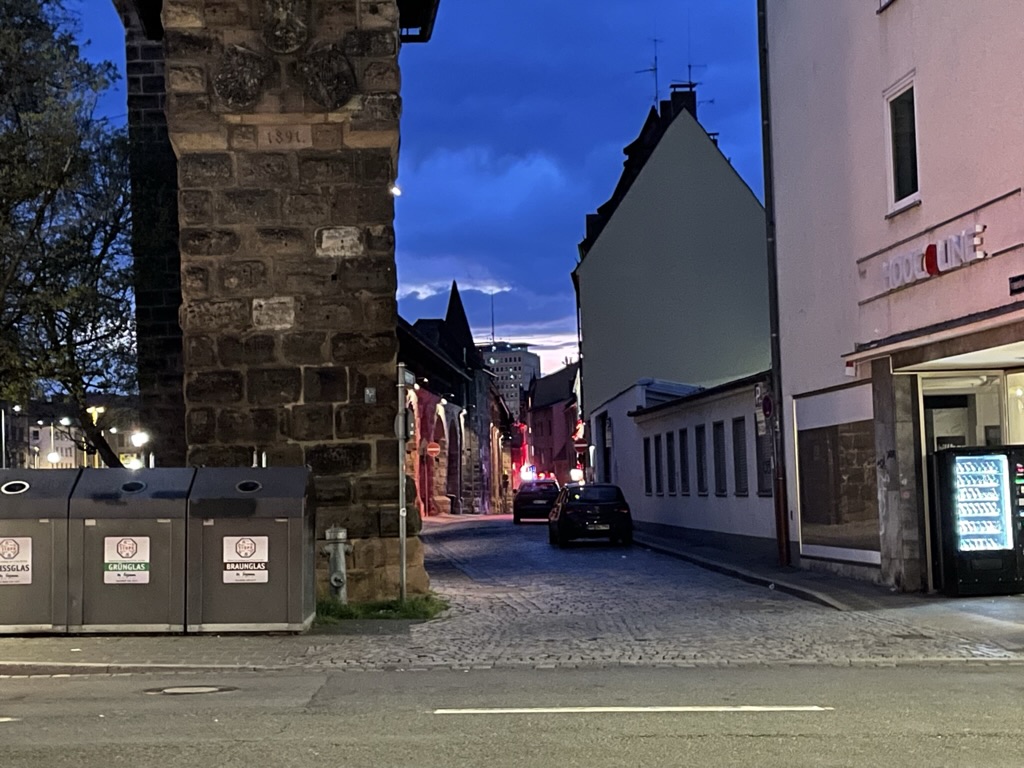
And the red lighting continued for some distance…. With, to Jacqui’s initial surprise, a very particular trade being ‘displayed’ in window after window.!…… welcome to the ancient city of Nurnberg.
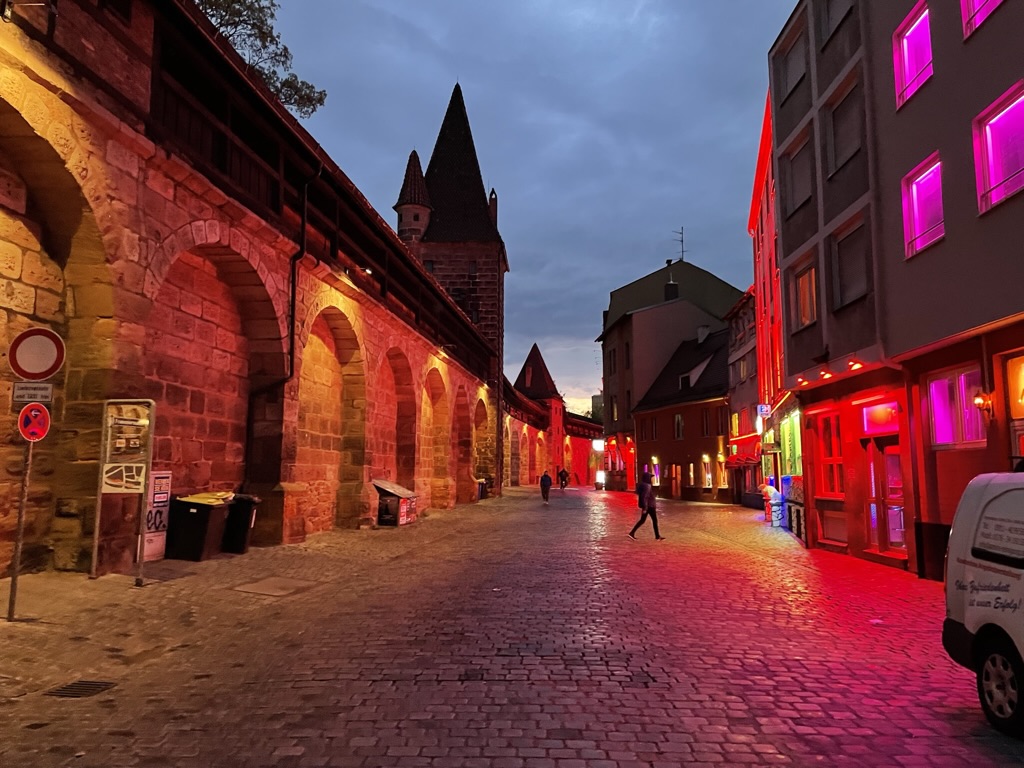
We are so innocent….. drifting towards the cosy red glow and appreciating the way the city authorities have provided pleasant lighting for their ancient city walls…… then we looked in a window!
There have been times when I’ve had chats with sex workers and found the conversations valuable & they’ve been quite humorously challenging….. but was that partly defensive?
The displays by those occupying the windows that we passed, left us feeling rather saddened by the experience.
Saturday April 15th
A day exploring the city
On Being (nearly) in the Centre
Shortly after the collapse of communism in central and eastern Europe I read that the changes had returned Nürnberg to its position as the city at the centre of Europe.
This may not be exactly true – there are many that have claimed the position but in the terms of the present EU (which represents a geographical spread covering much of the ‘accessible’ continent) it is reasonable.
27 members after Brexit: On 31 January 2020, with the withdrawal of the United Kingdom from the EU, the geographical mid-point moved to Gadheim near Würzburg, Bavaria
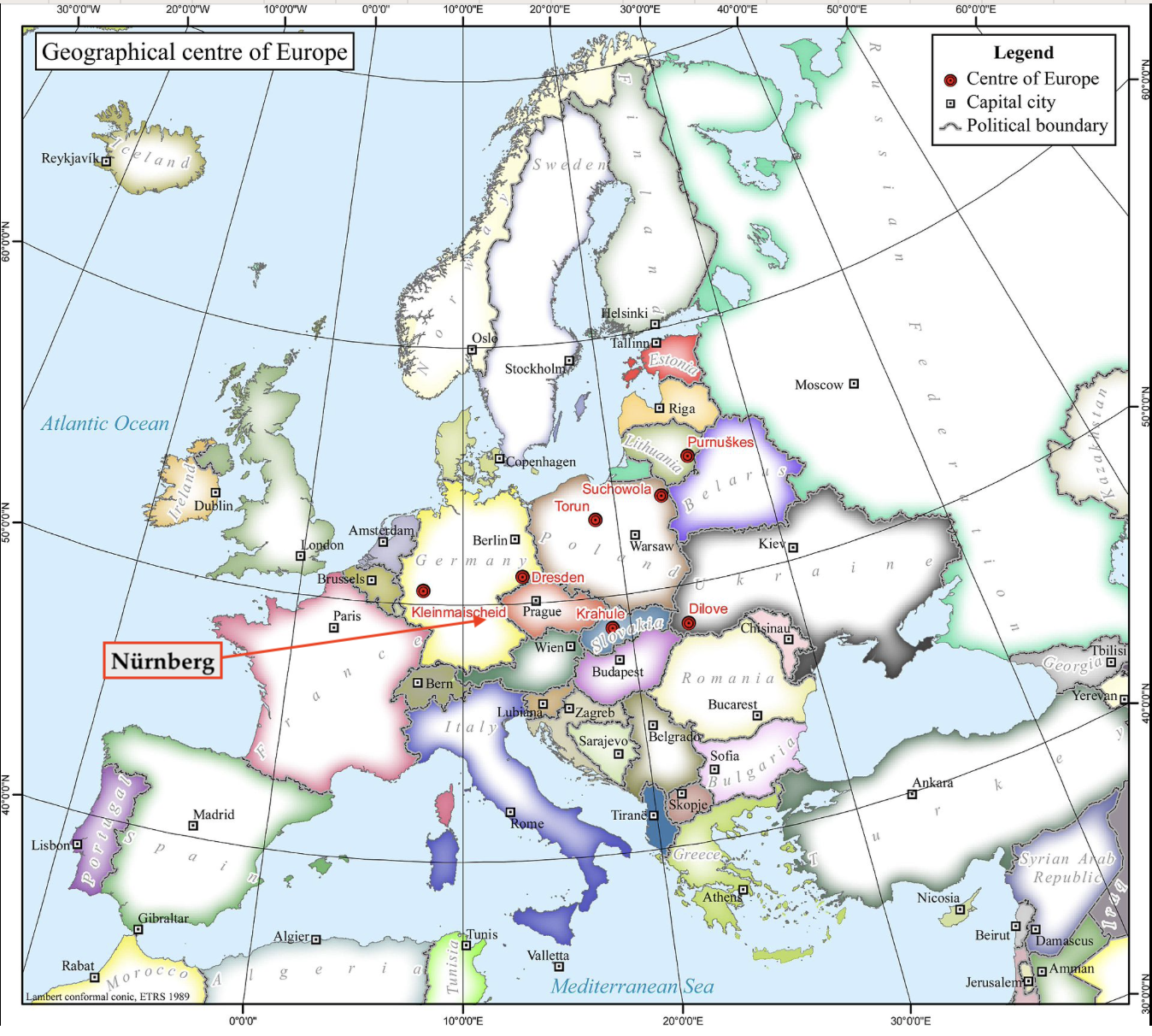
The question regarding ‘centrality’ of Europe raises other issues.
The USSR had continued as heir and successor to the Imperial Russian Empire – and expanded. The States involved became part of ‘Eastern’ Europe. BLOC
Yet most were not.
If anything they constituted the core of ‘central’ Europe.
The Polish-Lithuanian Commonwealth was a powerful mediaeval State extending to the Black Sea others including
the Transylvania region of Romania
Lviv, one-time capital of the Kingdom of Galicia–Volhynia & later a Hapsburg Kingdom,
Bohemia & Moravia (modern Czechia),
Slovakia, Croatia & Slovenia
were all constituent parts of the Hapsburg Austro-Hungarian Empire.
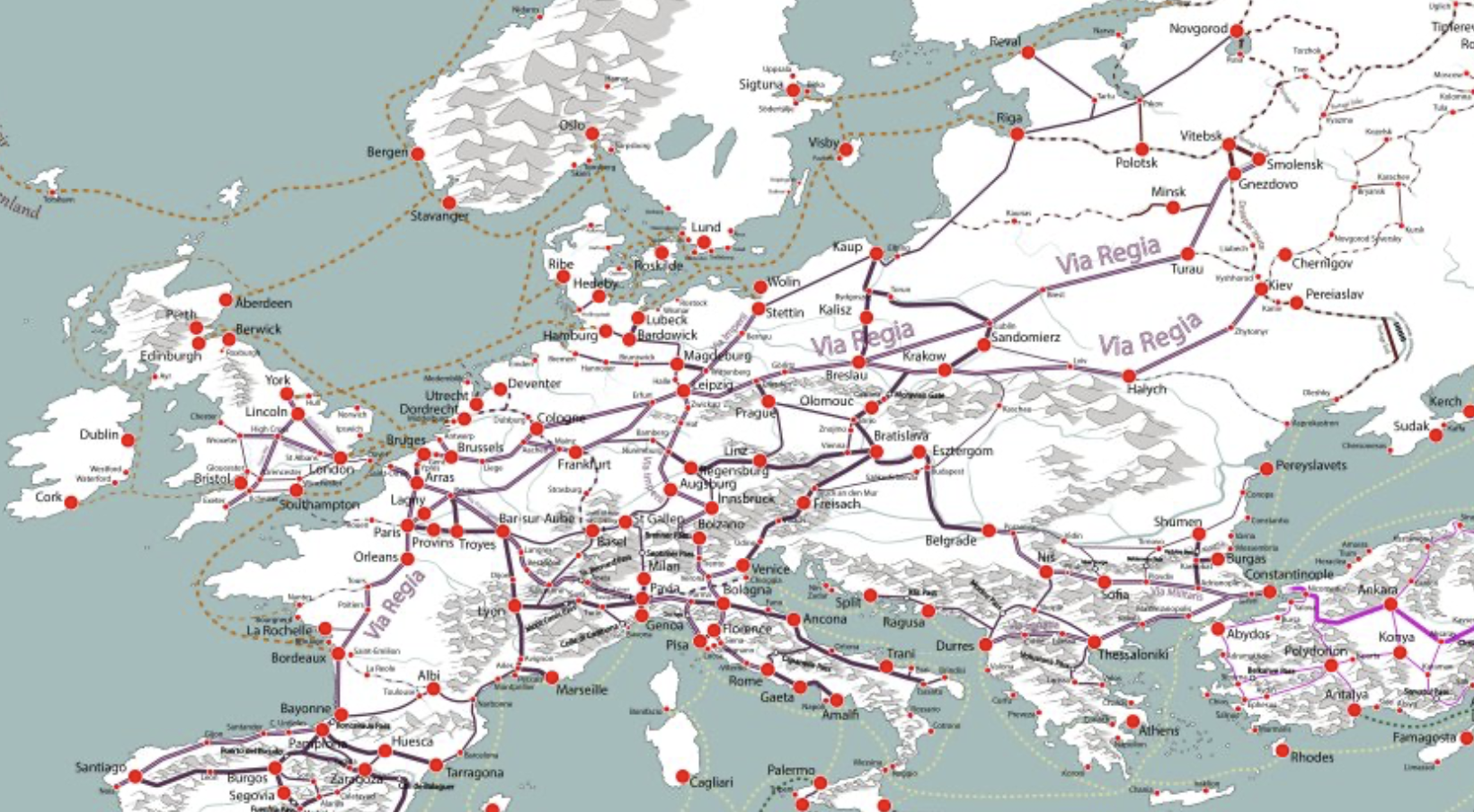
Kaunas (Lithuania), Riga (Latvia) were members of the international Hanseatic League of trading cities stretching across the Baltic & North Sea region
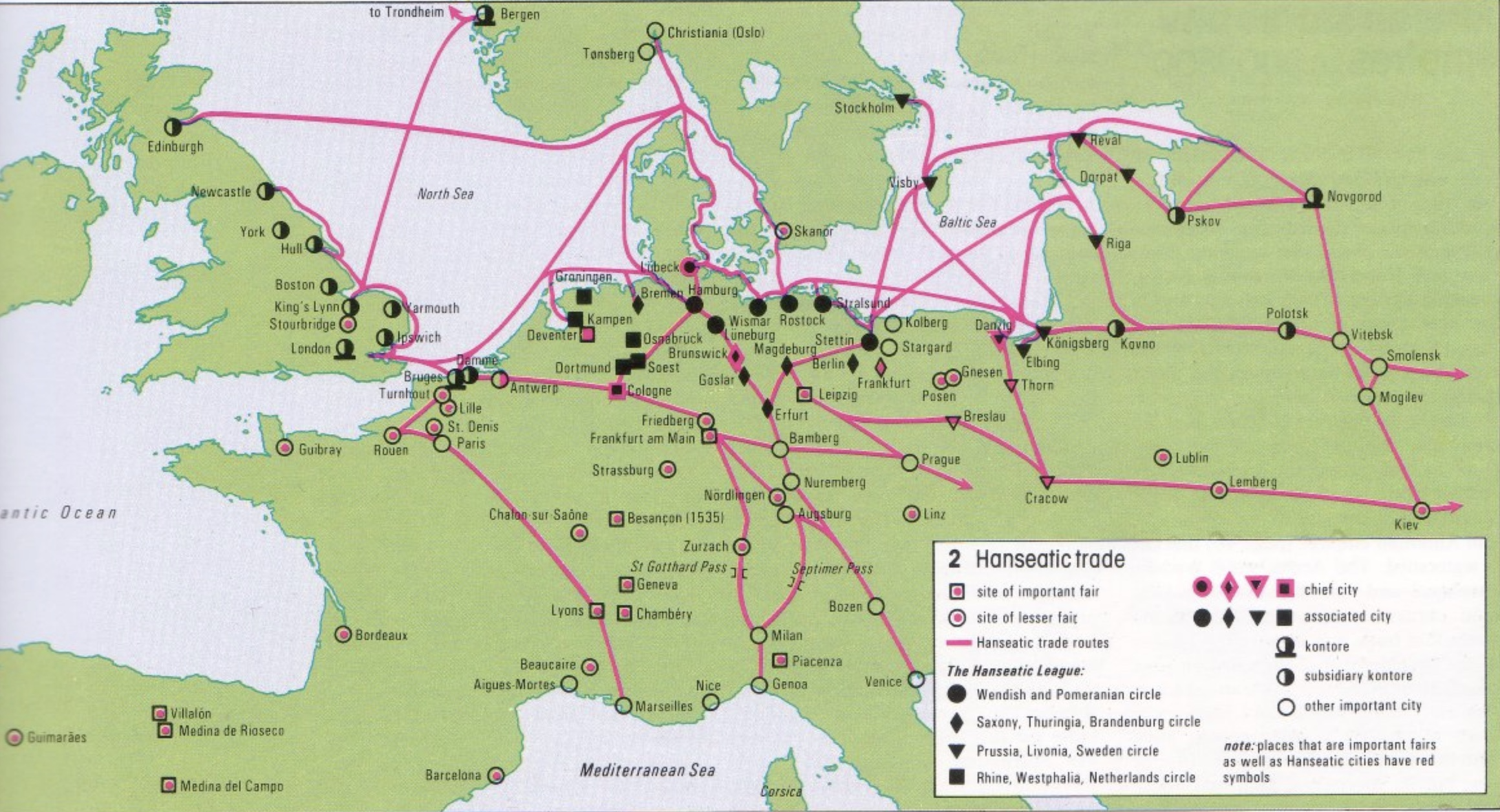
All these places were thoroughly integrated into the trade and culture of western and northern Europe.
In 1983 the Czech writer Milan Kundera wrote an essay ‘A Kidnapped West: The tragedy of Central Europe’.
Mentioning the uprisings against Russian controlled totalitarianism .in Hungary (1956), Czechoslovakia (1968) & Poland (several), he stated that they
‘were a drama of the West, A West that, kidnapped, displaced and brainwashed, nevertheless, insists on defining its identity’ (page 39).
The EU has been enthusiastic to include new members that were previously part of the Sovietised ‘Empire’.
In doing so it has returned many territories (now mostly ‘Independent Nation States’) to a normality that had existed before the expansion of influence and control of the USSR.
Unfortunately, as with anyone who has suffered from a lengthy spell of ‘kidnapping’, recovery from the ordeal takes time.
The actions of the ‘Atlanticised West’ (including the EU) have not paid sufficient attention to the impact of imprisonment on the social psychology of such places – and some developments have been sluggish or warped (partly fed by romanticised memories of the security of incarceration)…. Though none of those ’suffering’ from the condition have expressed a desire to leave their new ‘club’.
Putin’s Pain:
A man with an unresolvable ache:
– believing his country is uniquely special (‘without Russia there is nothing’)
– who has achieved personal control of the country (not even a Communist Party Central Committee with which to contend) that was in Czarist times always governed in such a way.
– A population that has been force fed on the myths & glories of Empire [eg the new history book for all schools]
– Then taking as personal insult that he & also his country has been ignored, mistreated and abused by those from whom he would wish to have attention & treatment as an equal
He has the power & control to express his pain and and accumulated anger – and thus manifests it on a neighbouring country (whom, in his romanticised mind, he believes should be part of ‘his’ country).
He seems to have a conscious principle:
The Equalisation of Pain……’Pain for me means Pain for you’.
[Therefore: How do we take away his pain?]
Central Europe – those lands mentioned above, is fearful
[In our travels on the No Kerosene Journey we have heard from many of their fear – even terror – when the invasion of Ukraine occurred – uncertainty is still present in a form that is different from the western(distant) nations]
Russia’s war against Ukraine is about post-imperial unfinished business and spheres of influence. It is also about real and imagined cultural and political boundaries in Europe, including that old chestnut about what constitutes central and eastern Europe.
We may hope, with Jacques Rupnik (above), that
“Today, not just Lviv but the whole of Ukraine is leaning westwards, and its nearest west is central Europe. The irony of history is that by including Ukraine, central Europe – once Kundera’s “kidnapped west” – is reinventing itself by expanding eastwards.”
If that occurs, Nürnberg would, once again, have moved its position.
Its Saturday morning – and a White Rhino is resting ‘on the tiles after ‘a good night out (as we might say in UK of someone who has had too much alcohol the night before).
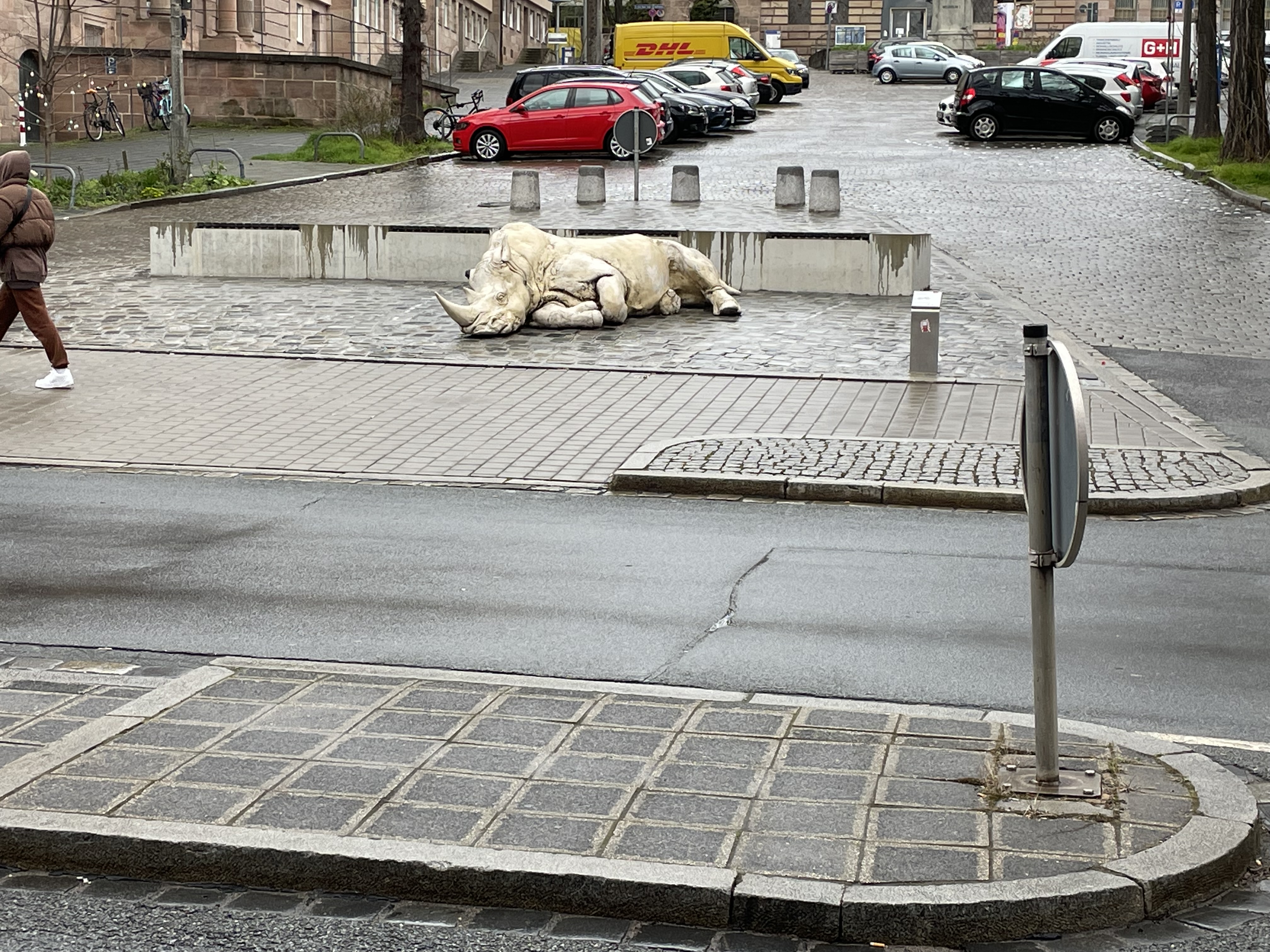
But why?
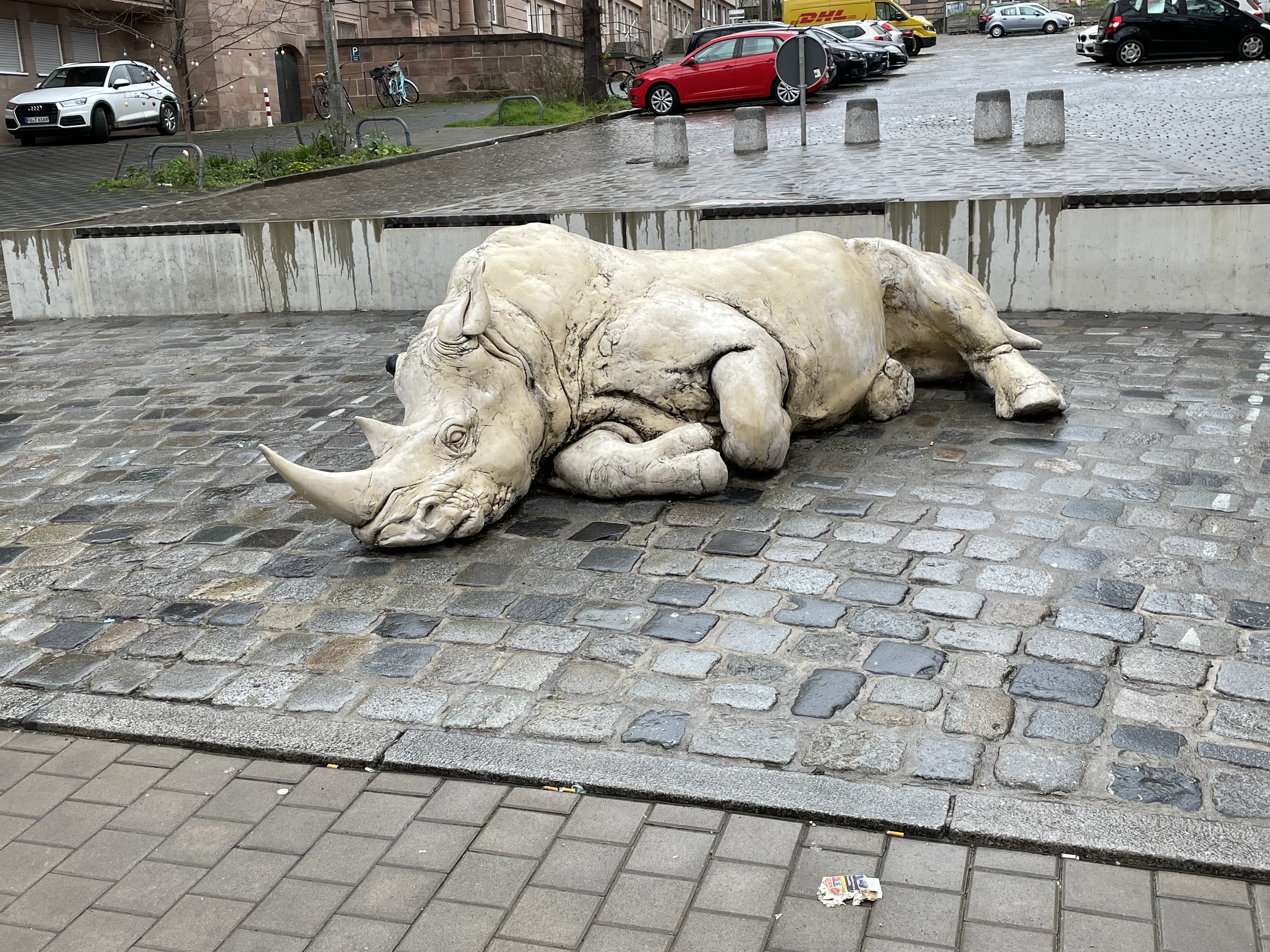

Albrecht Dürer (raised in Nürnberg) made a woodcut engraving of a rhino in 1515. His image had several errors. Prints of his picture were widely available and consequently, Rhinos being unknown in Europe at that time, his image was copied and used by many others for several centuries. The errors are so distinctive that pictures using them can be accurately traced back to his original.
Despite being in Dürer’s home city we did not view any of his works. His house and museum was closed.
Our main focus for the day was to visit two major churches & buy lebkuchen.
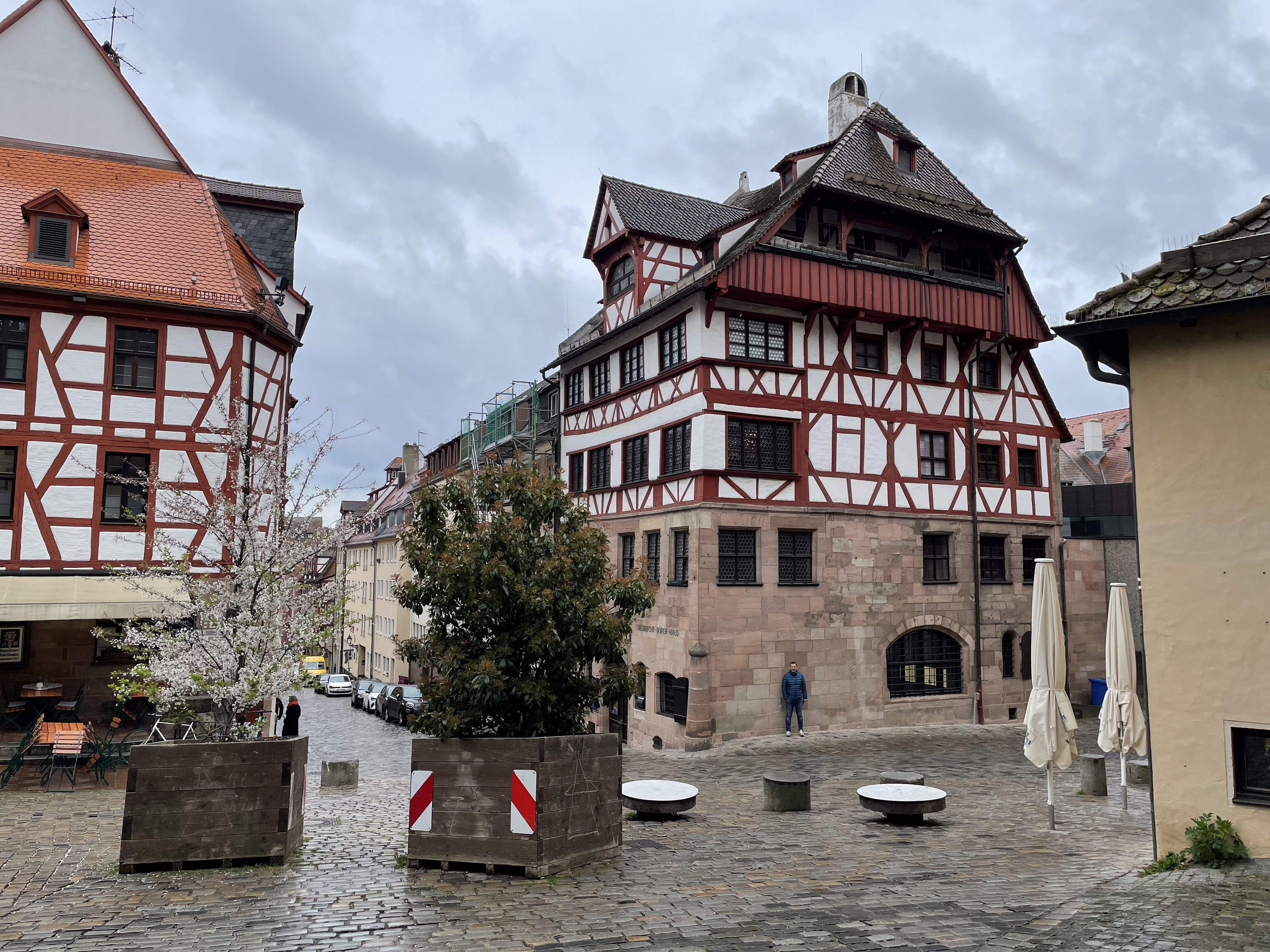
Above: Herr Dürer’s house – we knocked & metaphorically ‘rang the bell’ but no-one was at home
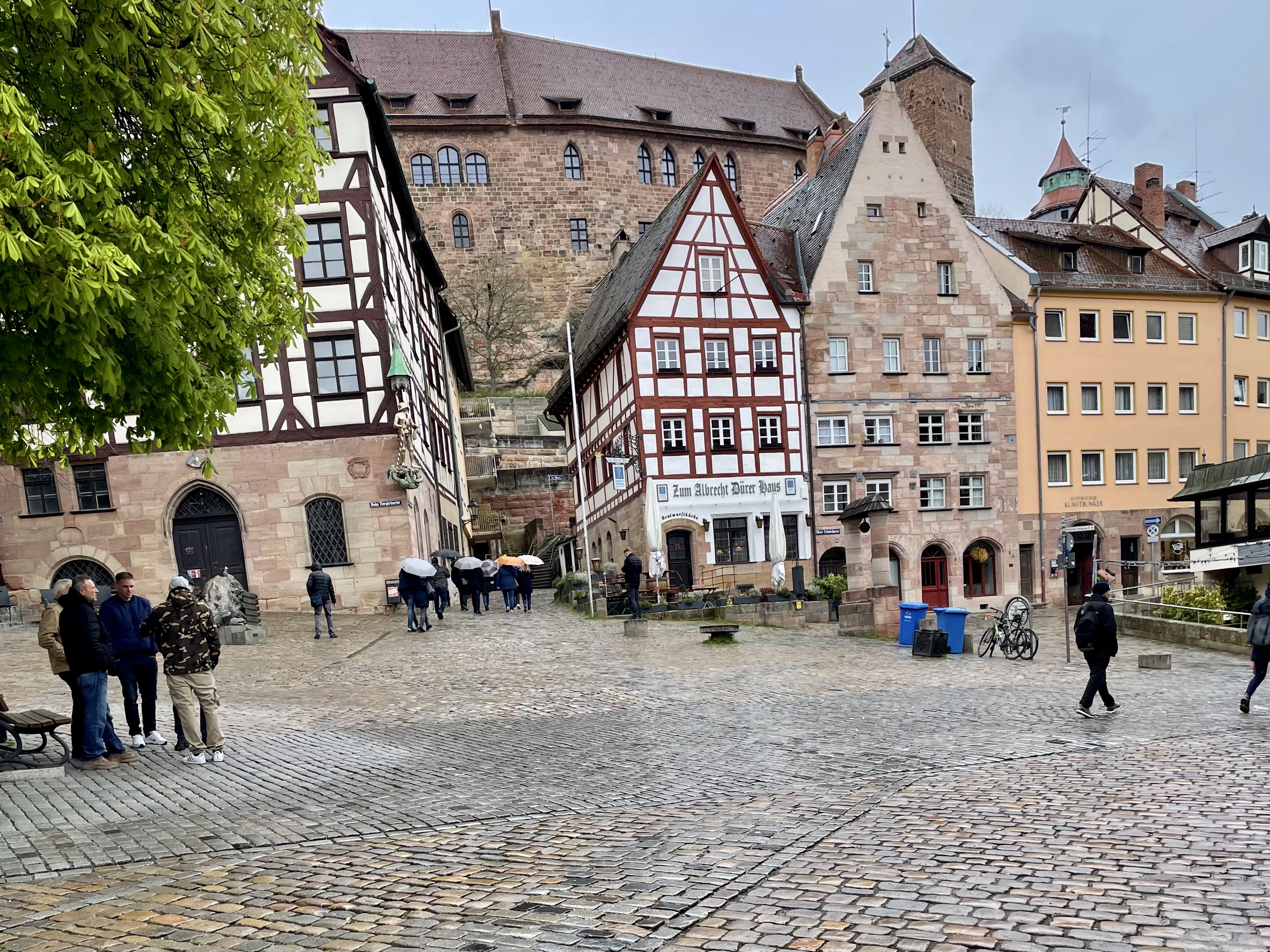

Nürnberg: An important Imperial City of the Holy Roman Empire in which ‘Diets’ (imperial consultative councils) were held.
The ‘Empire’ (neither Holy, nor Roman nor an Empire’) had provided a framework & the Hapsburgs became, by inheritance, permanent rulers. Thus in some senses, by the C18th Vienna became the new ‘Rome’.
Our travels, since travelling up the Jiu Valley & into Petrosani have been within the boundaries of territories that are historically linked. The link continues on our journey to places well beyond Nürnberg.
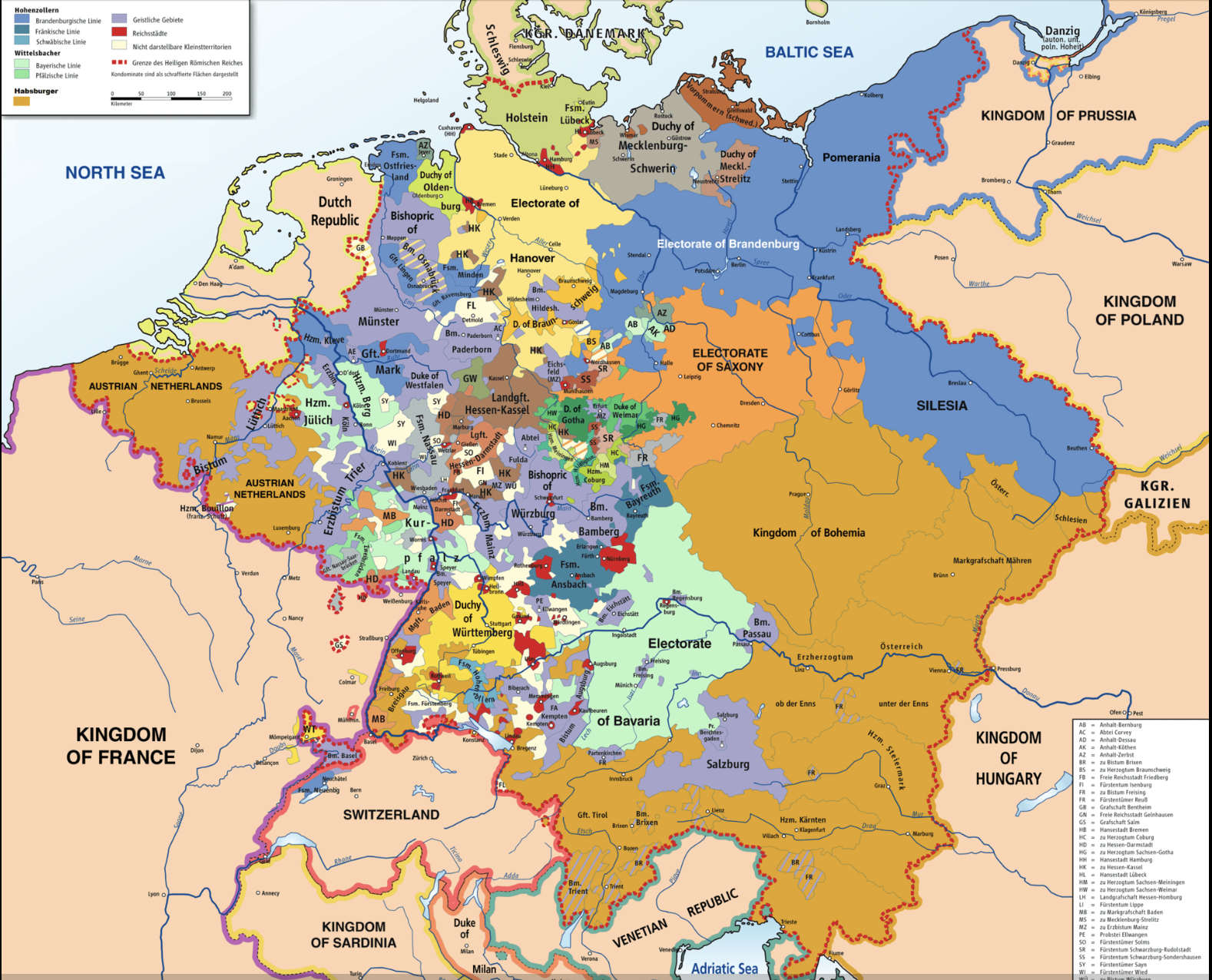
The Empire, as complex as ever (!) in its final phase in 1789.
Nürnberg was strategically sited on the major trade route to Italy (the Via Imperii) & in the C15th was the centre of the German Renaissance.
The link with Prague was sufficiently important for there to be a named Imperial road connecting them: The Via Carolina.
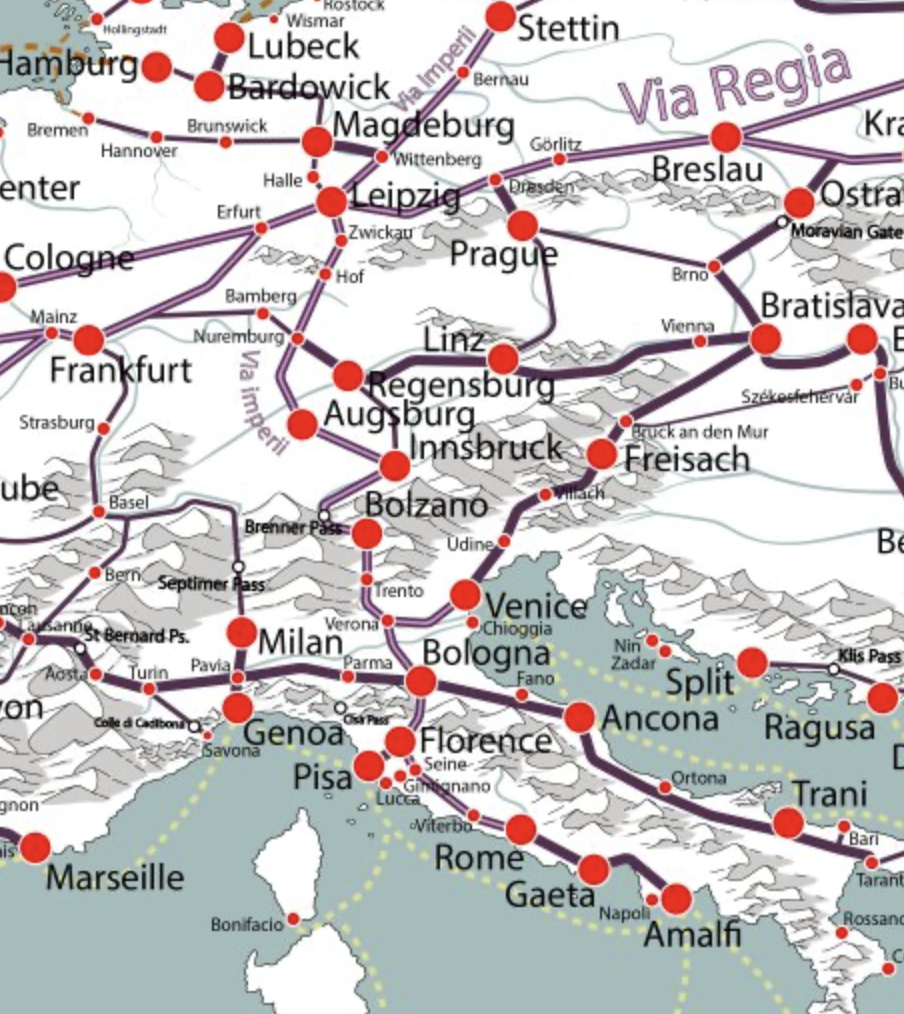
Nürnberg was strategically sited on the major trade route to Italy (the Via Imperii) & in the C15th was the centre of the German Renaissance.
The link with Prague was sufficiently important for there to be a named Imperial road connecting them: The Via Carolina.
Nürnberg’s importance as a centre of German culture was abused by Hitler – & was for the infamous Nürnberg Rallies. This then led to it also being used for the post war Nürnberg Tribunals.
The Nazis also used the vast network of underground galleries (below the castle) as storage for valuable items looted from elsewhere.
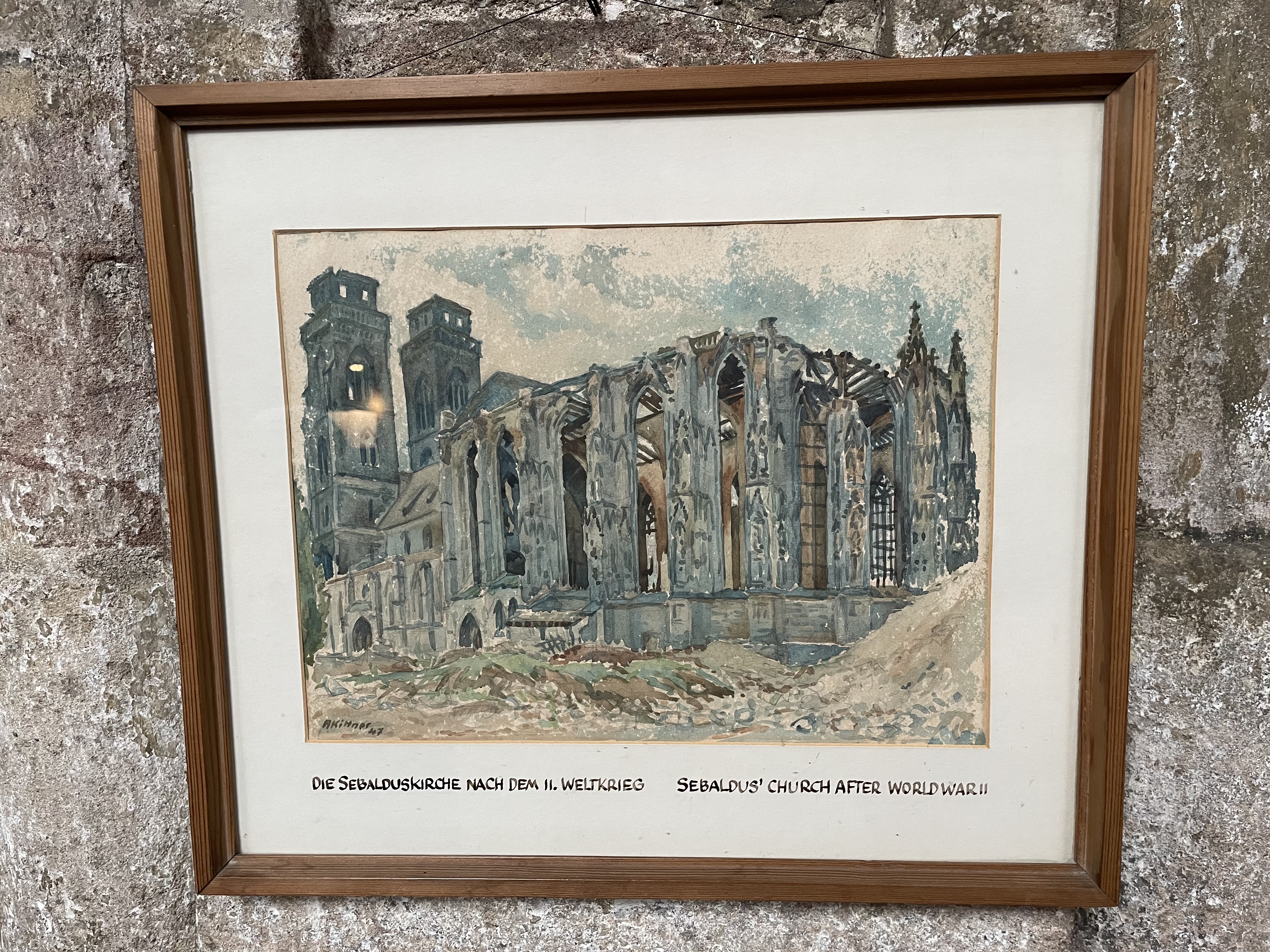
In the final stages of the war control lay with Nazi extremists resulting in the near total destruction of the city by British bombing and American artillery. Fortunately many important maps and articles had been stored underground and the city decided to make extensive renovations and restorations.
……………
I had been ‘schooled’ on the ‘classical’ view that the Renaissance was largely an Italian movement – with the grim ‘gothic’ (ie ‘barbarian’) north rather slow to ‘catch-up’.
So, for me, it was a rather slow personal journey (culminating in my first visit to Nürnberg in 1987) in understanding that the spirit of that movement was not confined to Italy but been vigorously active elsewhere
Albrecht Dürer made his own particular contribution by breaking with the tradition of only allowing Jesus to look straight at the viewer, as in this Flemish image (c.1450-80)…
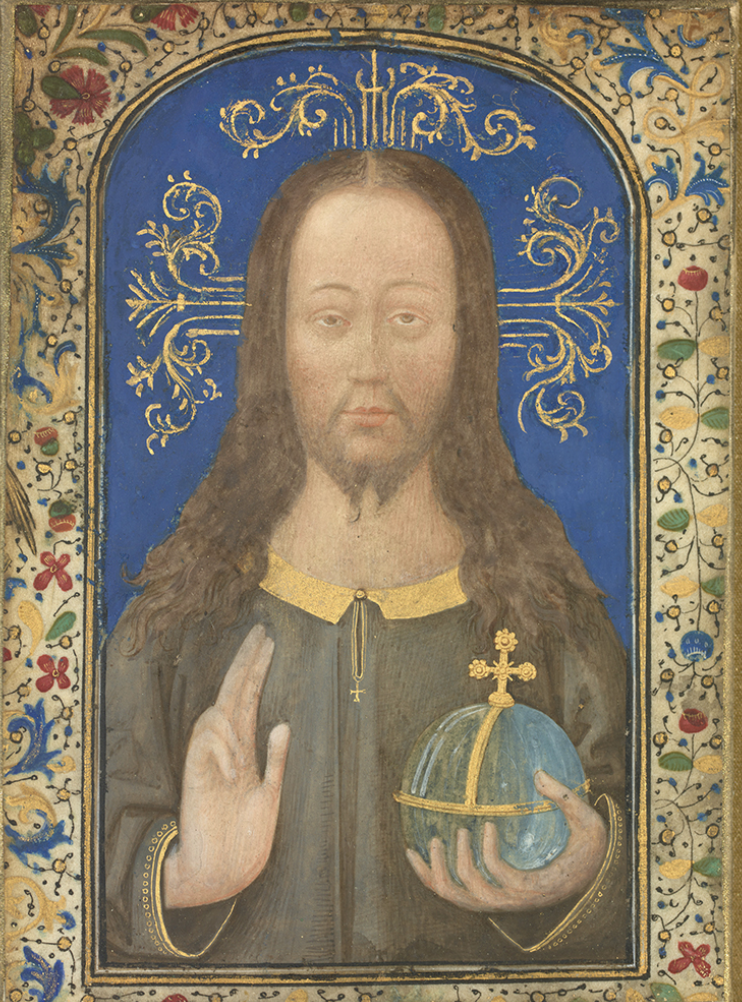
The Dürer self-portrait is most remarkable because of its resemblance to many earlier representations of Christ…
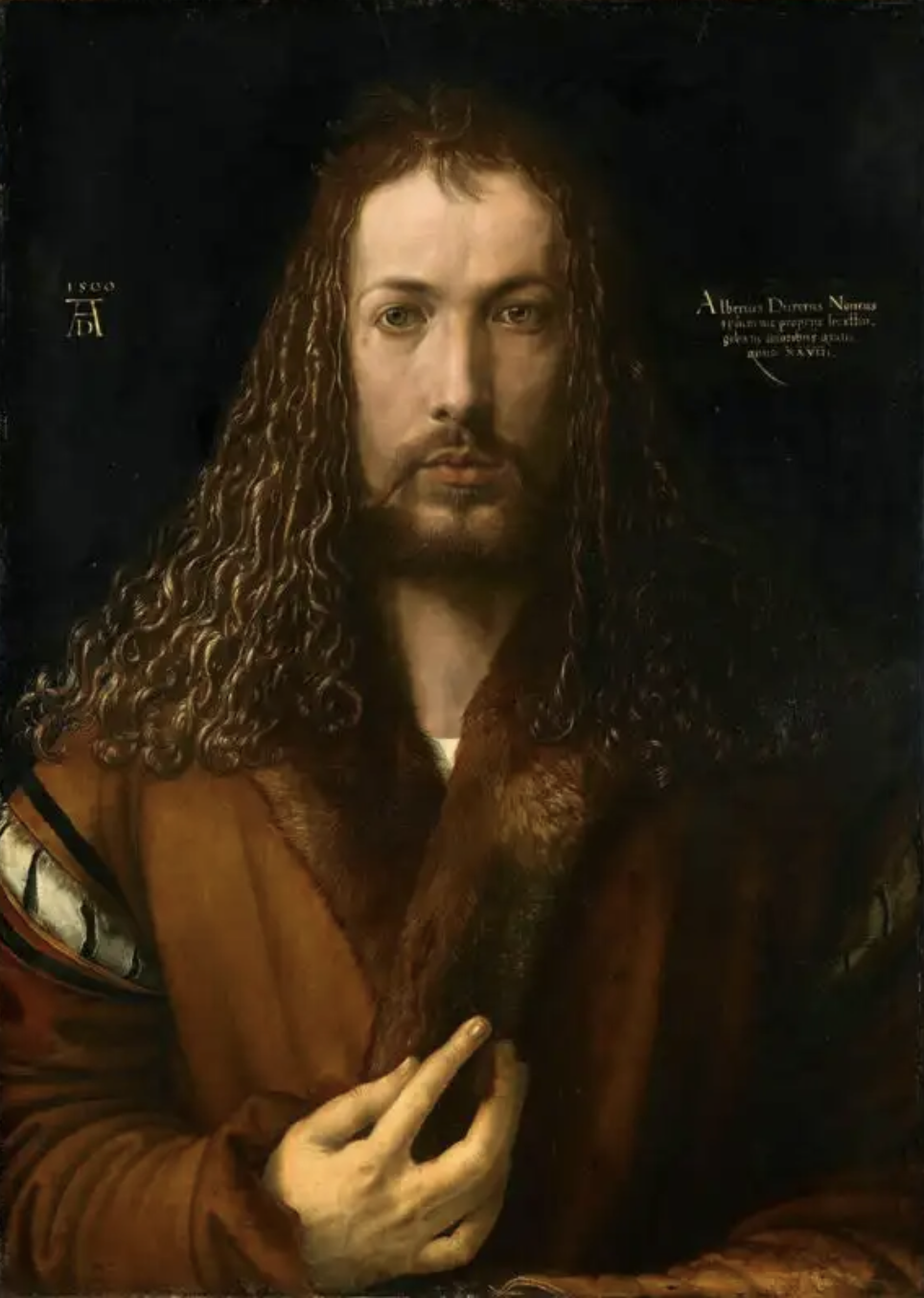
To the left of the image is his signature, to the right a ‘Personal Statement’
I, Albrecht Dürer of Nuremberg, made an image of myself in appropriate (everlasting) colors in my 28th year
In 1500, a frontal pose was exceptional for a secular portrait. In Italy the conventional fashion for profile portraits was coming to an end, but being replaced with the three-quarters view which had been the accepted pose in Northern Europe since about 1420
The exceptional nature of the work & the influence of Dürer is demonstrated by analysis of later images of Christ – being copied (as with the Rhinoceros) from his image.
It is a ‘break-out’ moment. A marker in the growth in understanding of humans as ‘individual beings’ (compared with the rigid structures of feudalism) & eventually, the value of ‘personal & social development’.
It is, in the religious context of the time, a ‘MeToo’ moment, in that it boldly suggests that each person is sacred (and therefore should be ‘untouchable’).
Dürer may only have been concerned (somewhat proudly & arrogantly) present himself – but It would not have been possible without an ‘accepting’ social context.
His very personal statement (underscored by text he added) occurs at a time when other important changes are occurring. Thus he becomes a major representative of the “Volksgeist” of the age of the ‘Protestant’ Reformation (1517) & in which Nürnberg, in 1525, became the 2nd city to declare as such.
Two Churches
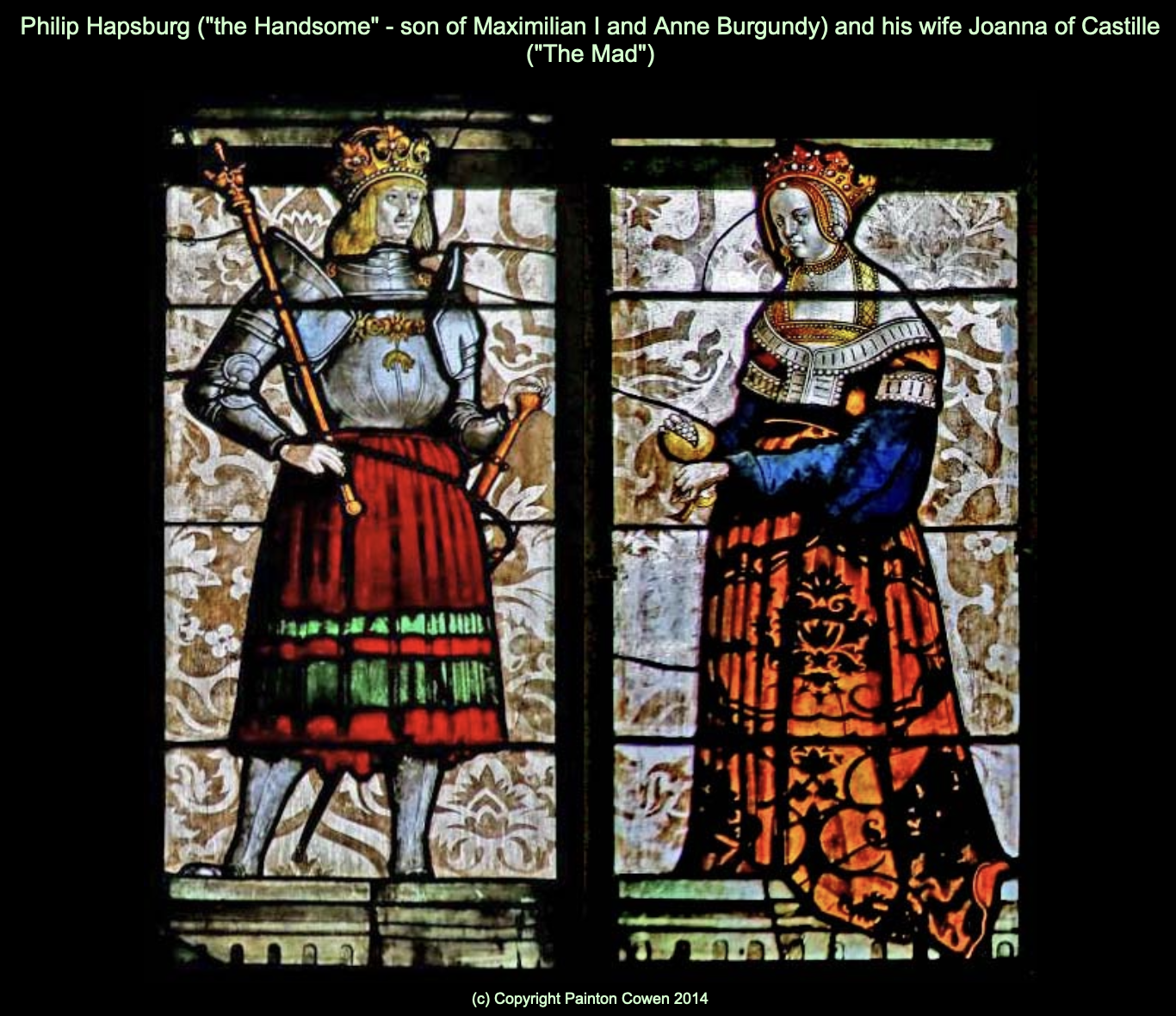
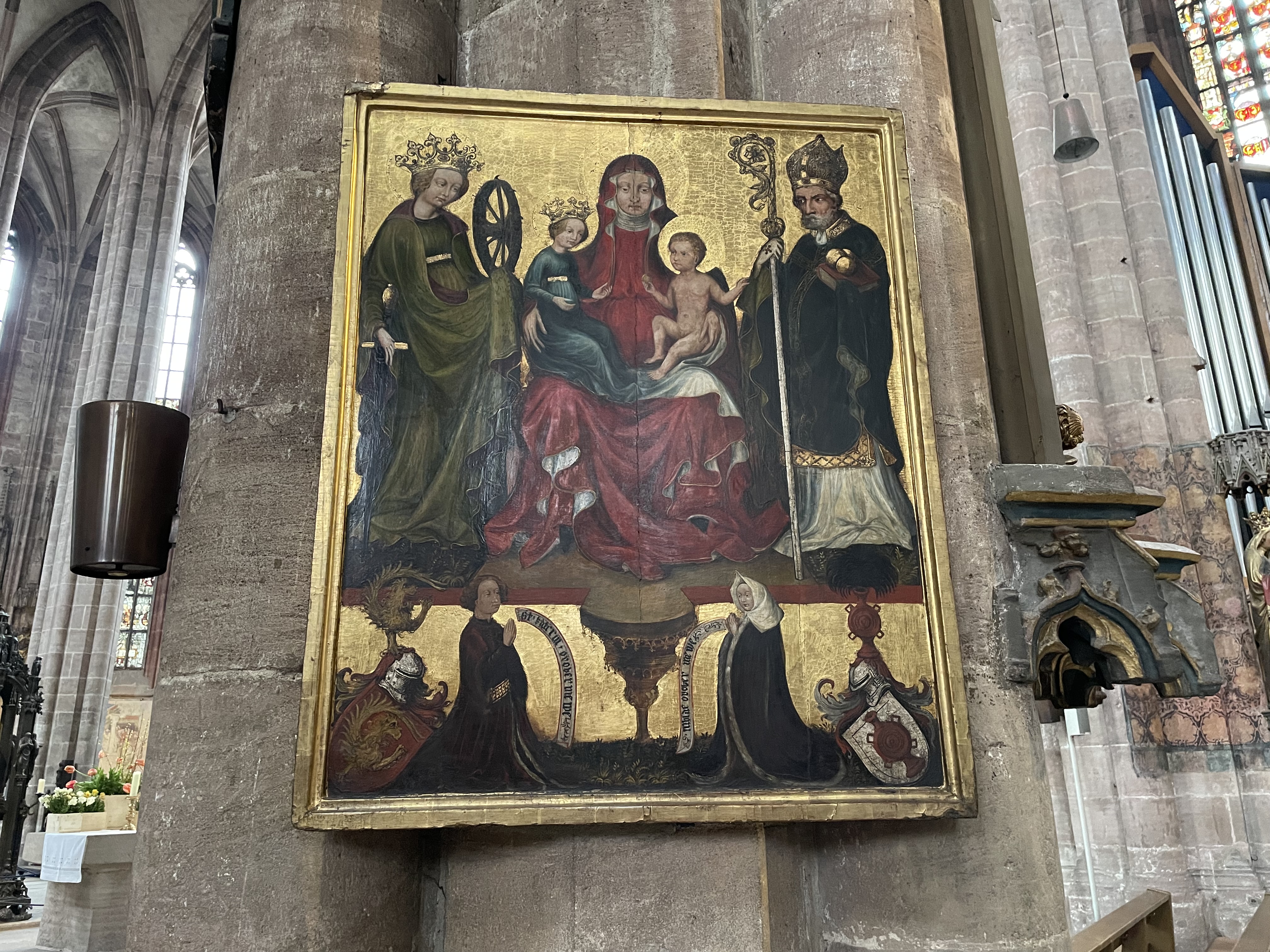
The images presented from the 2 churches visited are illustrative of the quality of work being developed in a Renaissance that was particularly different in style from that of Italy.
Sebalduskirche
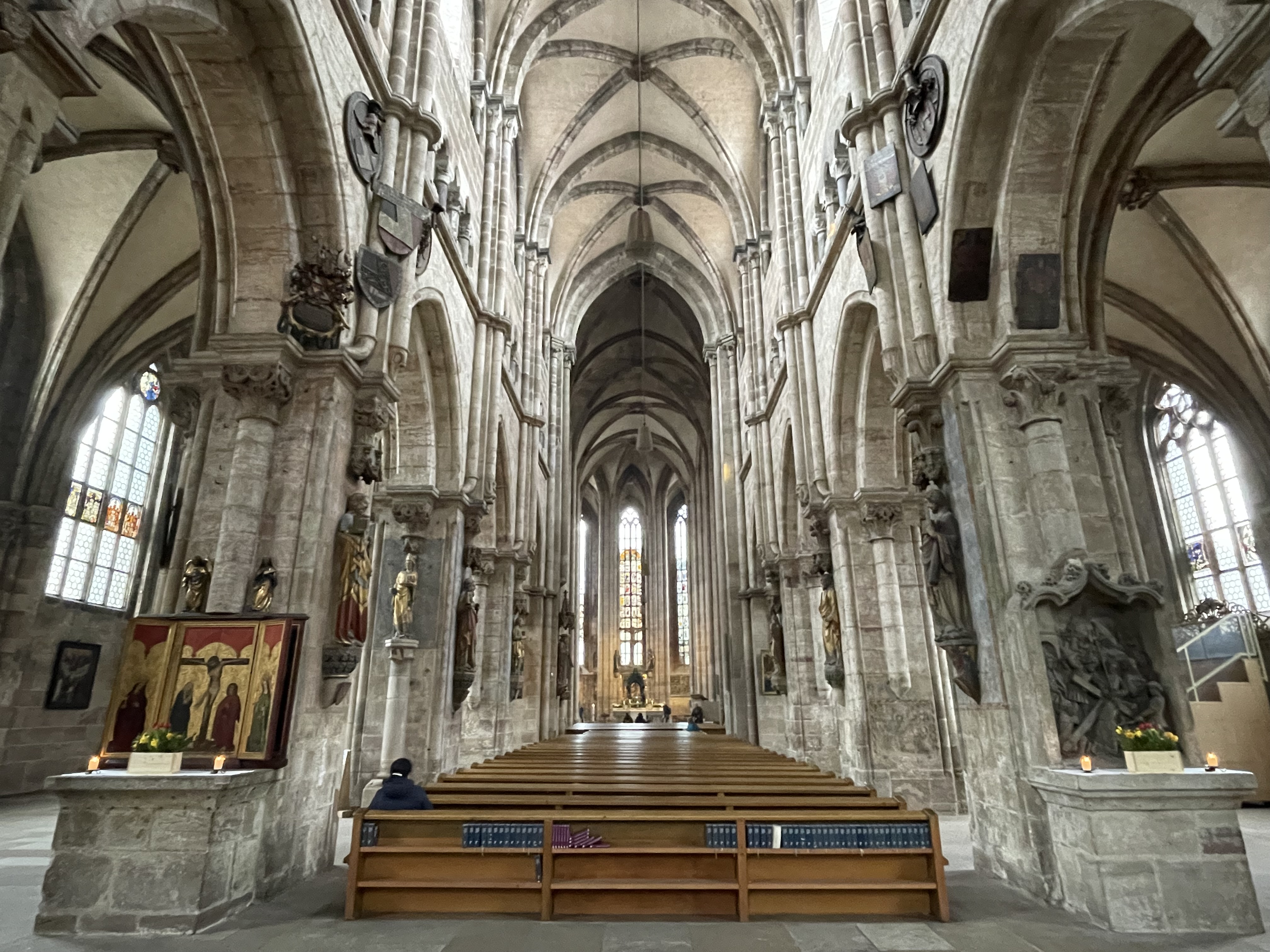
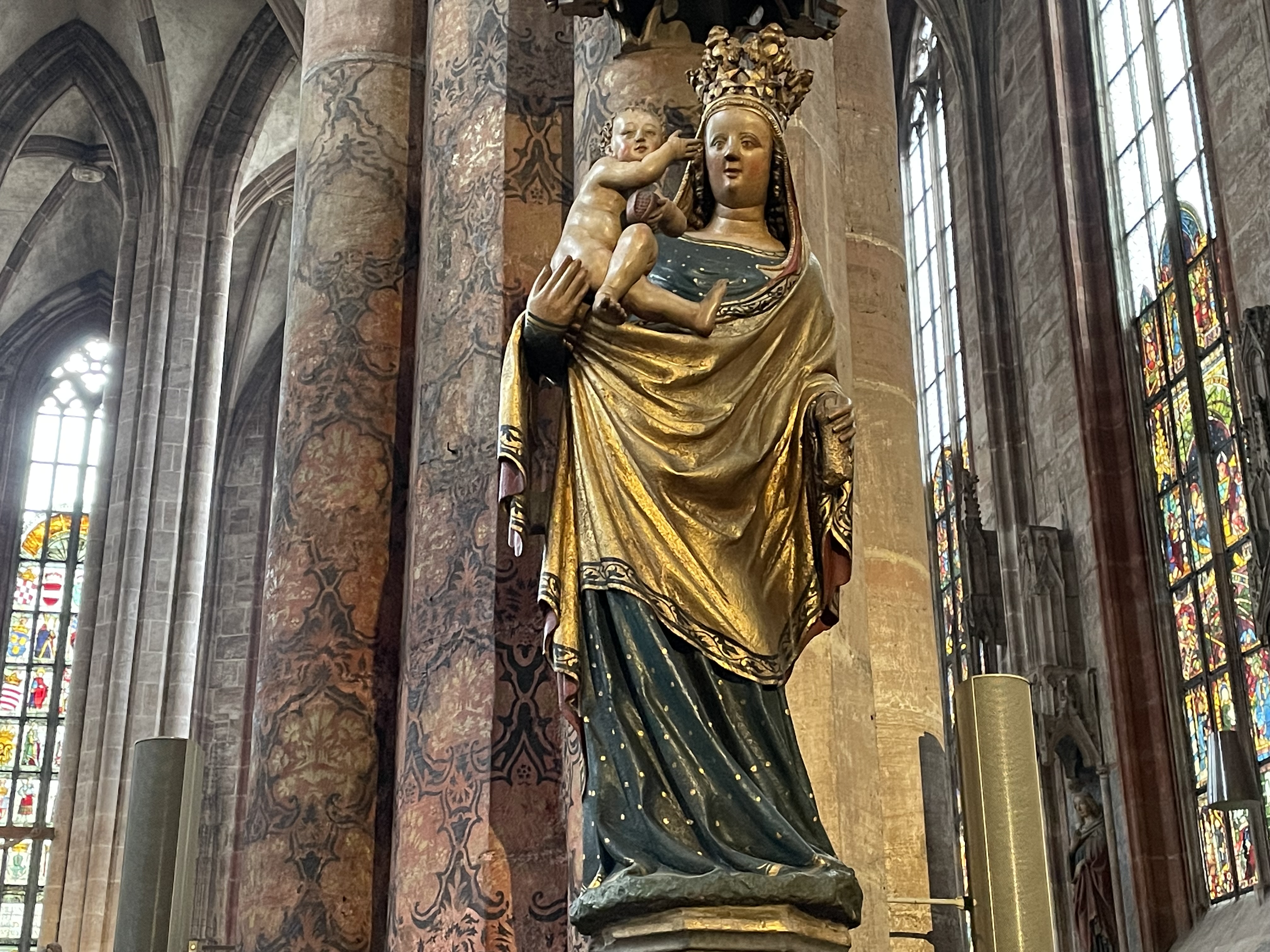
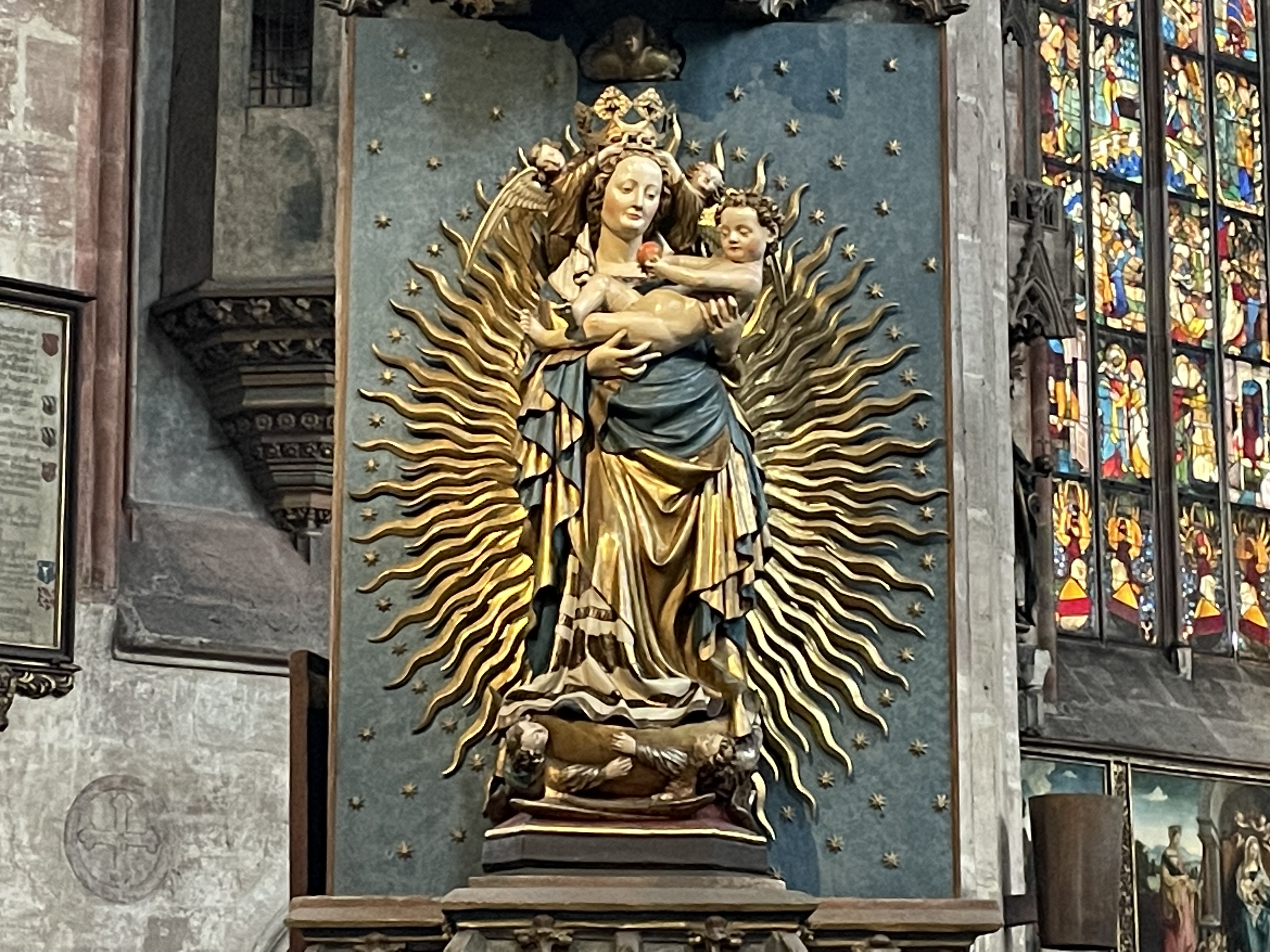
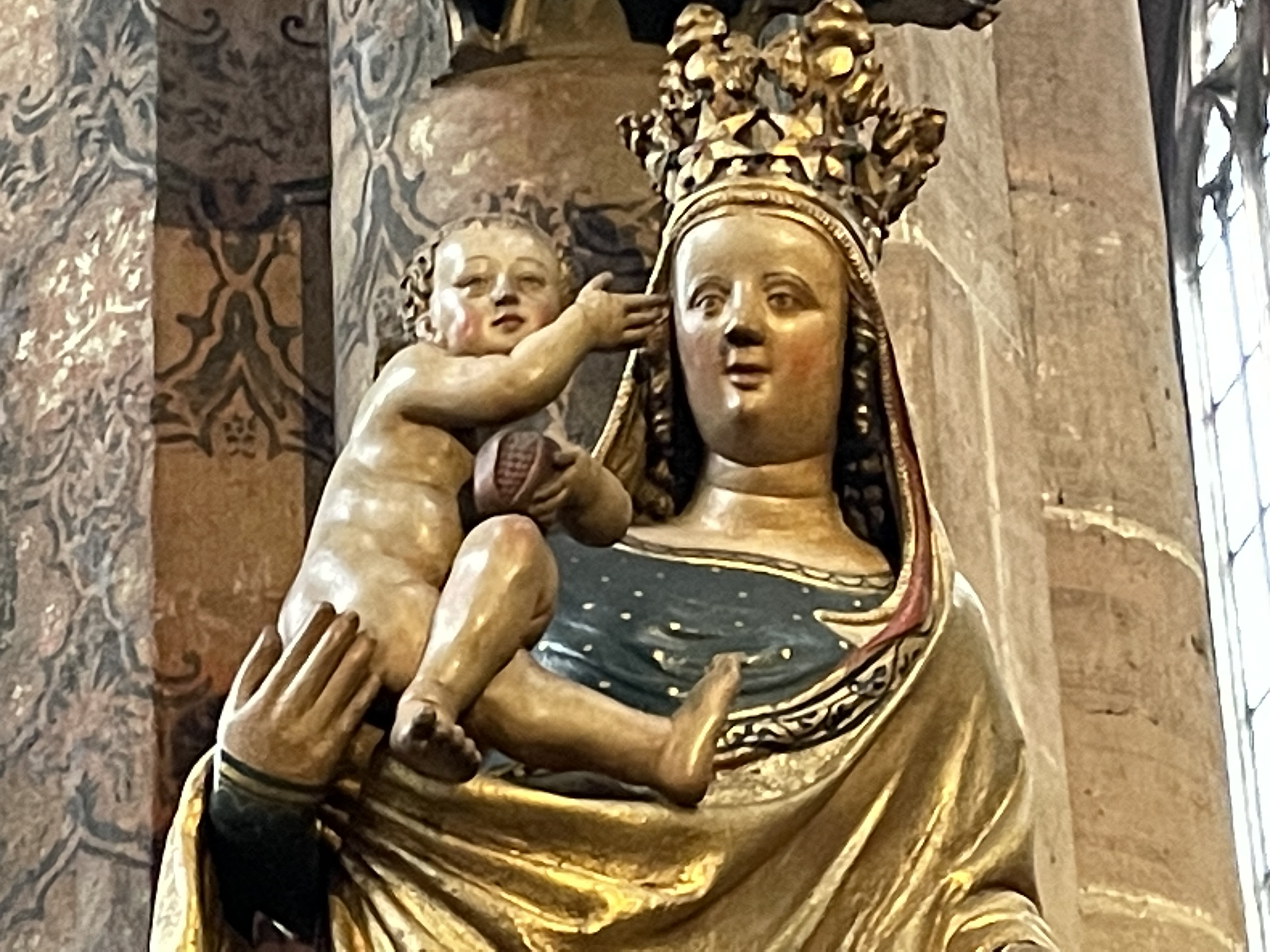
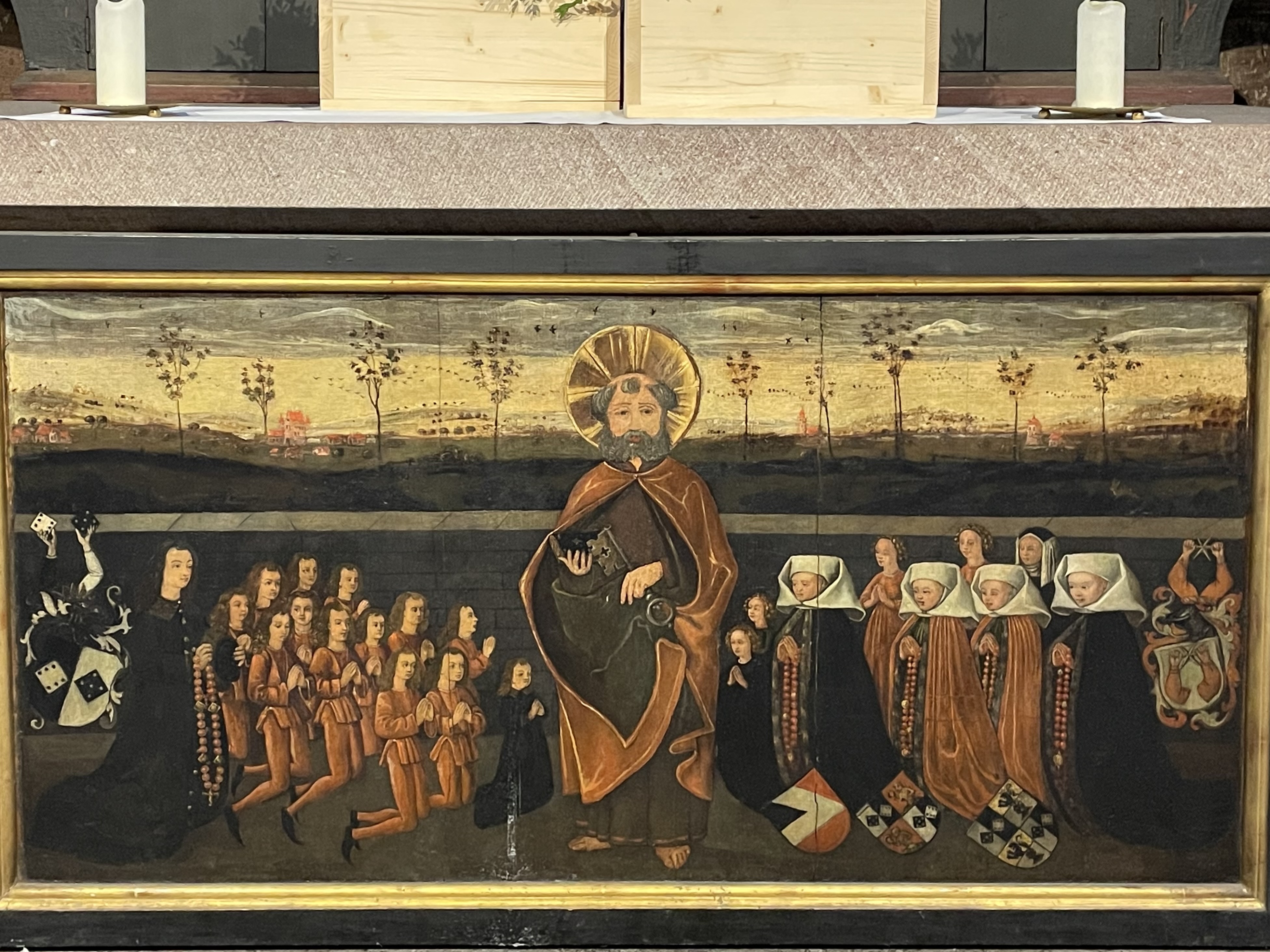
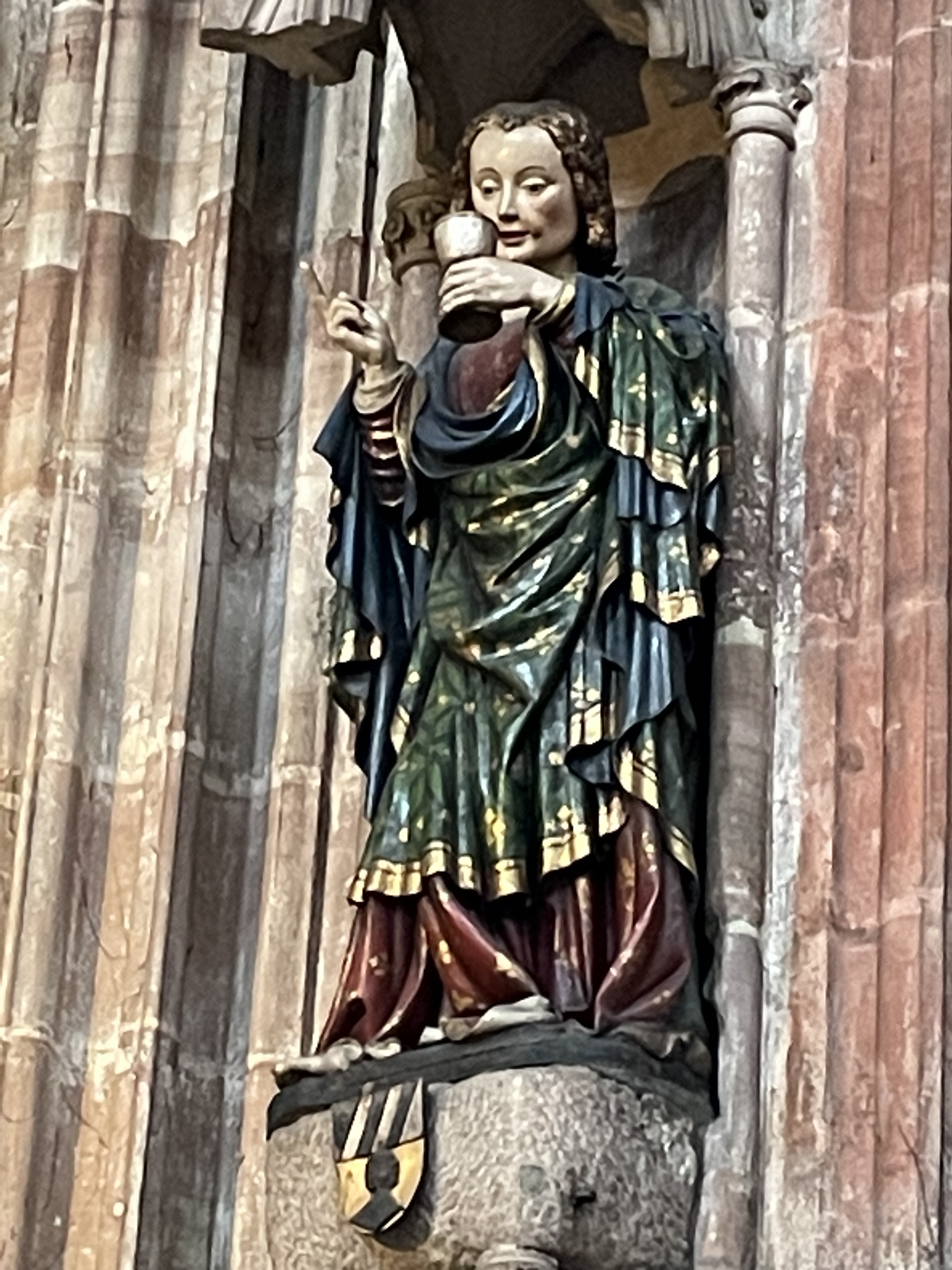

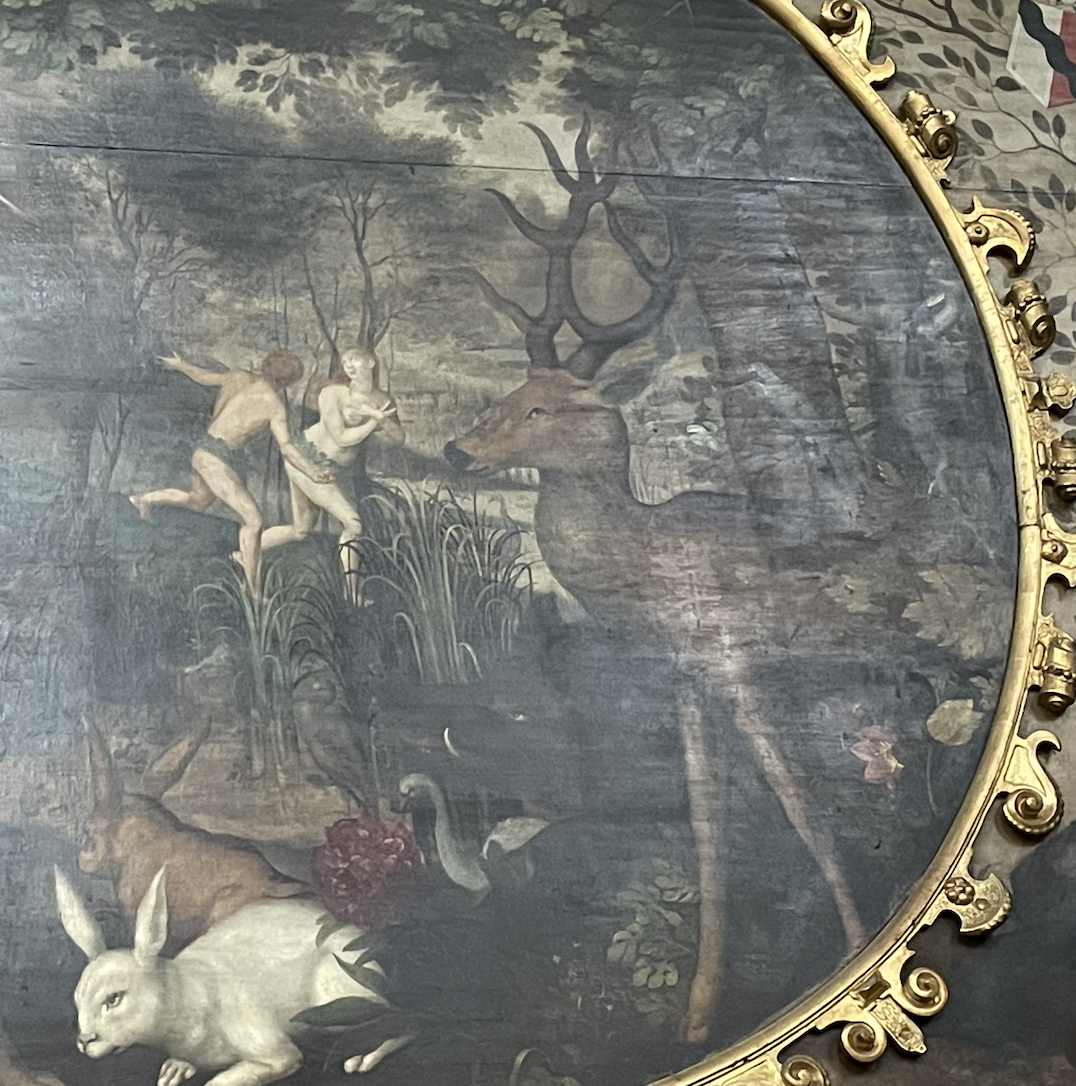
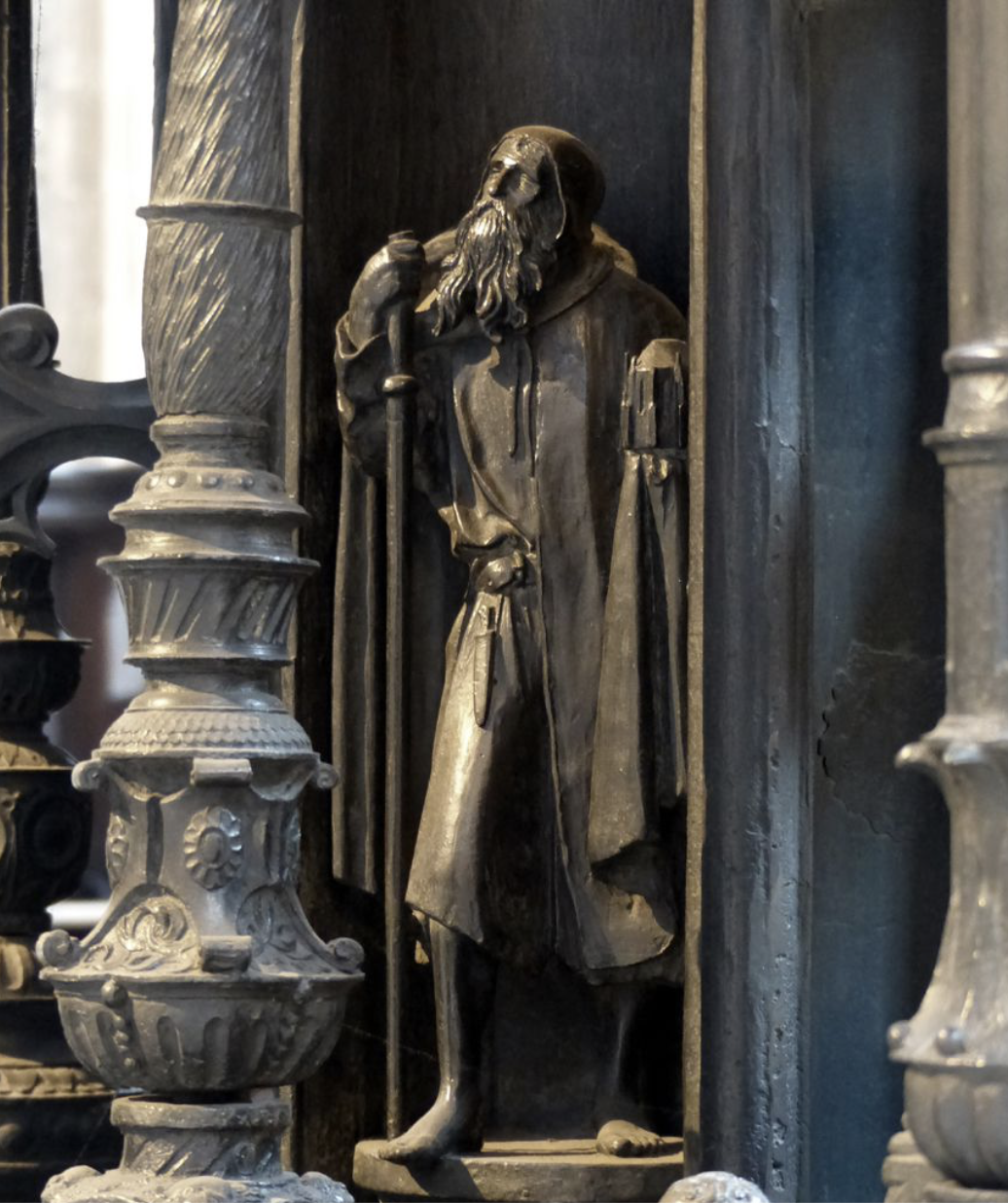
St. Sebald.
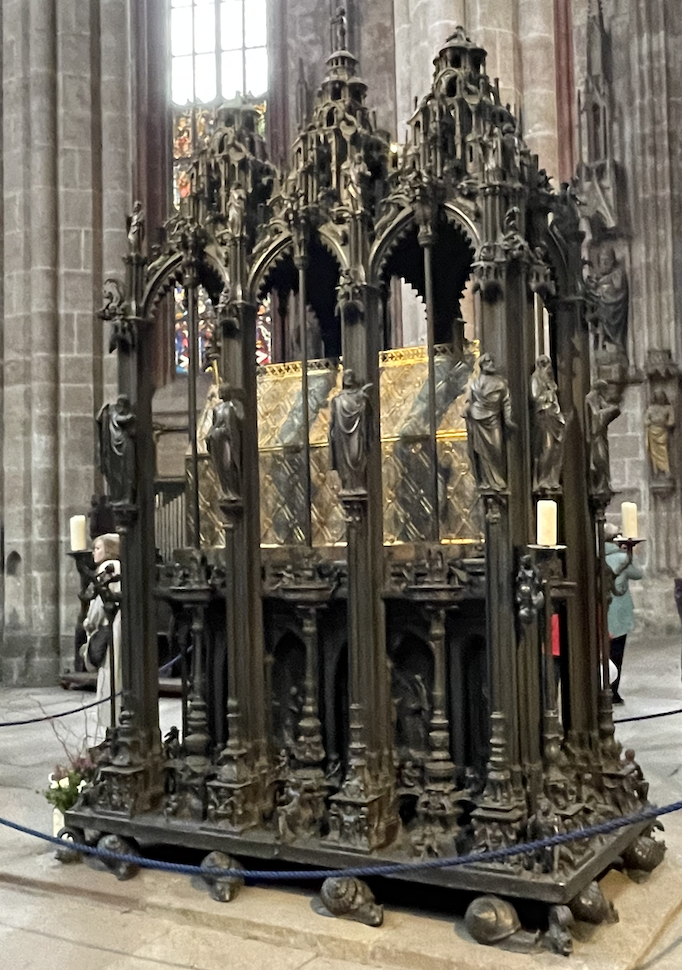
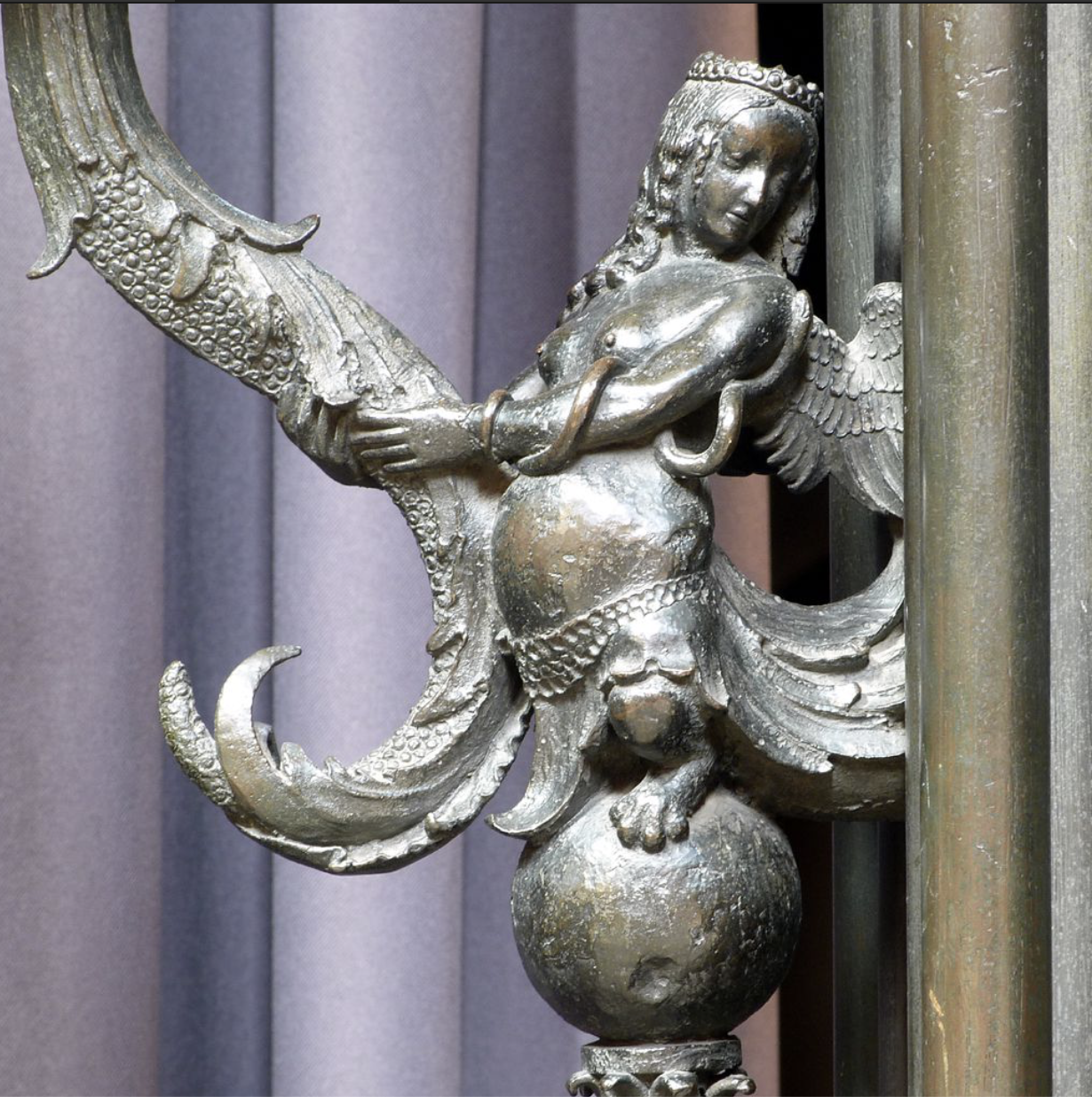
St Sebald may have been an itinerant Anglo-Saxon who lived as a hermit in the forests near Nürnberg. His relics are contained in the casket held within the shrine.
He is invoked for protection against cold weather
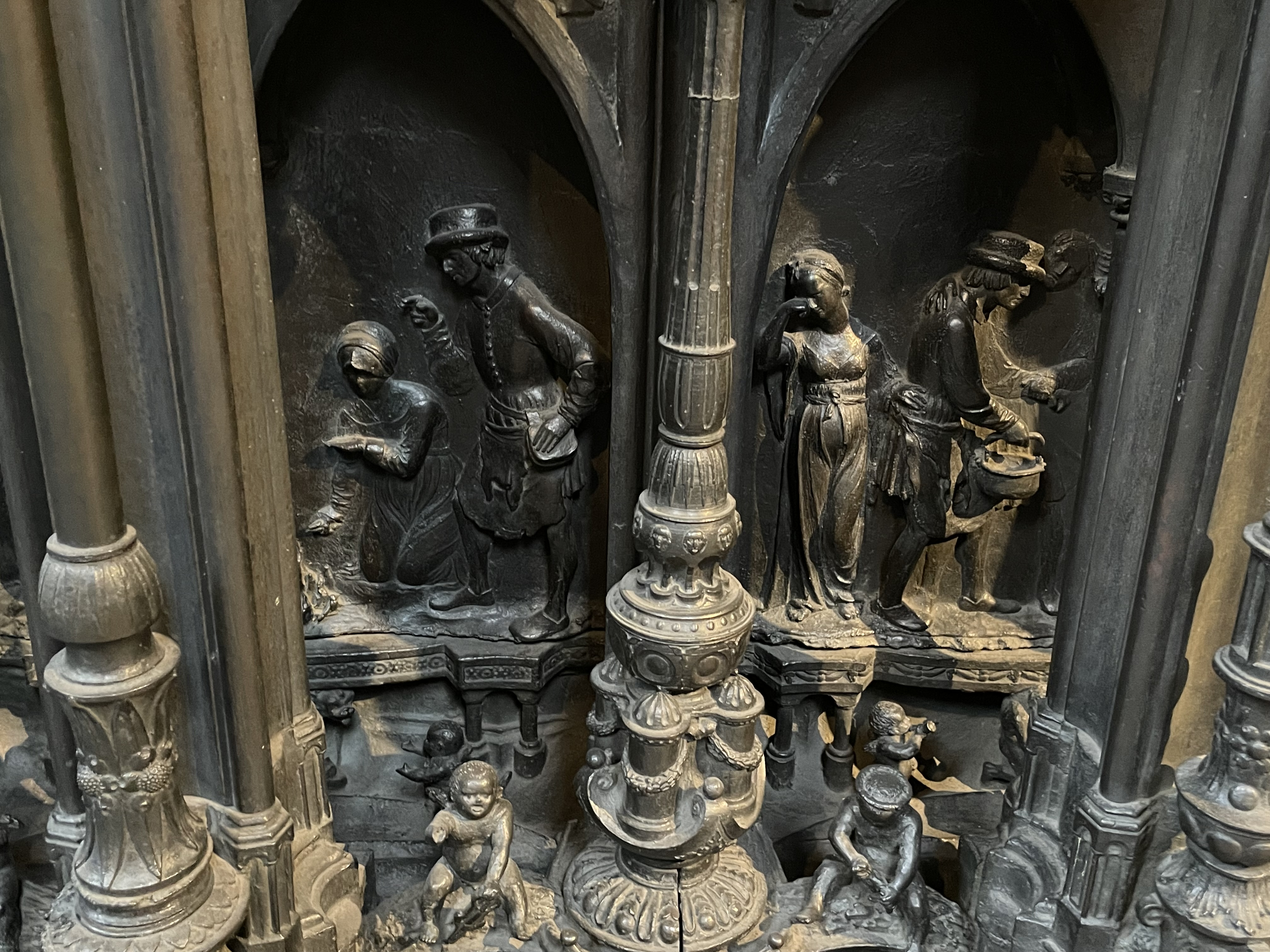
Stories associated with the saint decorate the shrine
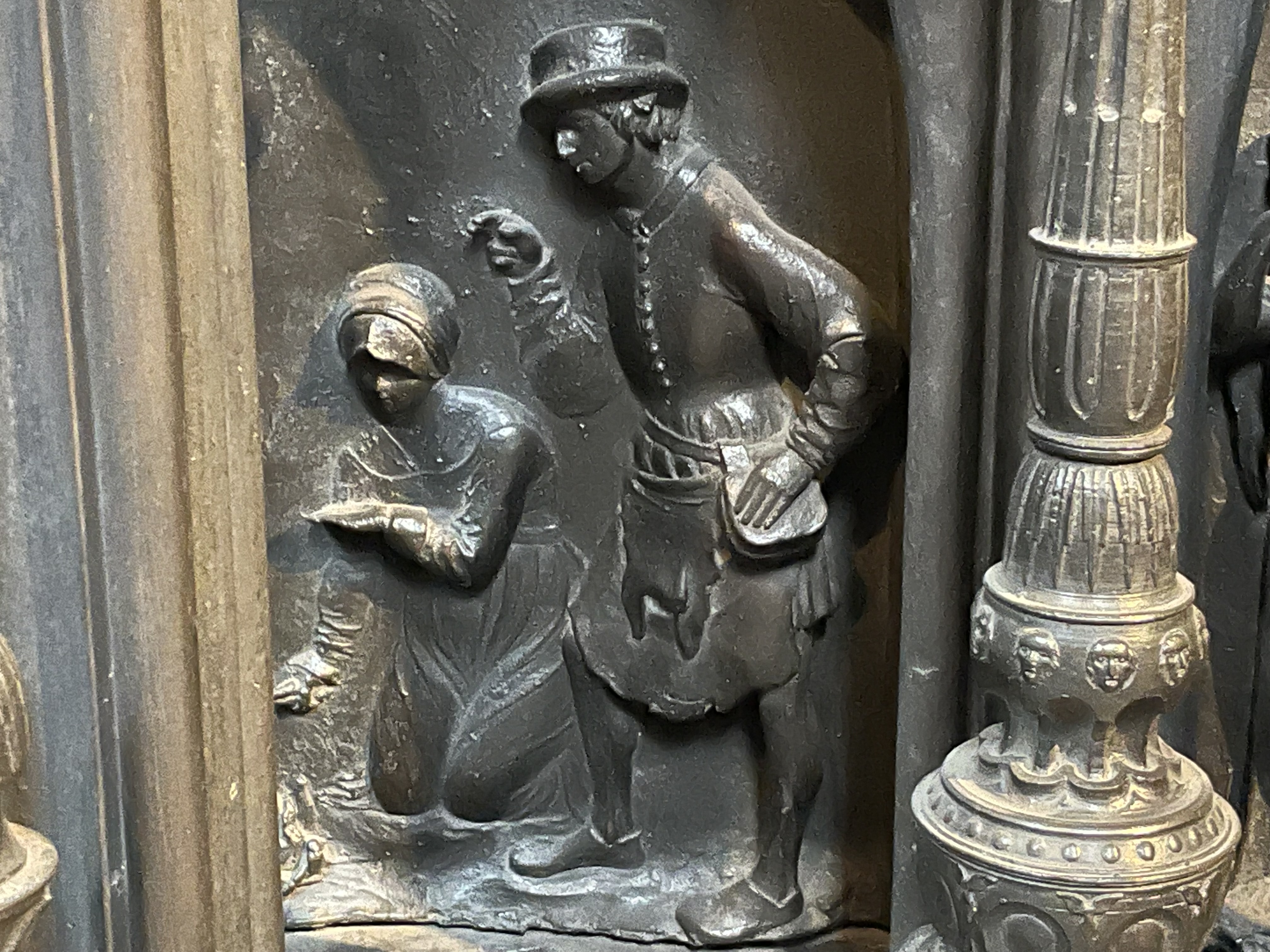
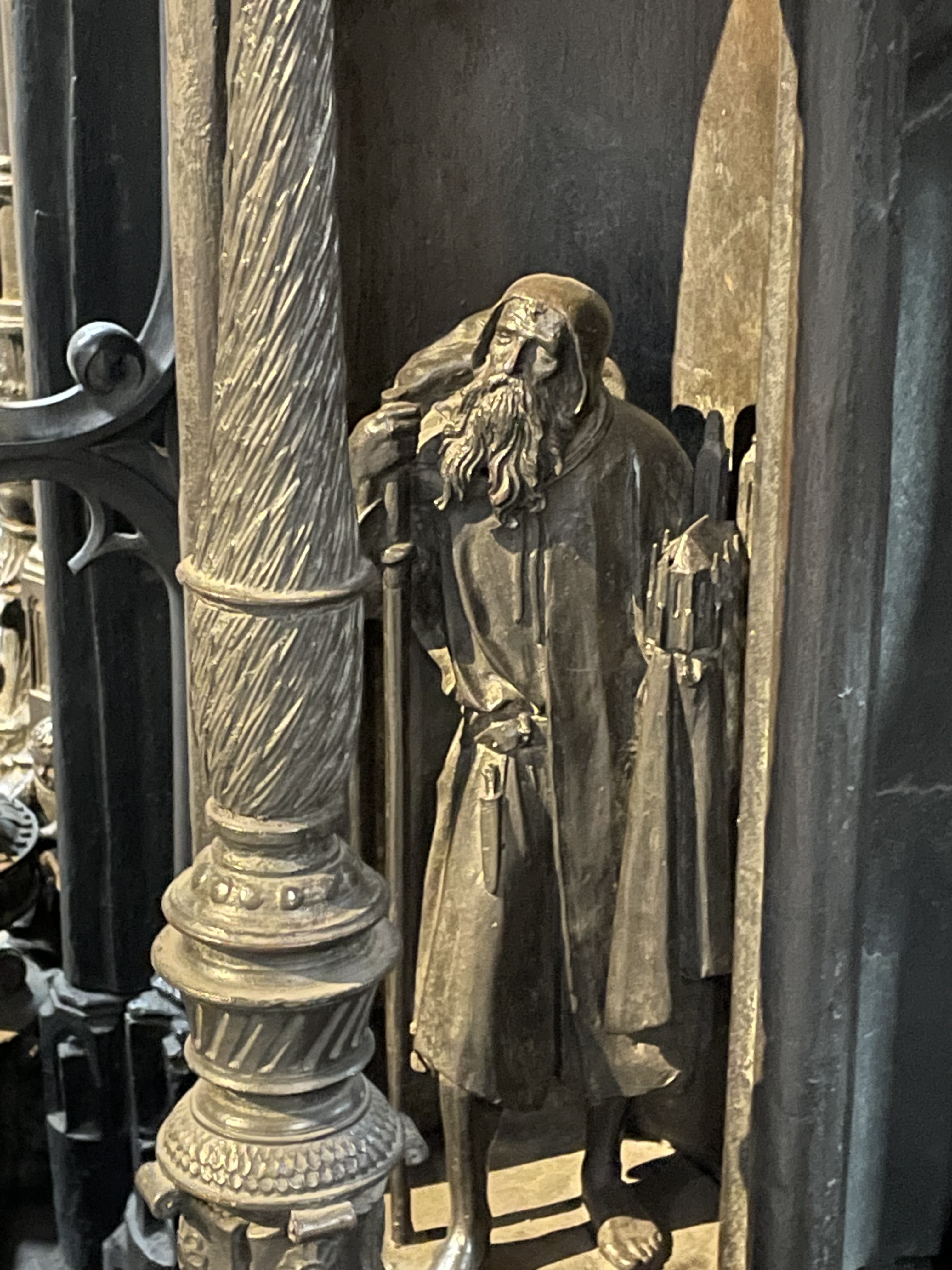
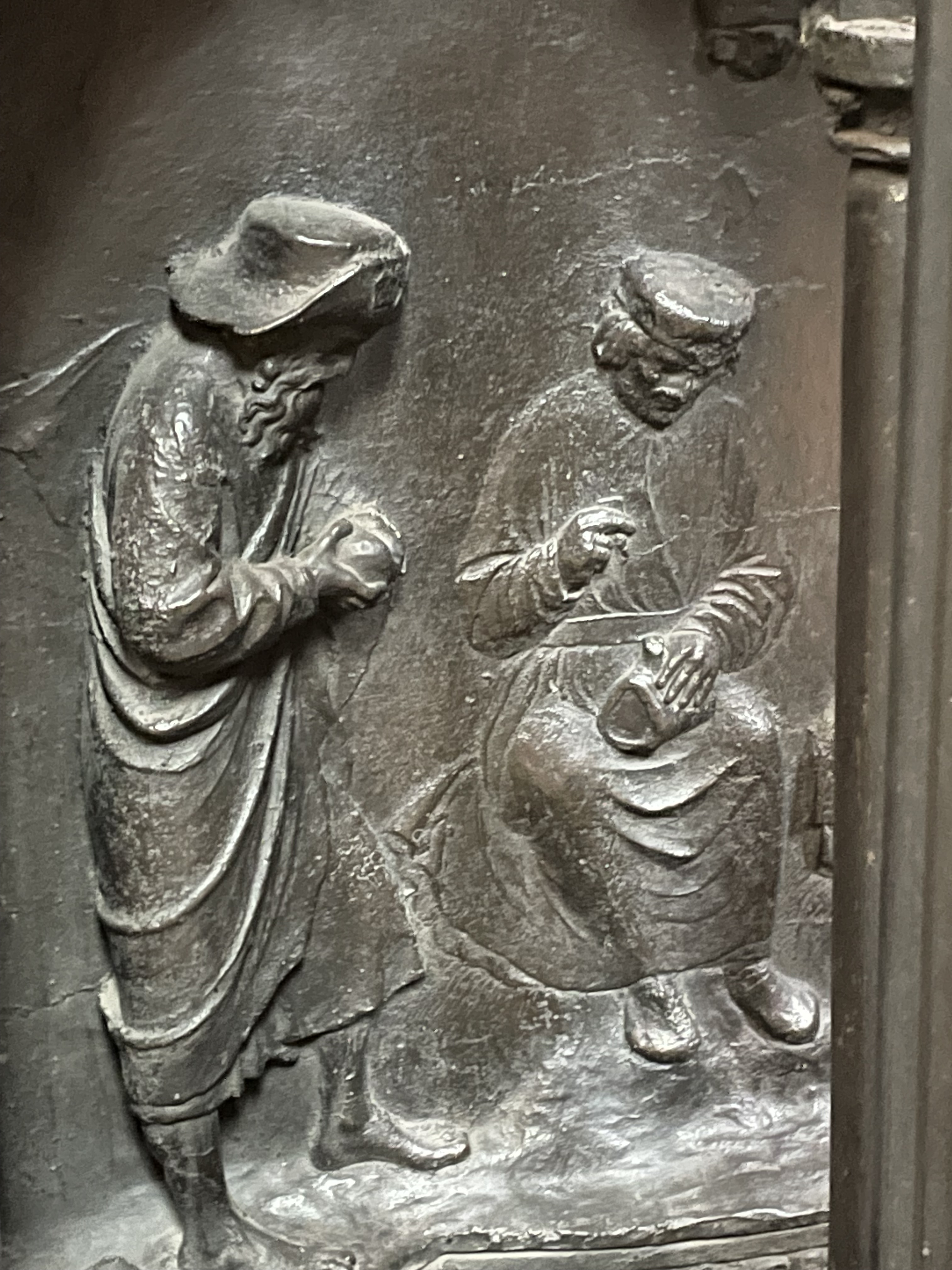
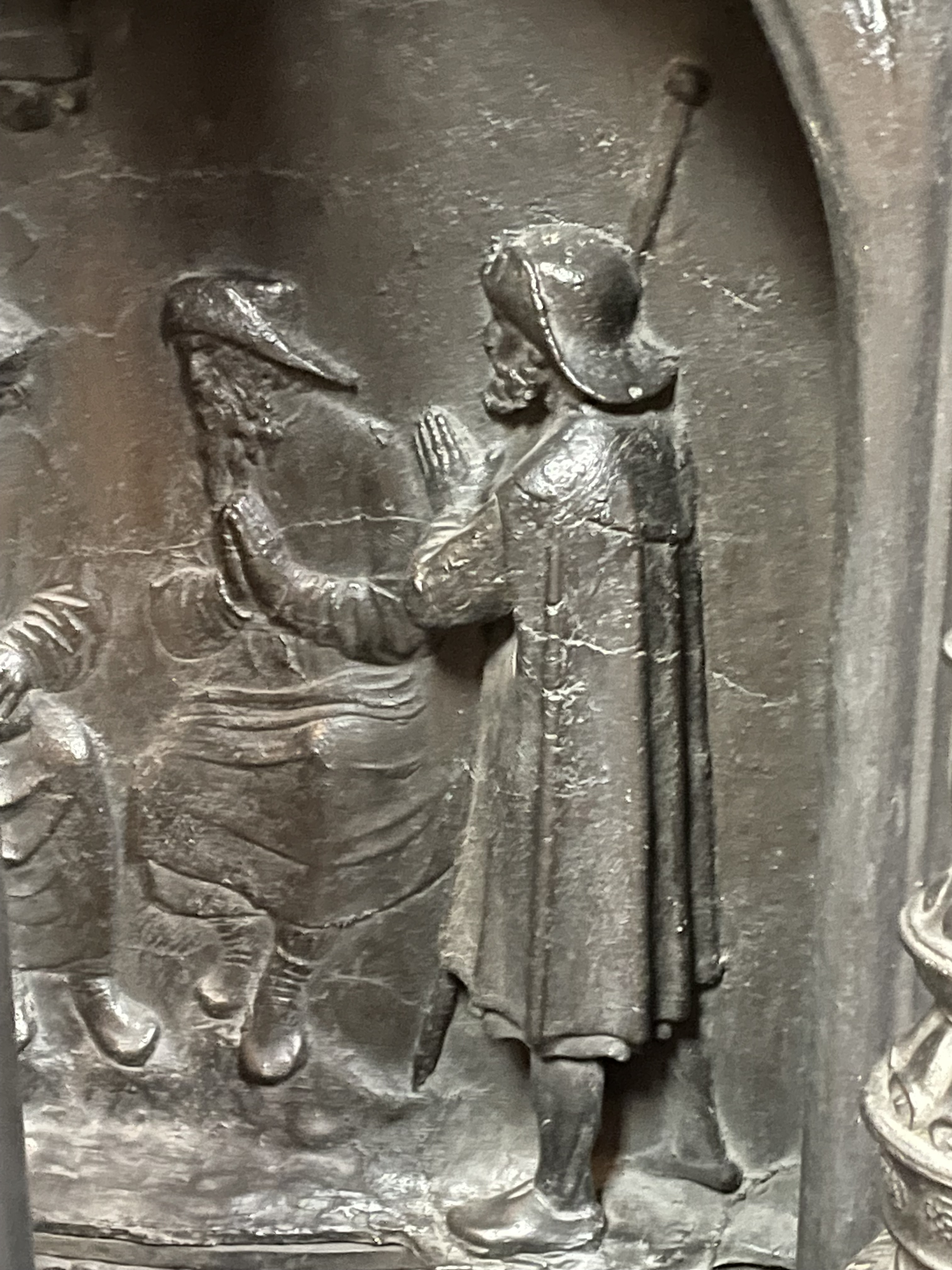
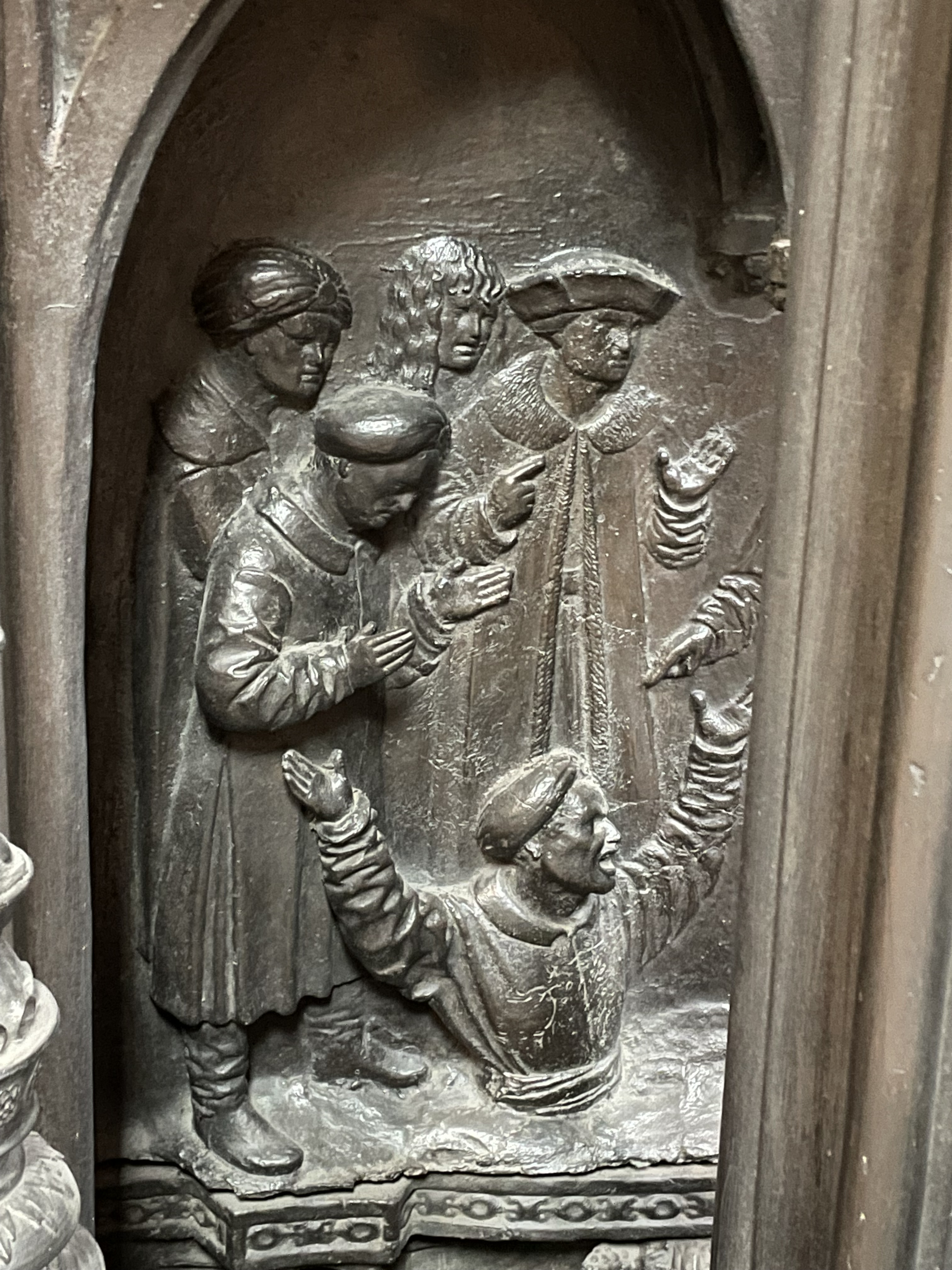
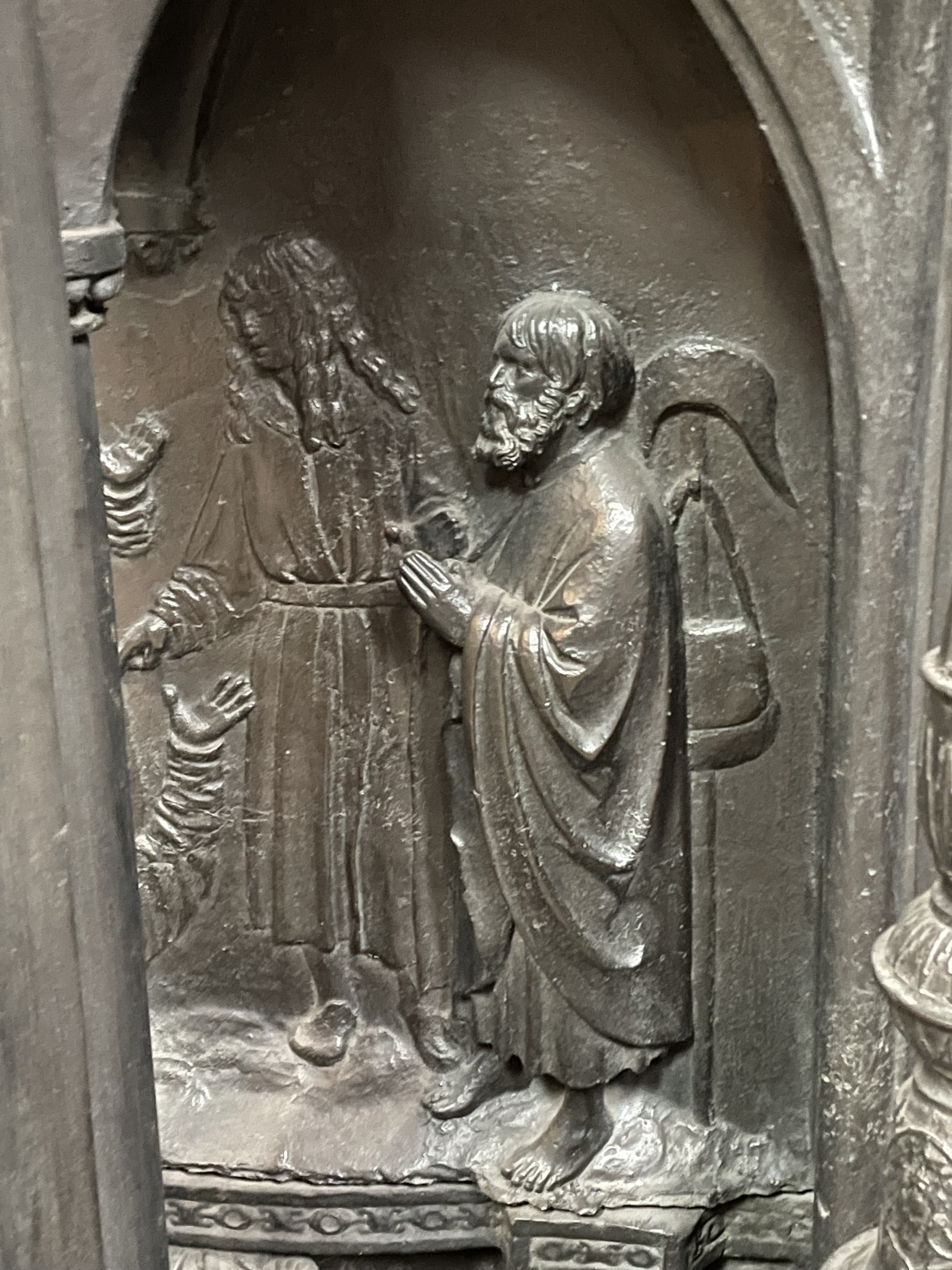
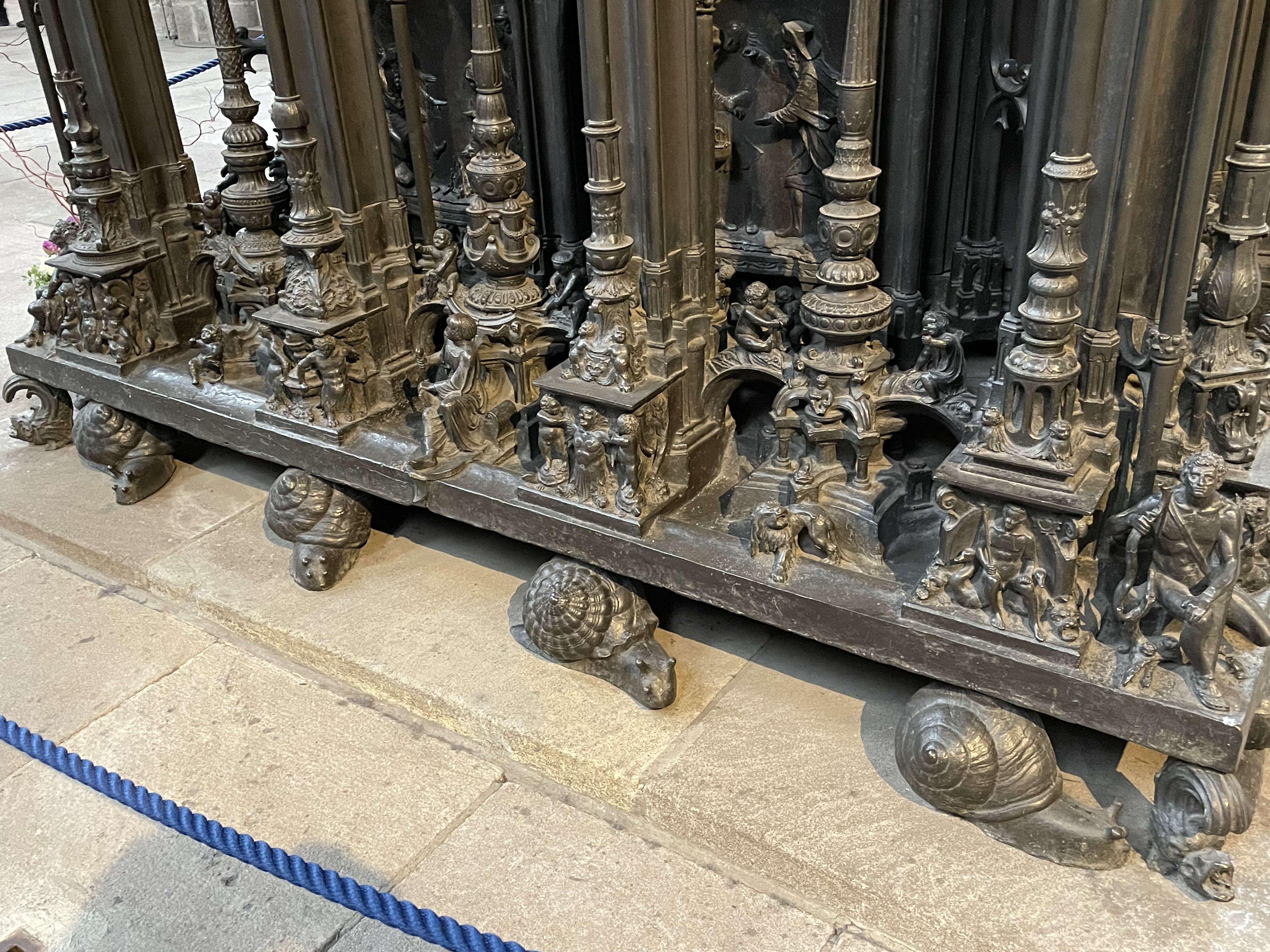
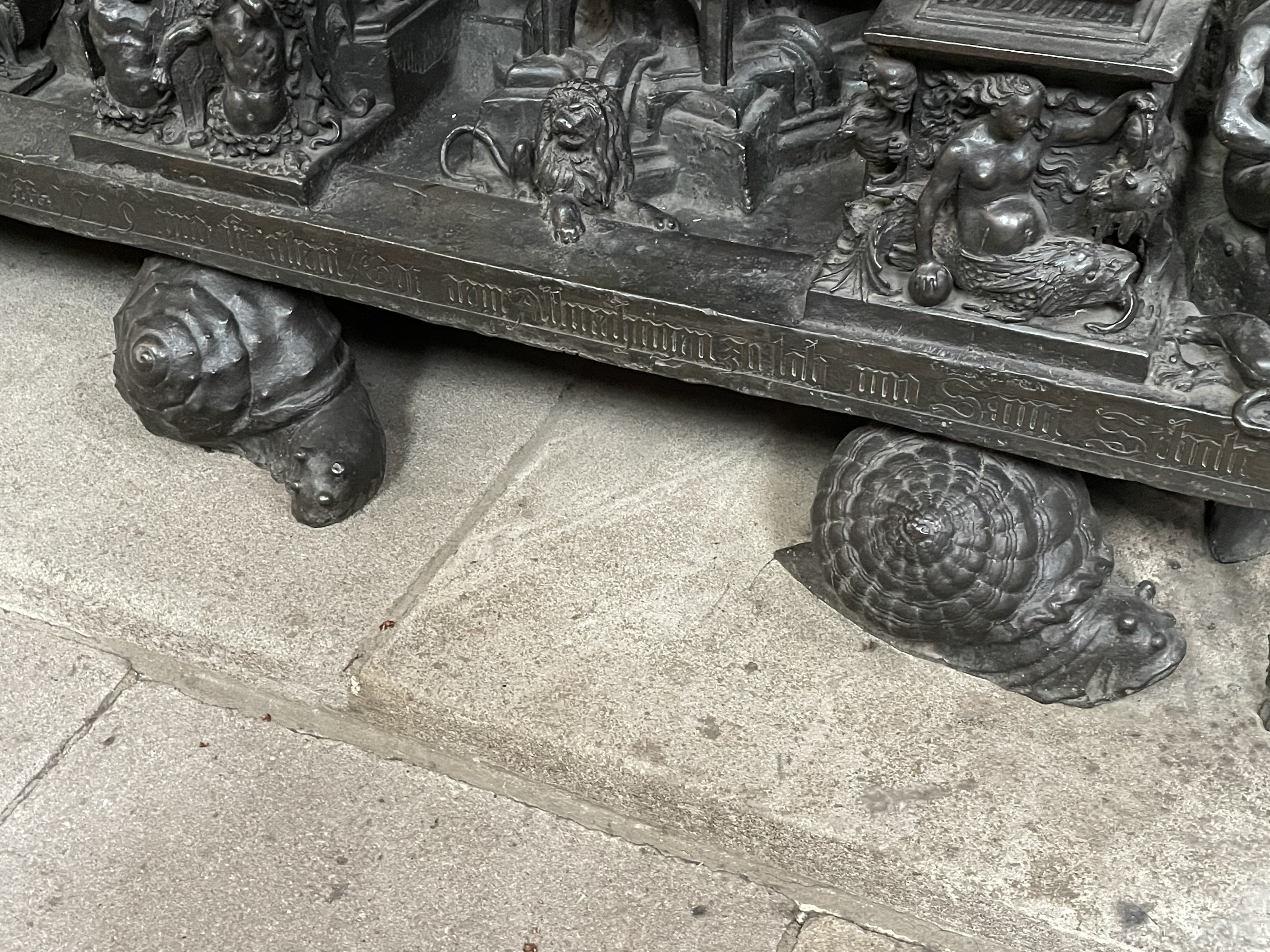
Snails! The whole monument is being carried on their backs.
Their presence has caused commentators to ’scratch their heads’ in puzzlement as they try to explain their presence.
Mediaeval manuscripts contain images of snails fighting warriors (successfully!) & snails make appliances in the work of C15th Italian artists (eg 1490 Carlo Crivelli, The Virgin and Child with Saints Francis and Sebastian in National Gallery London)
They are ‘of the earth’, in folk-belief & to be ’self-creative from mud’. Being low, were associated with humility (as was St Sebald, hermit & pilgrim) & penance. Their shells, often seen empty were also images of resurrection.
They also move slowly – and one story says that St Sebald expected to be present at the Resurrection but there was plenty of time before it arrived.
The species has been identified they are stylommatophoran land snails. One variety is Helix pomatia known as the Burgundy snail. Given the date of the shrine and the marriage represented in the Emperor’s window… are they the ‘shrine bearers’?
The only questionable element is that the Burgundy snail is a popular food – therefore would St Sebald’s journey to the resurrection be disrupted en route due to theft & consumption of his ‘shrine bearers’?
There is a very detailed (& delightful) virtual presentation available : click here
examples
The Imperial status of the church is marked by the ‘Emperor’s Window’
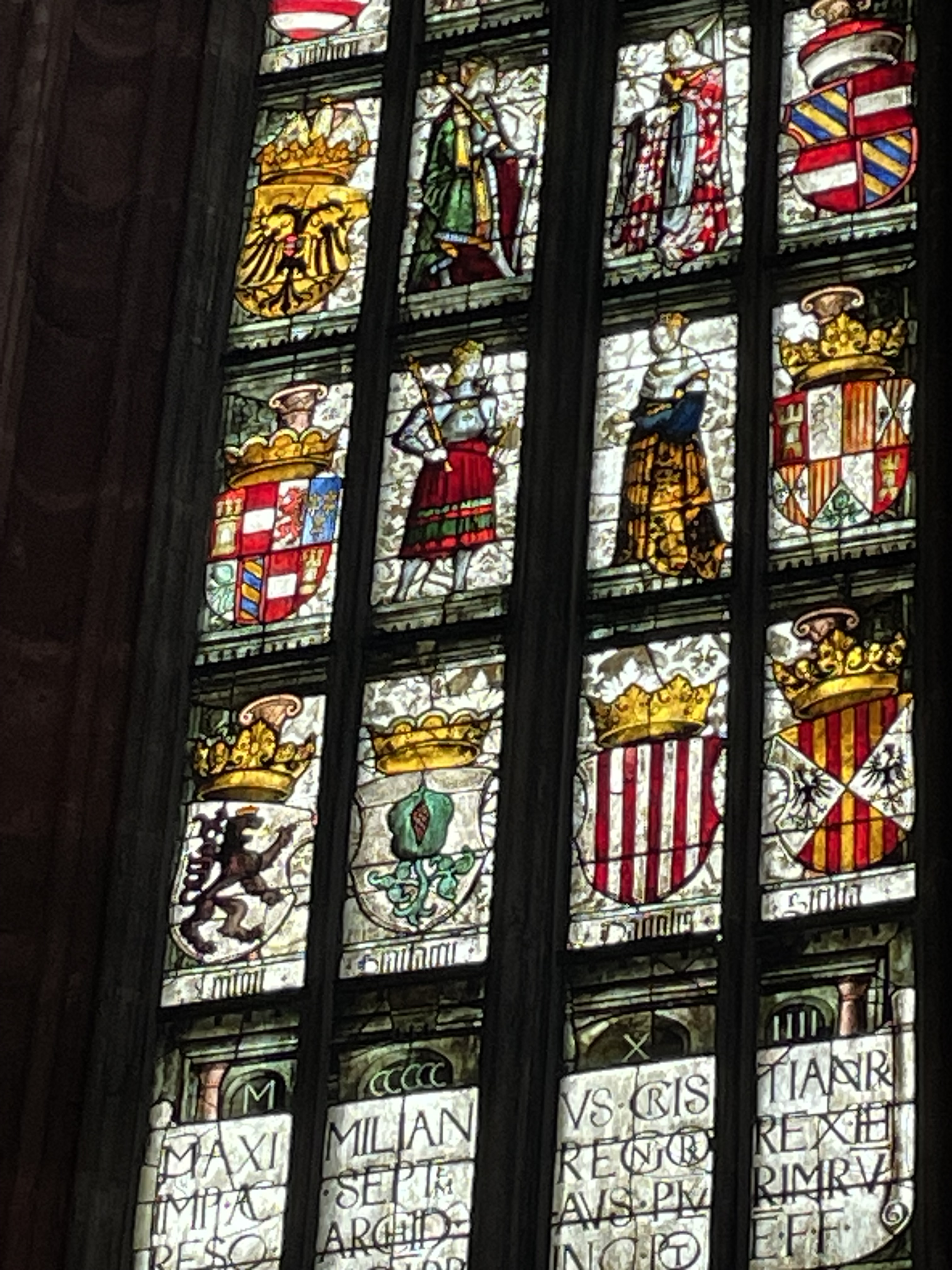

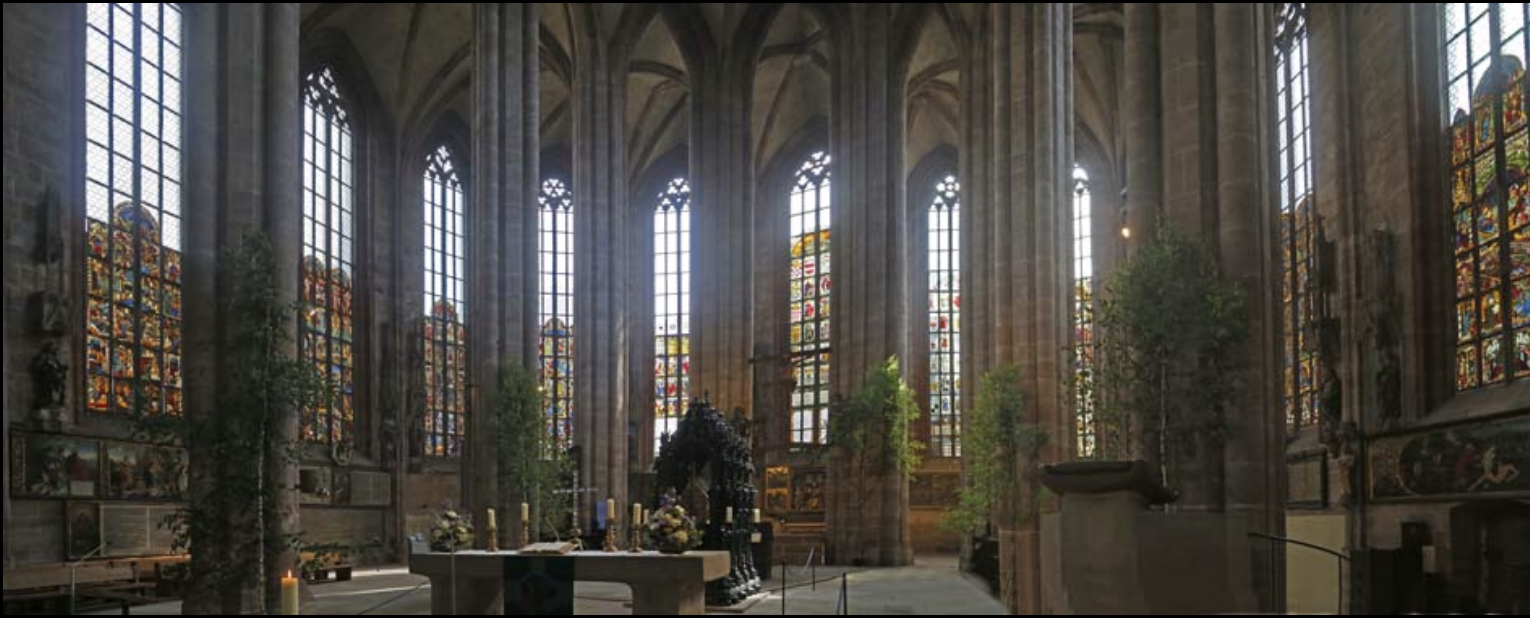

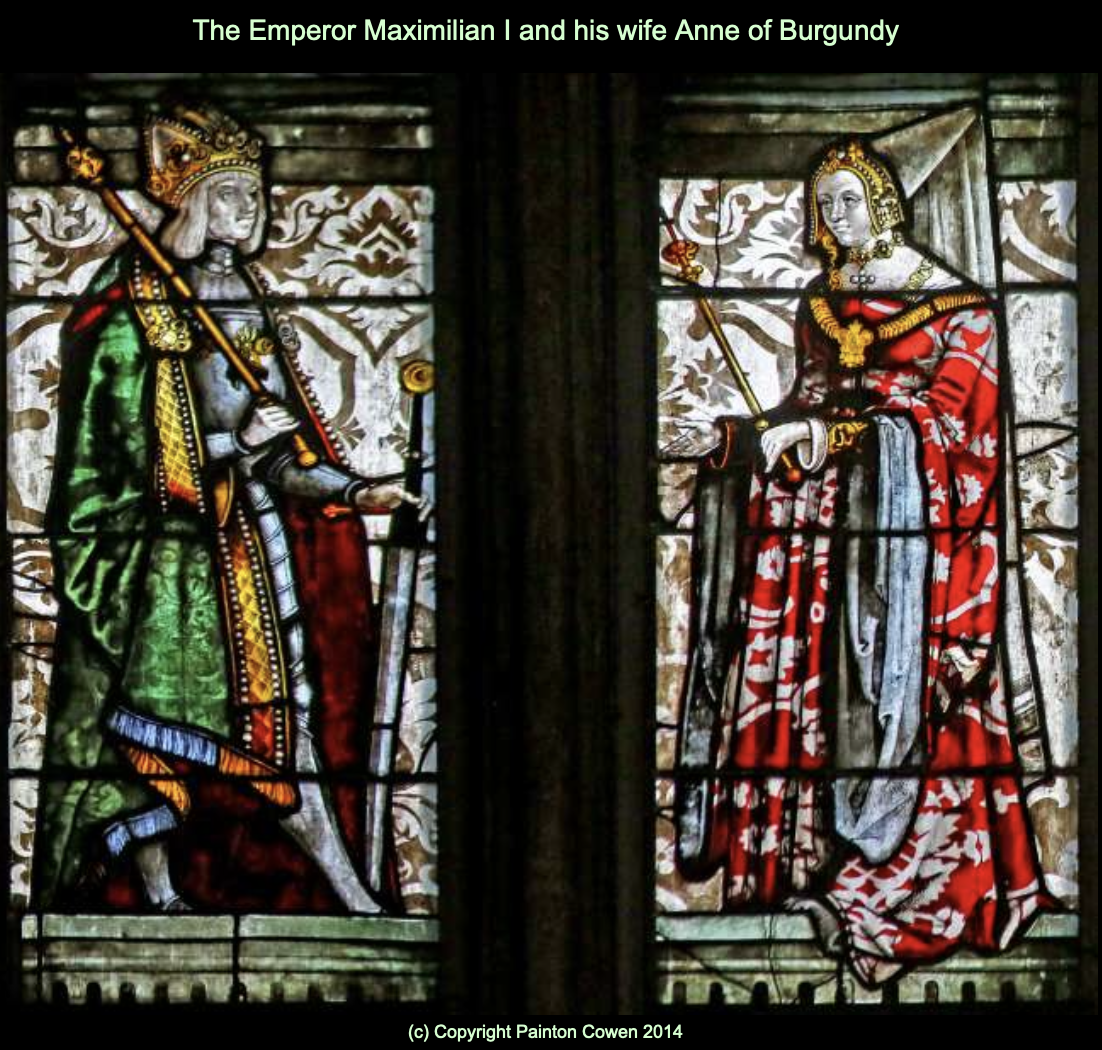
Maximilian I, Mary of Burgundy, Philip the Handsome, Joanna of Castile, part of the Emperor’s Window, Sebalduskirche, Nürnberg (1514)
The following has incorrectly named Mary of Burgundy as ‘Anne’.
Again: mother was Mary of Burgundy (not ‘Anne’)
The Imperial status of the church is marked by the ‘Emperor’s Window’.
It includes images illustrating the stretch of influence being constructed by Maximilian: the Dukedom of Burgundy (& territory) had been absorbed by France after the death of Mary’s father but Mary also inherited the Burgundian Low Countries.
Philip (son of Max & Mary) & Joanna: The other marriage in the window, resulted (eventually) in Philip becoming ruler of Spain (for just over 2 months before his death in 1506).
Before that time the Philip and Joanna had produced 6 children – each becoming either Queens (France, Denmark, Hungary & Portugal) or Holy Roman Emperors.
Philip’s sister Margaret of Burgundy had married the John – brother of Joanna (and he also died young).
The inter-relationships may seem complicated but are as nothing, compared with those that presently exist in my farming neighbourhood on the Welsh-English Border.
The images used above have been taken from 2 valuable photographic resources:
https://www.therosewindow.com/pilot/index.htm
https://www.therosewindow.com/pilot/Nuremberg-St-Sebald/Ew.htm
https://www.moleiro.com/en/home.htm
https://www.moleiro.com/en/art-books/talleres-del-renacimiento/miniatura/414
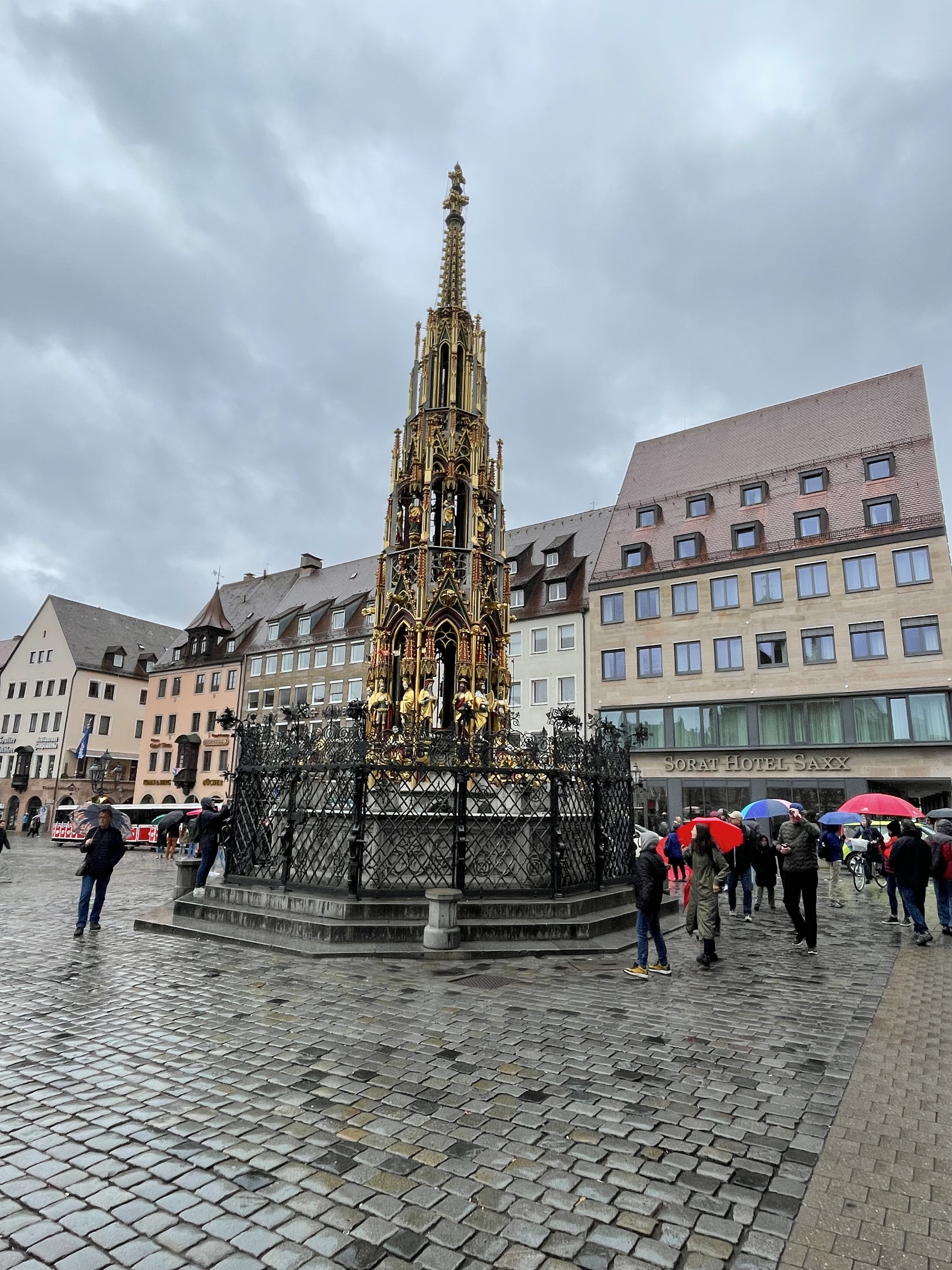
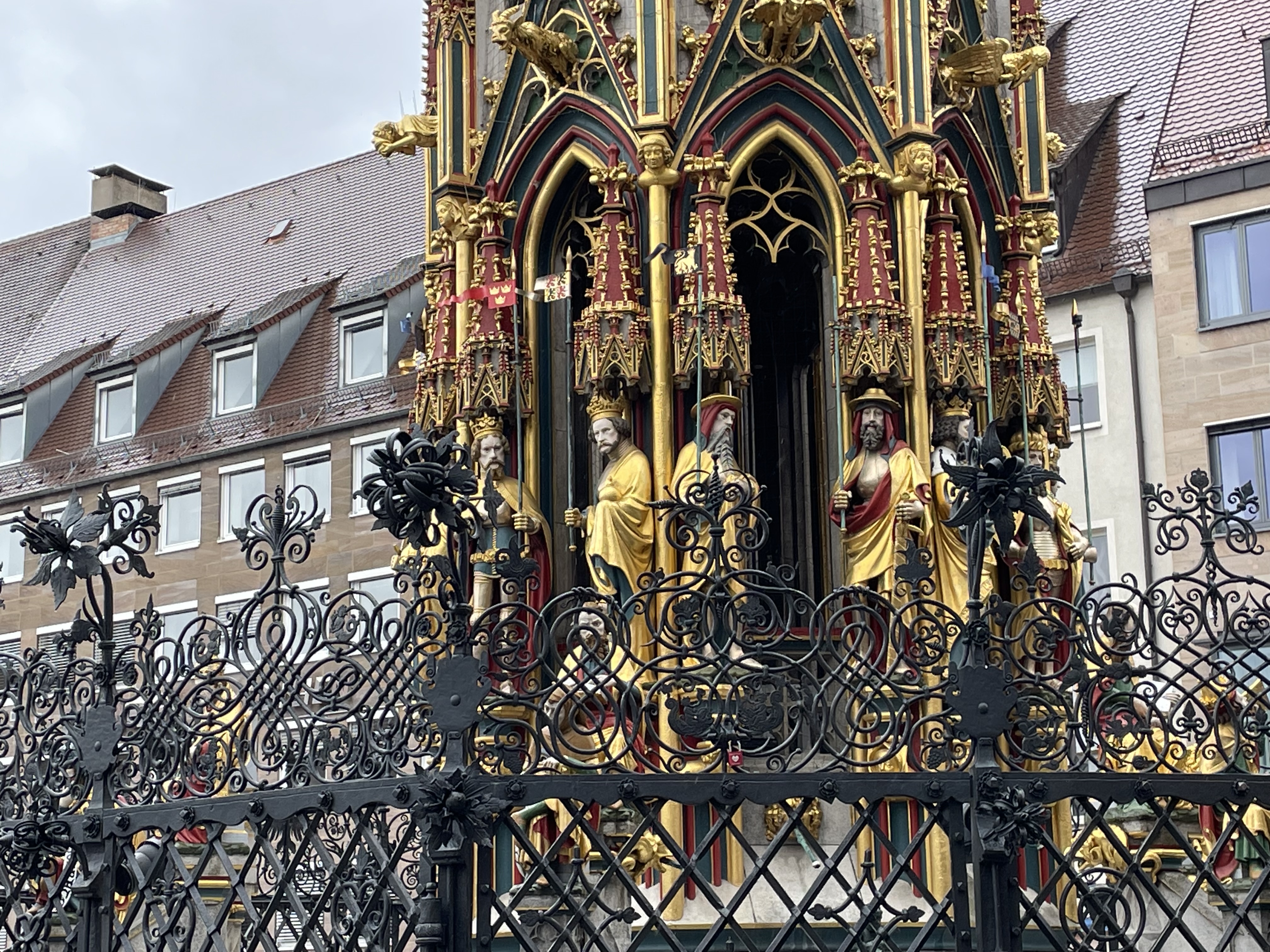
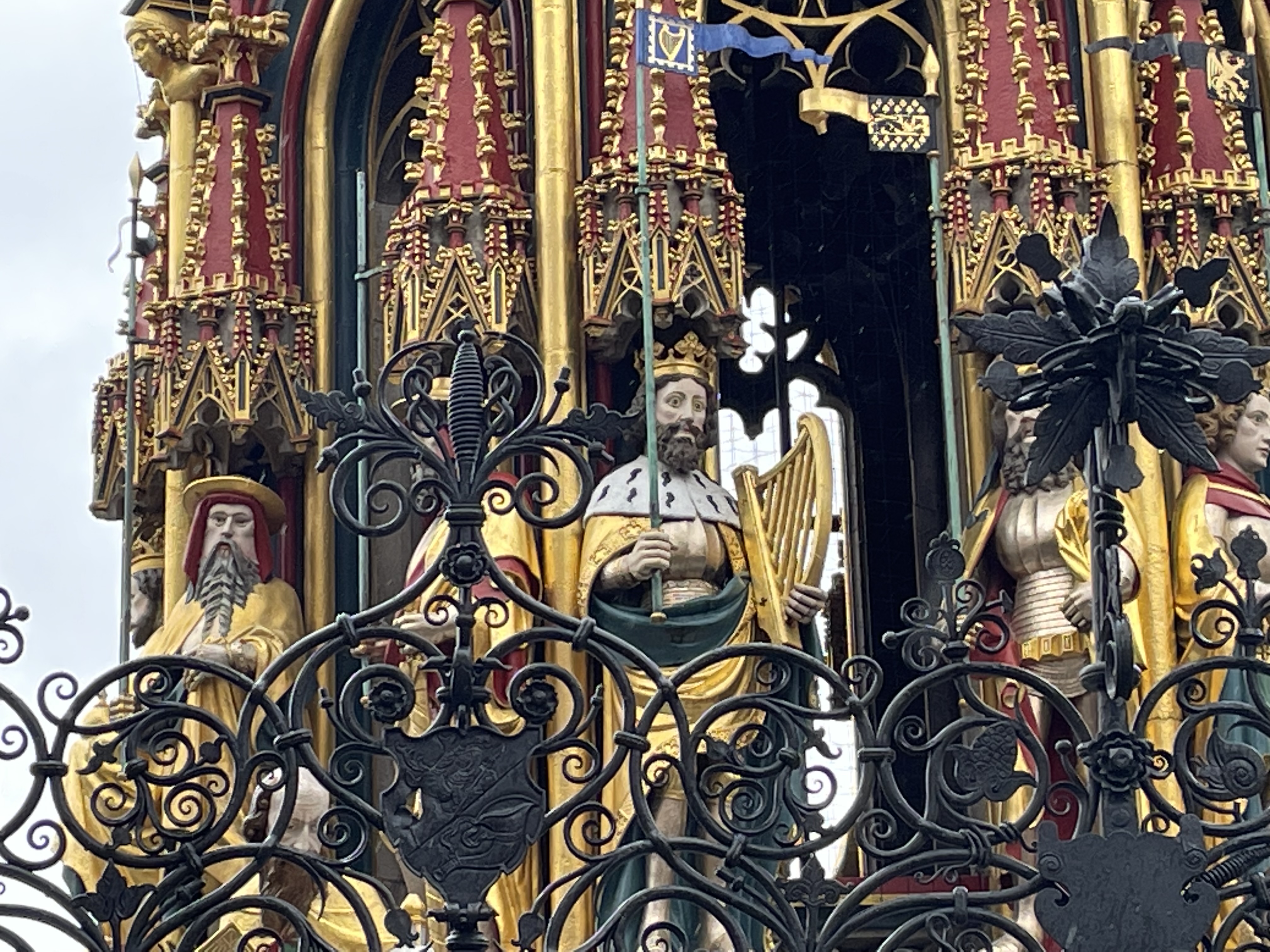
Between the 2 churches is the Hauptmarkrt & with its decorous C14th Schöner Brunnen
The fountain survived destruction in WW2 as the City Authorities had, at the beginning of the war, encased it in a concrete shelter.
Many other items plus Nazi ‘loot’ gathered from around Europe were placed in the underground galleries now known as the Historischer Kunstbunker. They are accessible to the public.
The final defence of Nurnberg was led by the fanaticist Karl Holz. Driven by the Nazi themes of death, transcendence, and commemoration he executed reluctant defenders, encouraged self destruction rather surrender & was prepared to use demolition teams to destroy everything of worth – including the stored art treasures. Fortunately he died before being able to enact his intentions.
The present war waged by Russia against Ukraine contains many of those elements – particularly the Nazi themes & an expression of total destruction being preferable to any form of compromise. The near total control of the media that exists is another parallel & that allows dictators to continue to control the ‘action’.
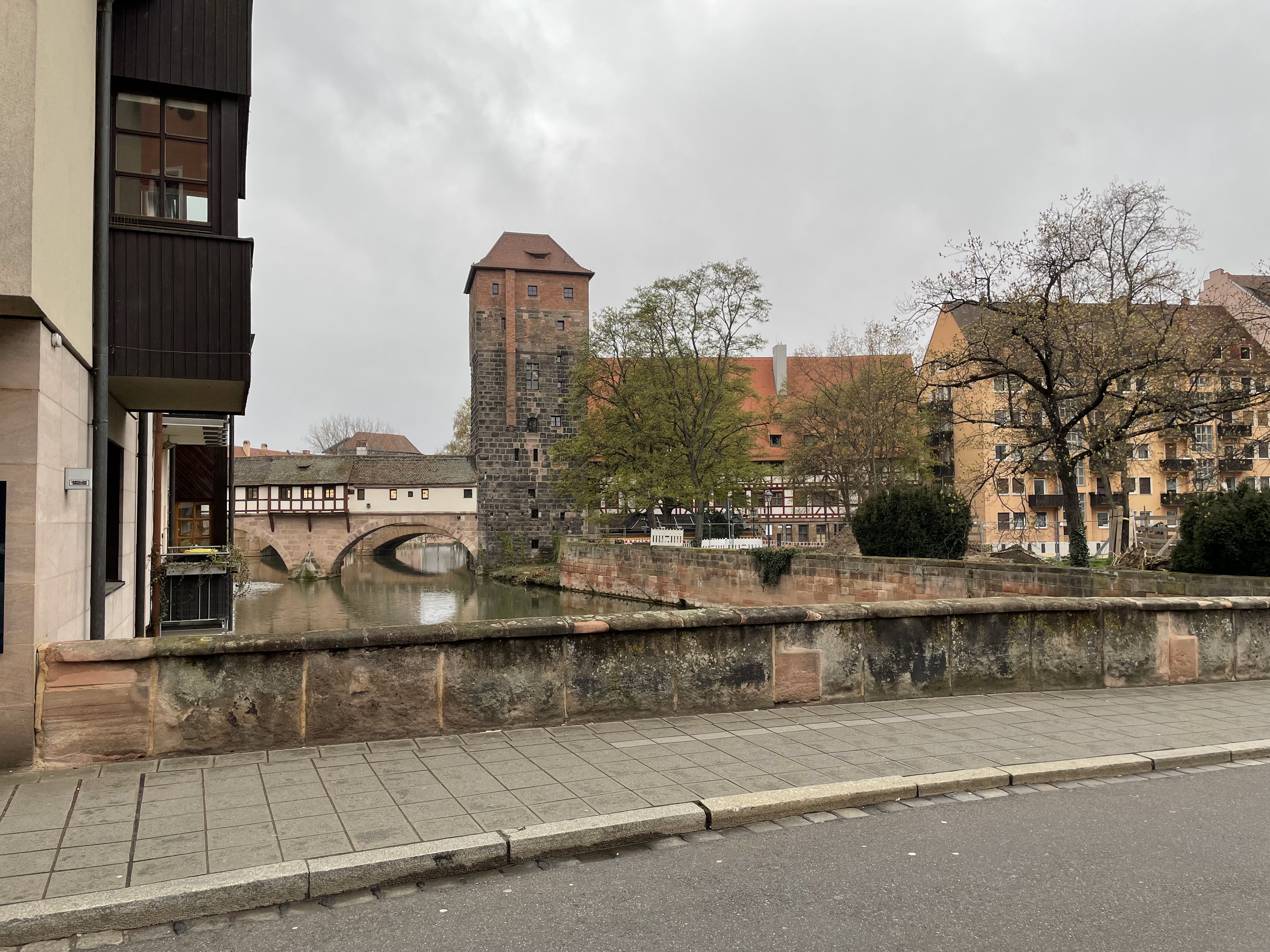
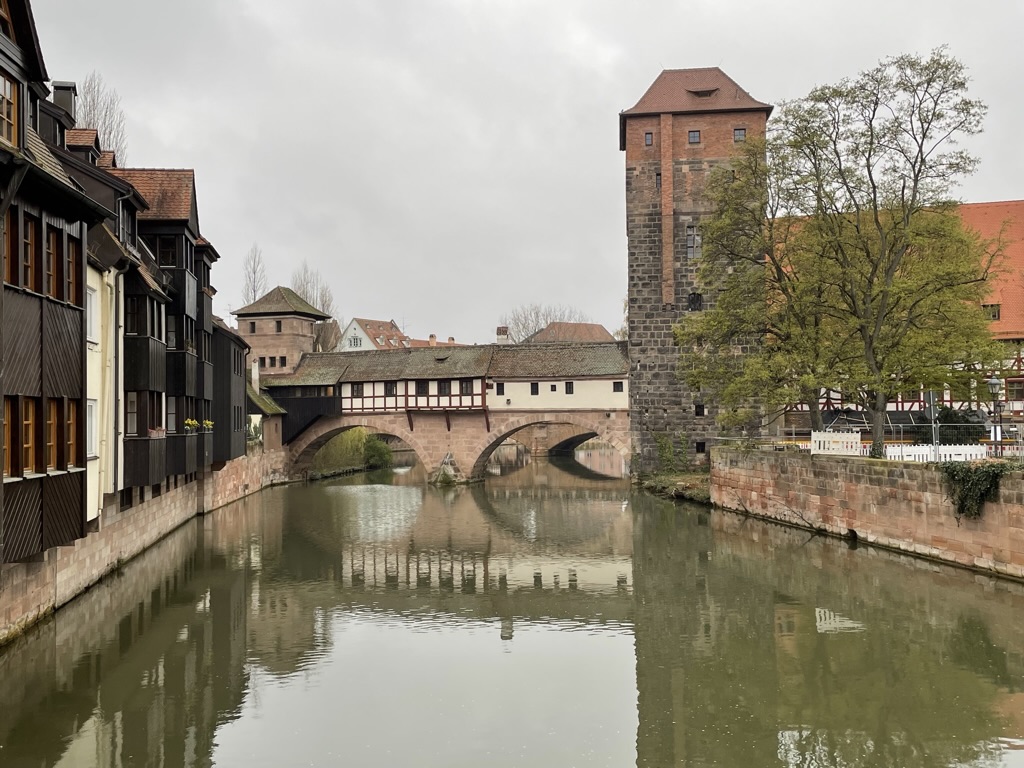
The river Pegnitz
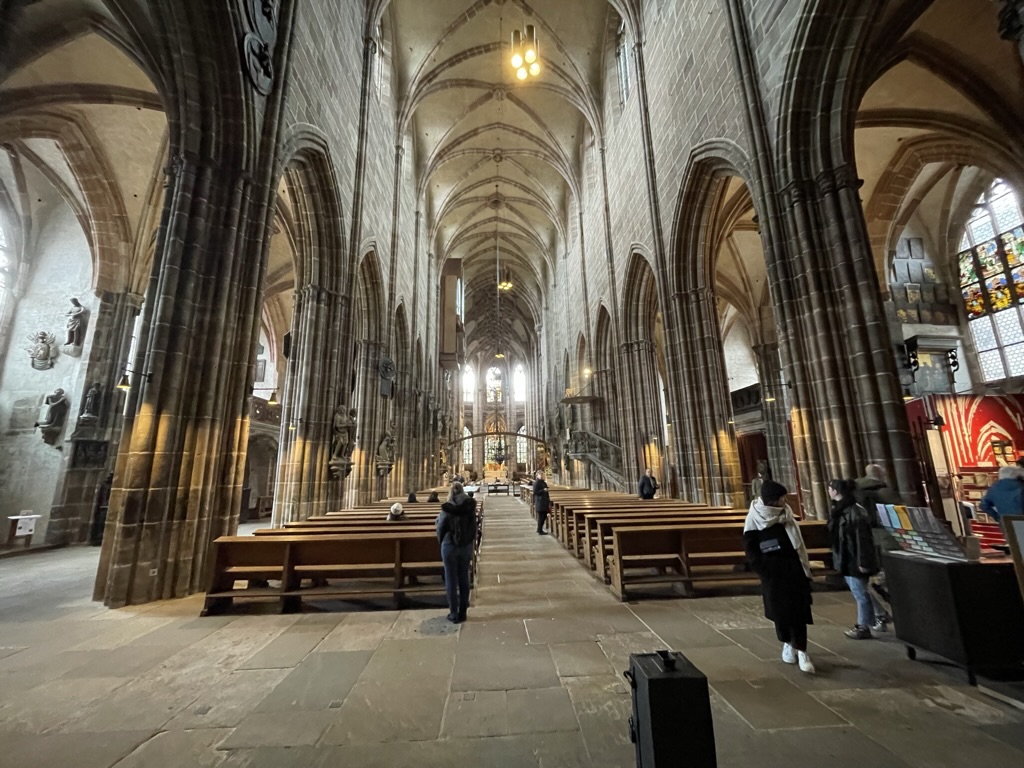
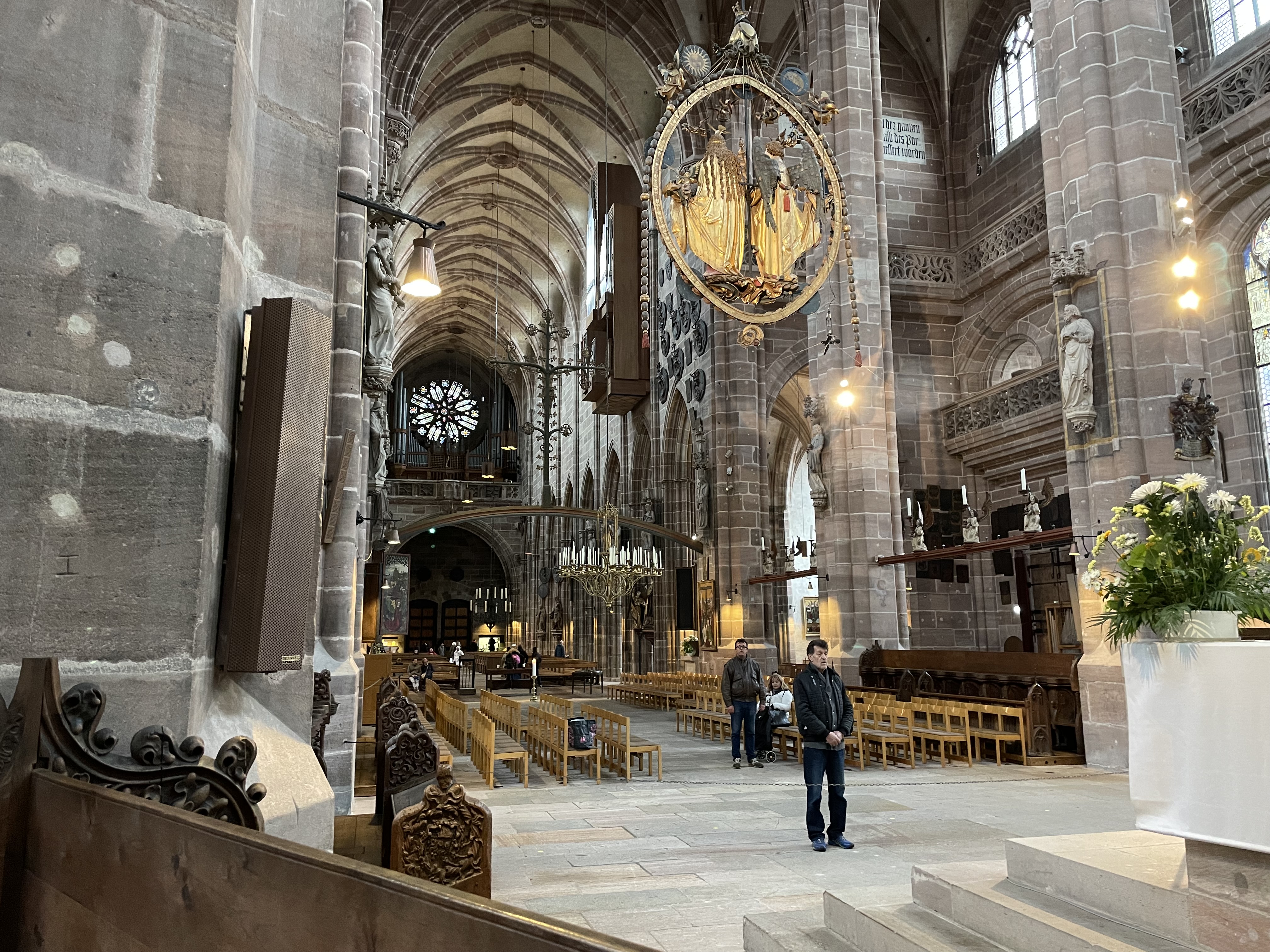
St Lorenz
St Lorenz Church was (and remains) ) the ‘City’ church, compared with the Imperially related St Sebald.
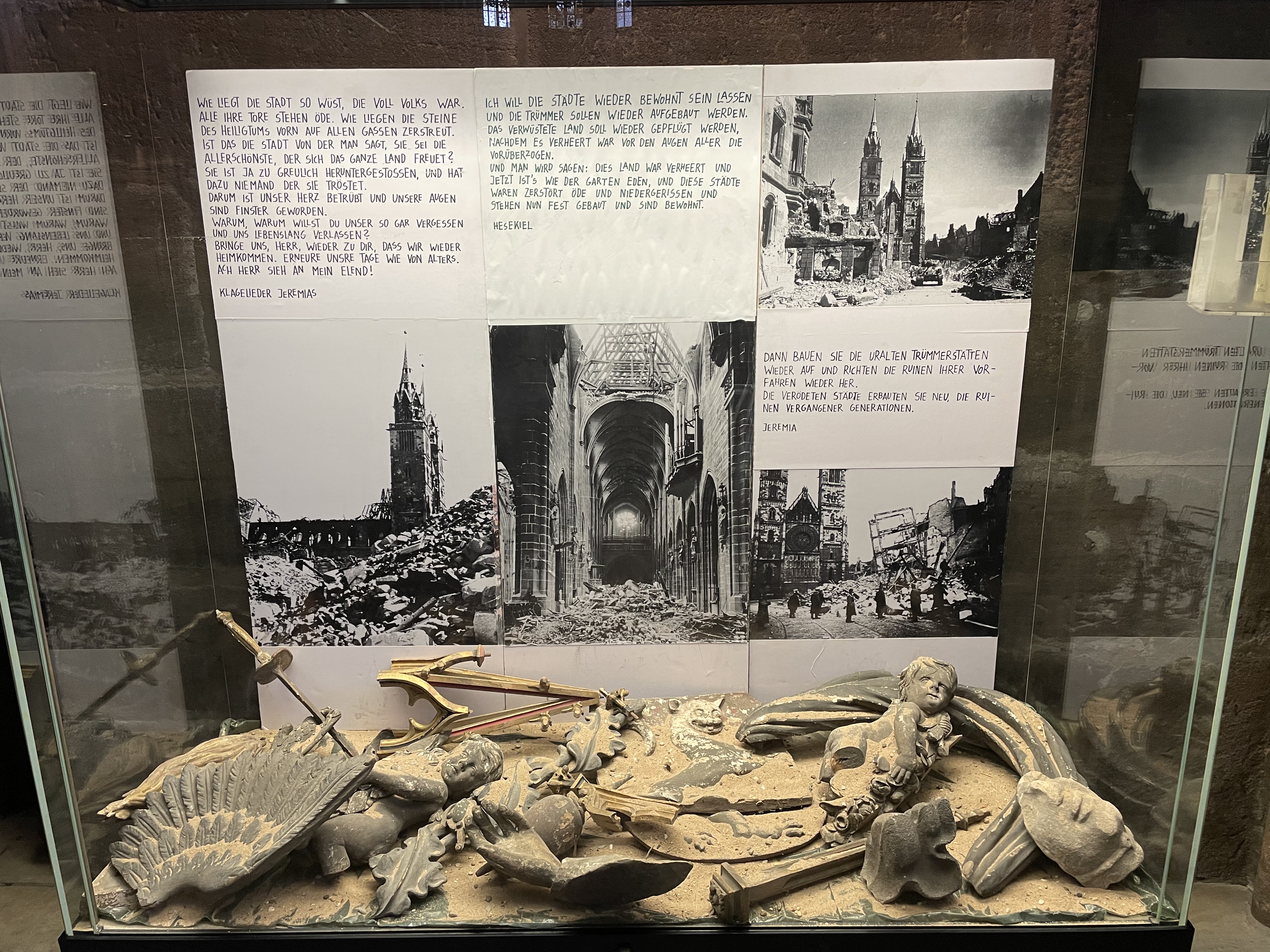
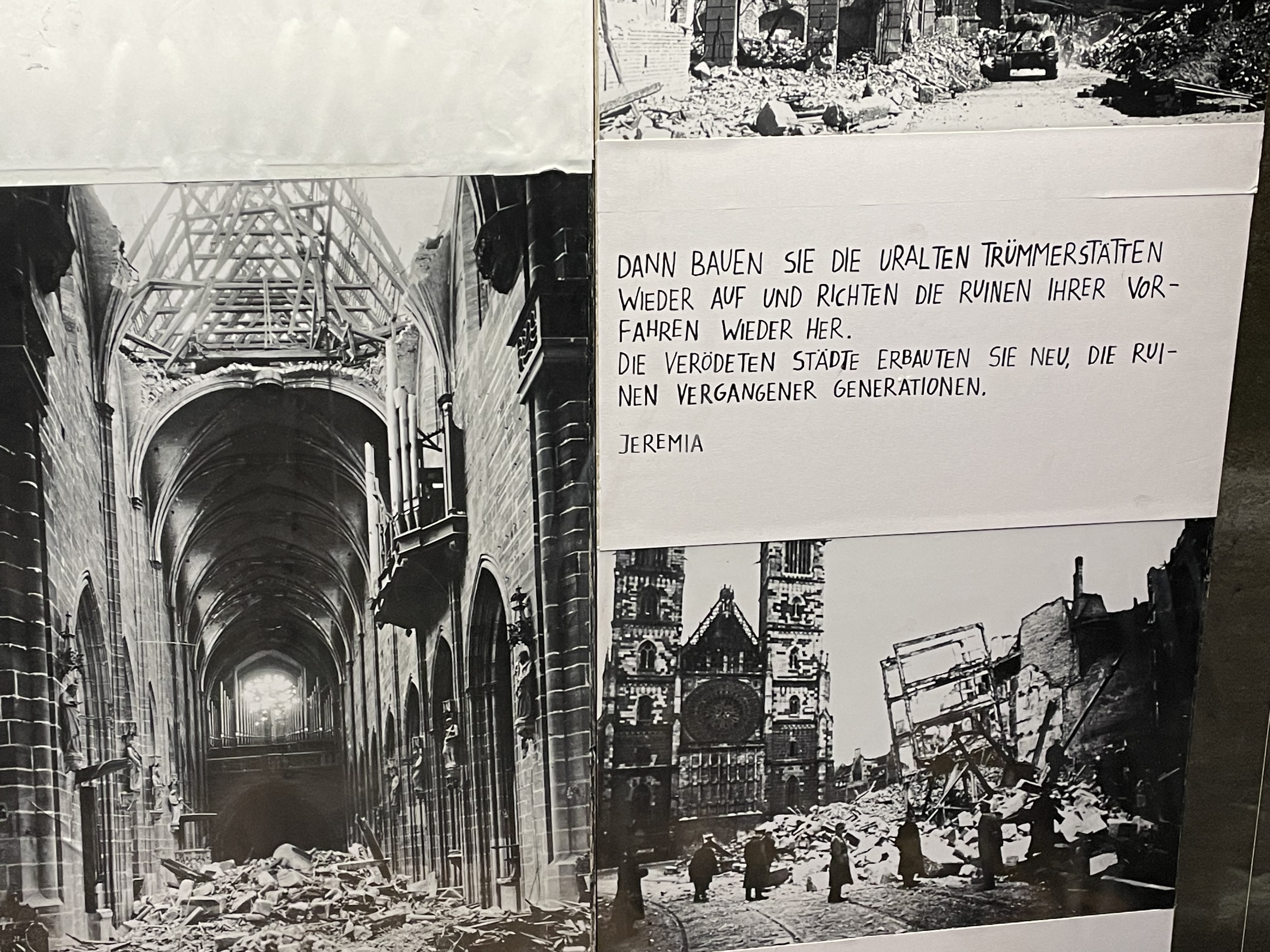
As the City Church many of the important works of Art had been stored safely underground
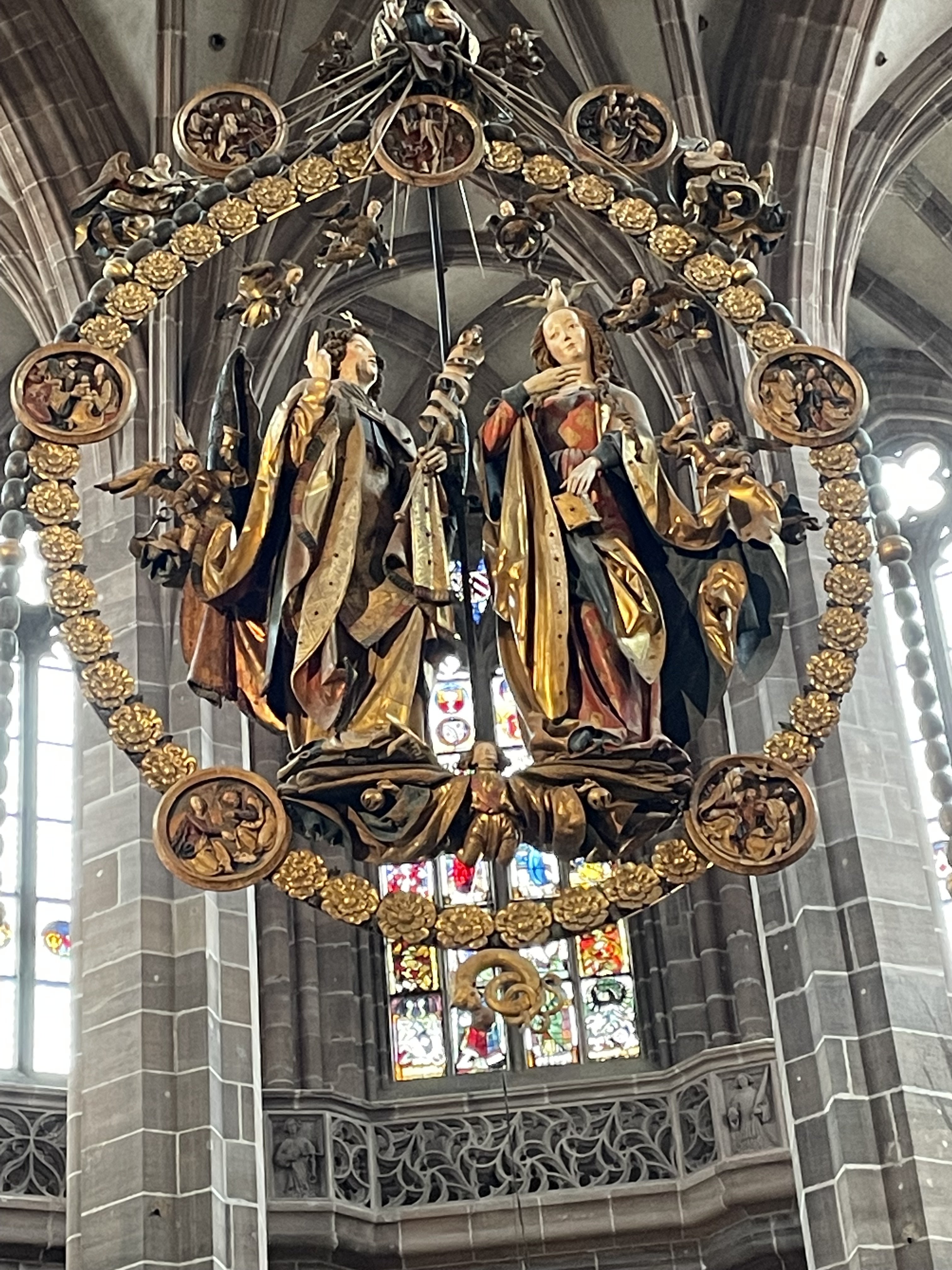
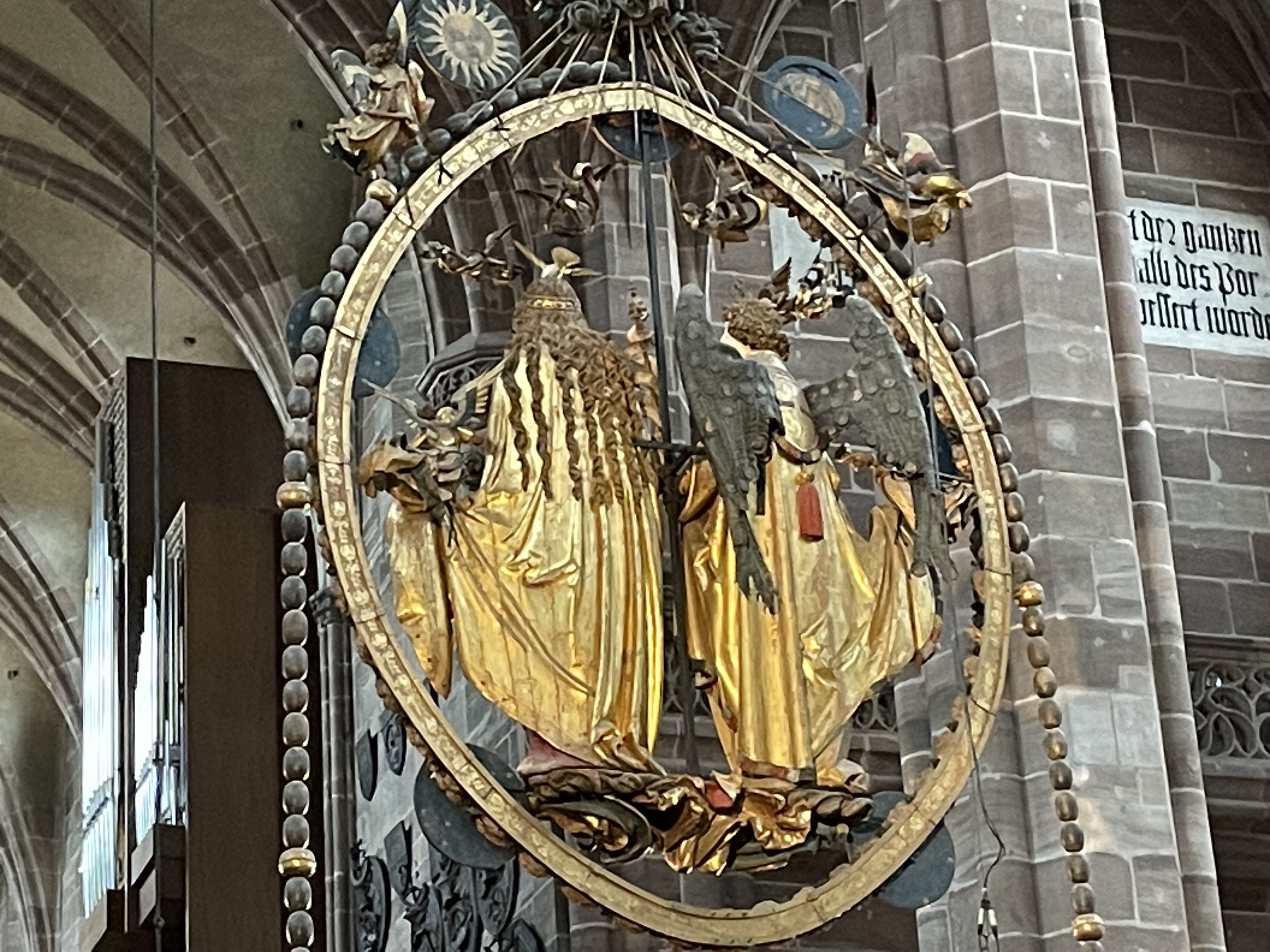
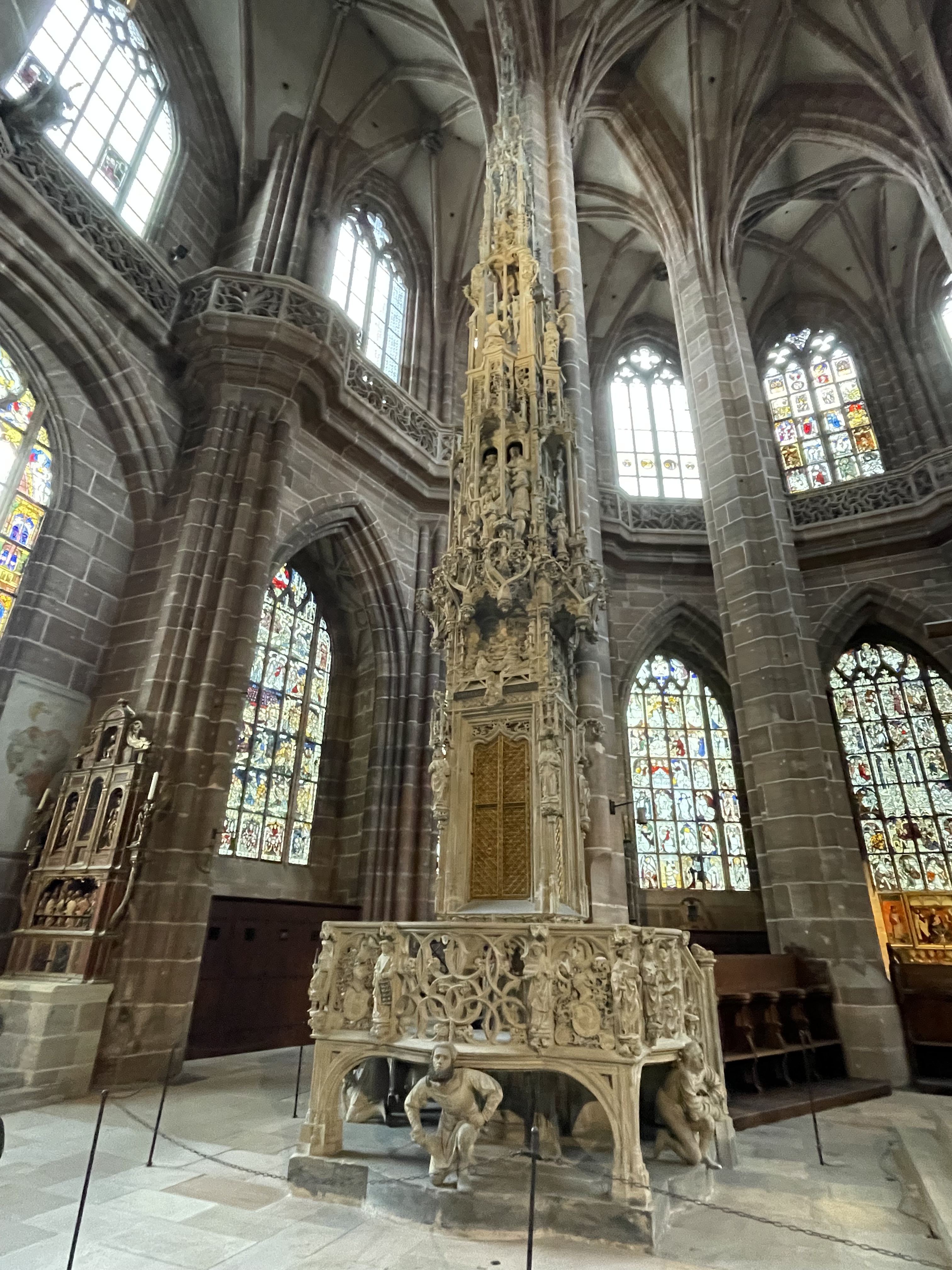
The tabernacle:
a locked box for the consecrated communion hosts capable of being used ‘in extremis’ (without any further formalities) – or for those who still follow the tradition, use in home communion.
This, very spectacular example of a tabernacle was stored underground with other treasures.
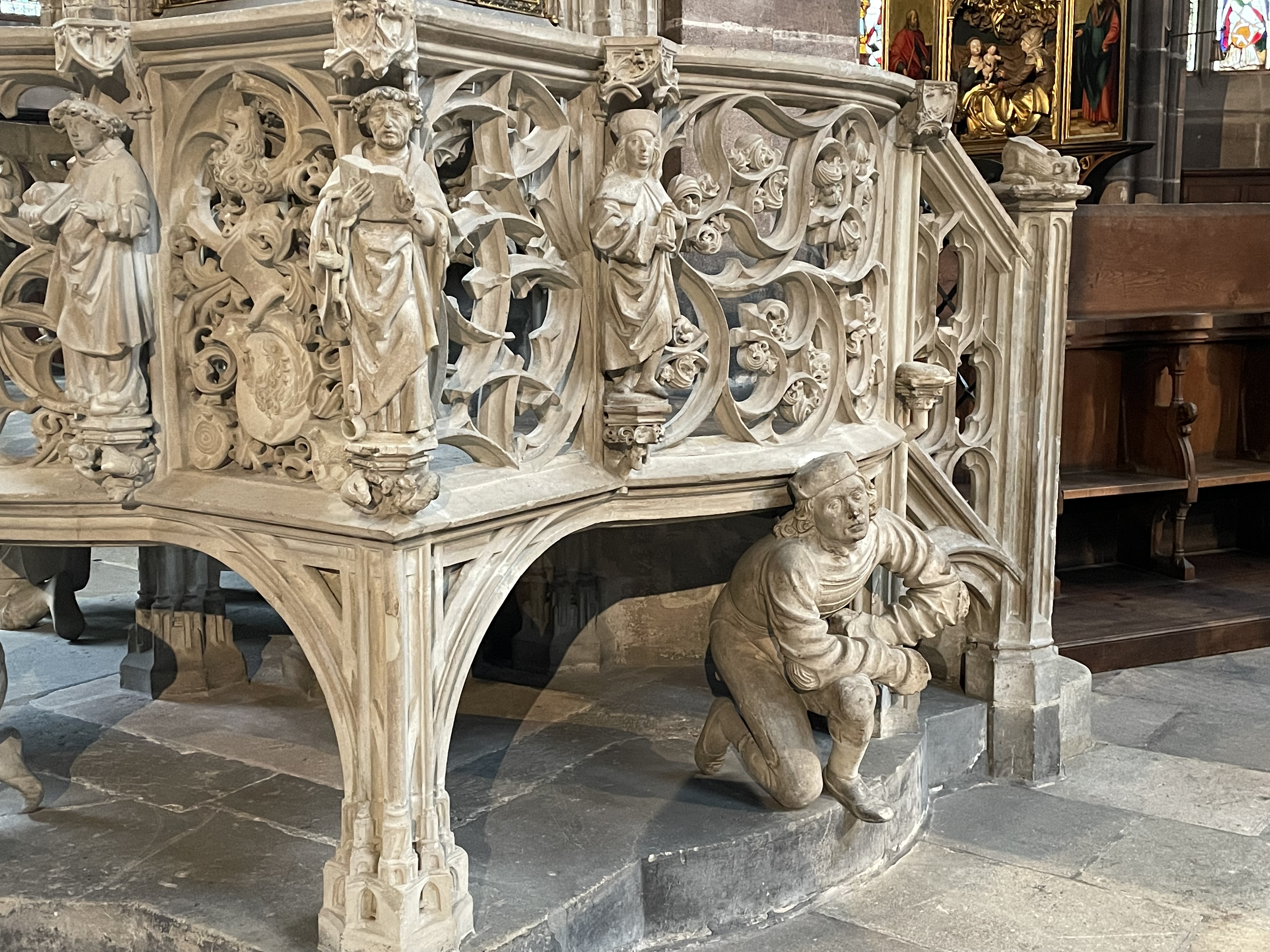
The appropriately named sculptor Adam Kraft included himself in the work
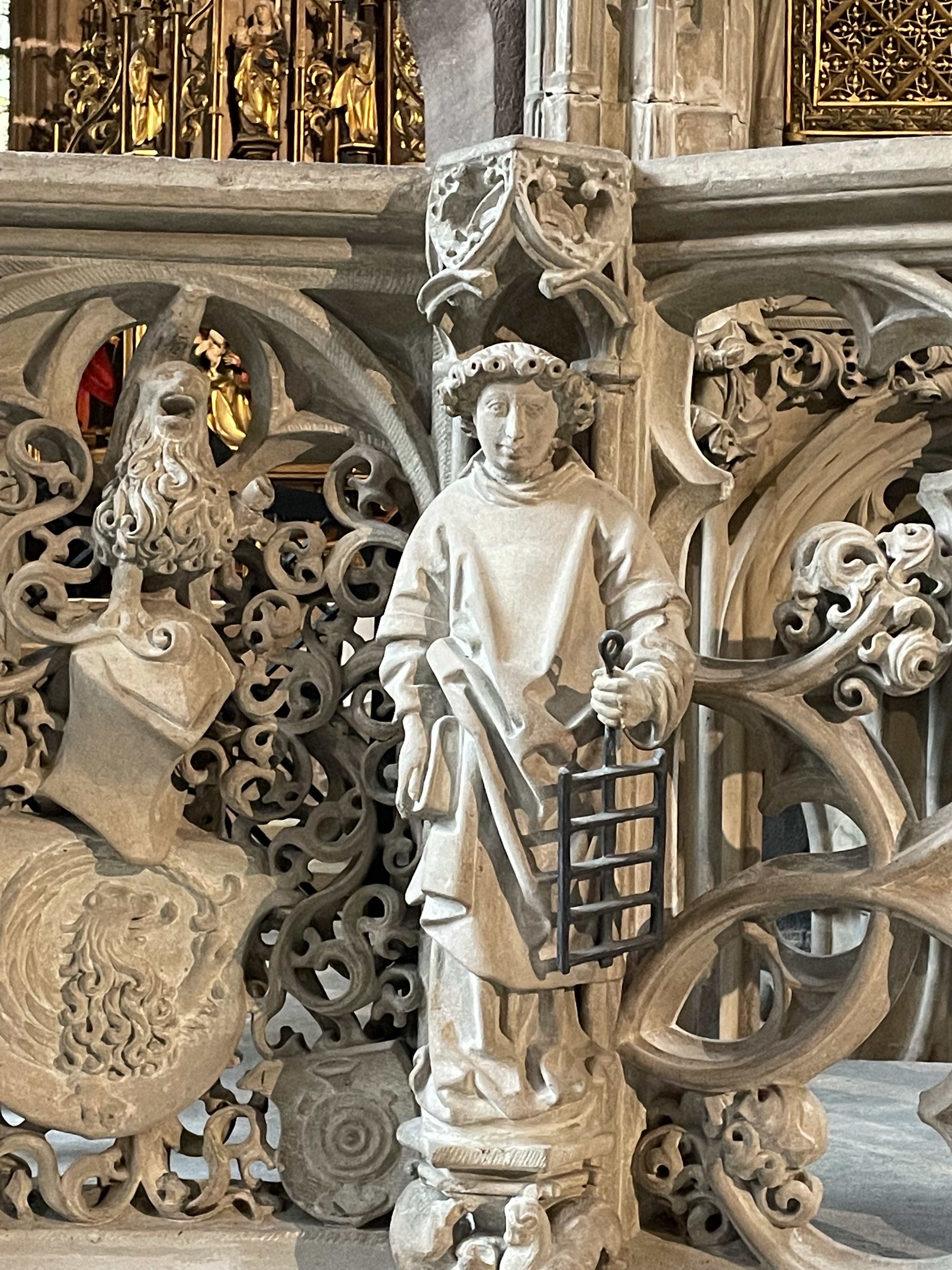
A case of bring your own ‘barbie’…. Stories say St Lorenz/Laurence was martyred by grilling… probably a bit of Christian hyped-up myth making. At the time of his death beheading was the usual method.
BUT! The ancient story was heavily embellished stating that after he had lengthy suffering he cheerfully declared: “I’m well done on this side. Turn me over!”
St. Lawrence is patron of cooks, chefs, and comedians.
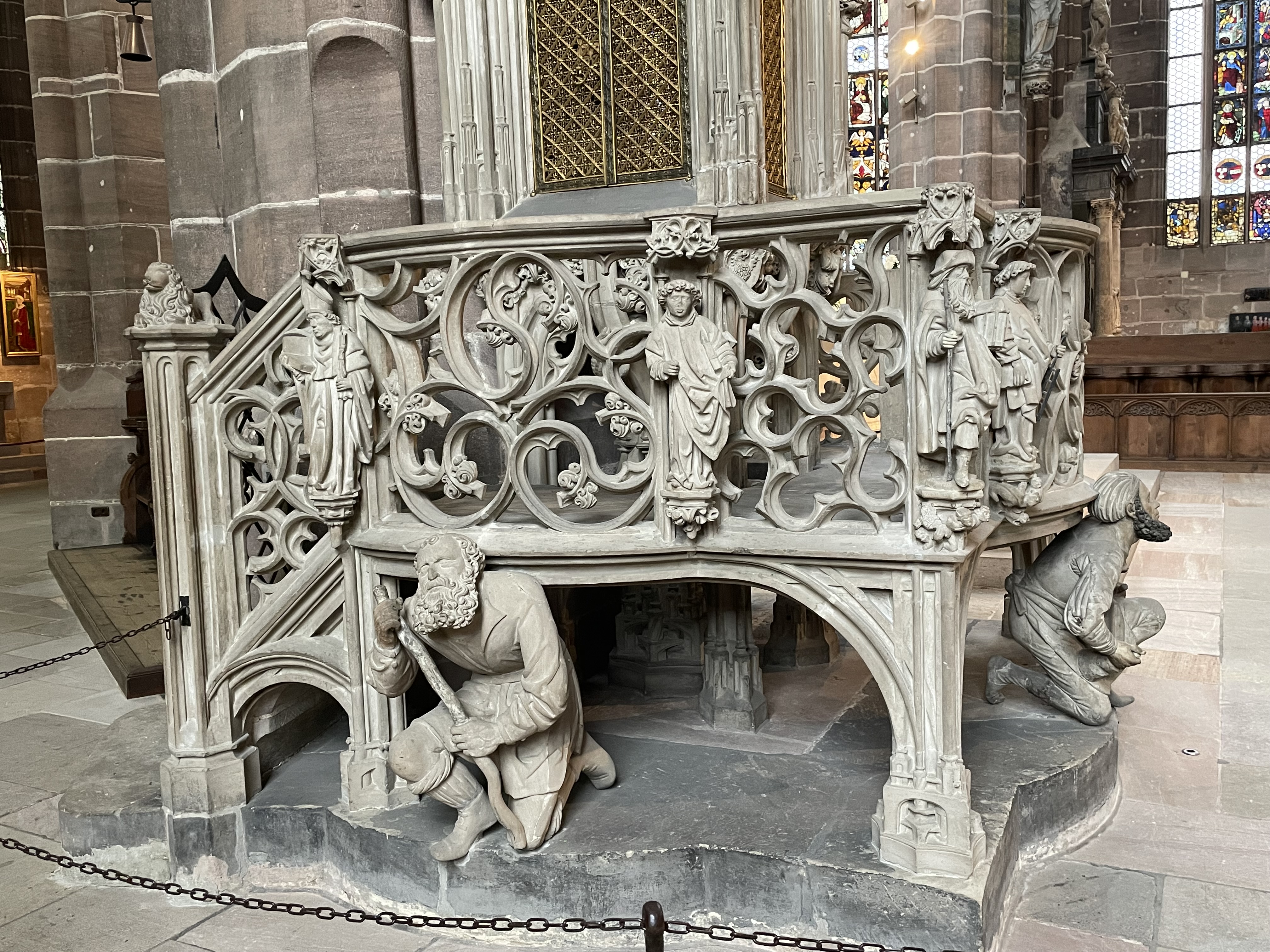
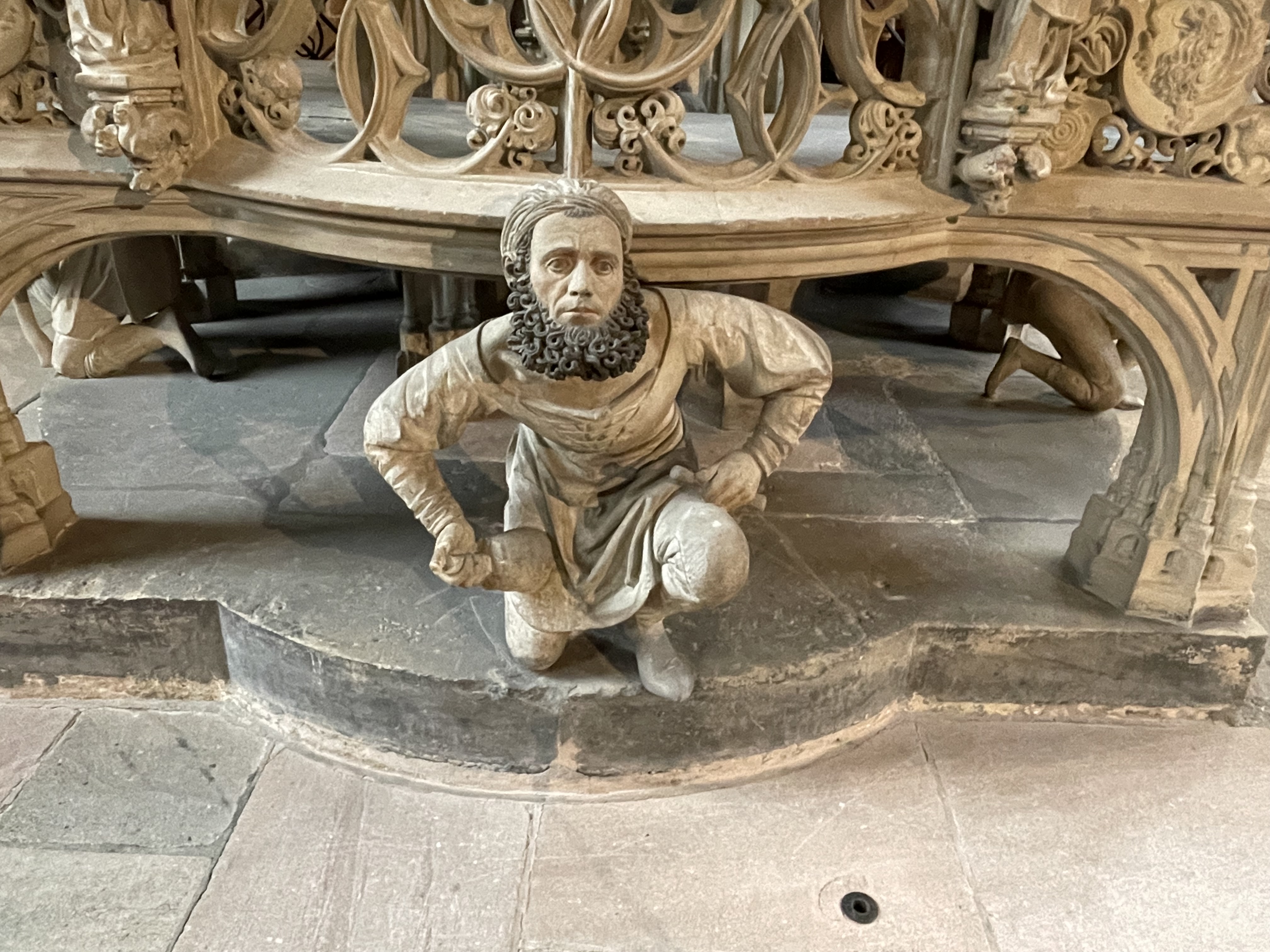
Adam Kraft
An early example of the ‘Hipster’ style?
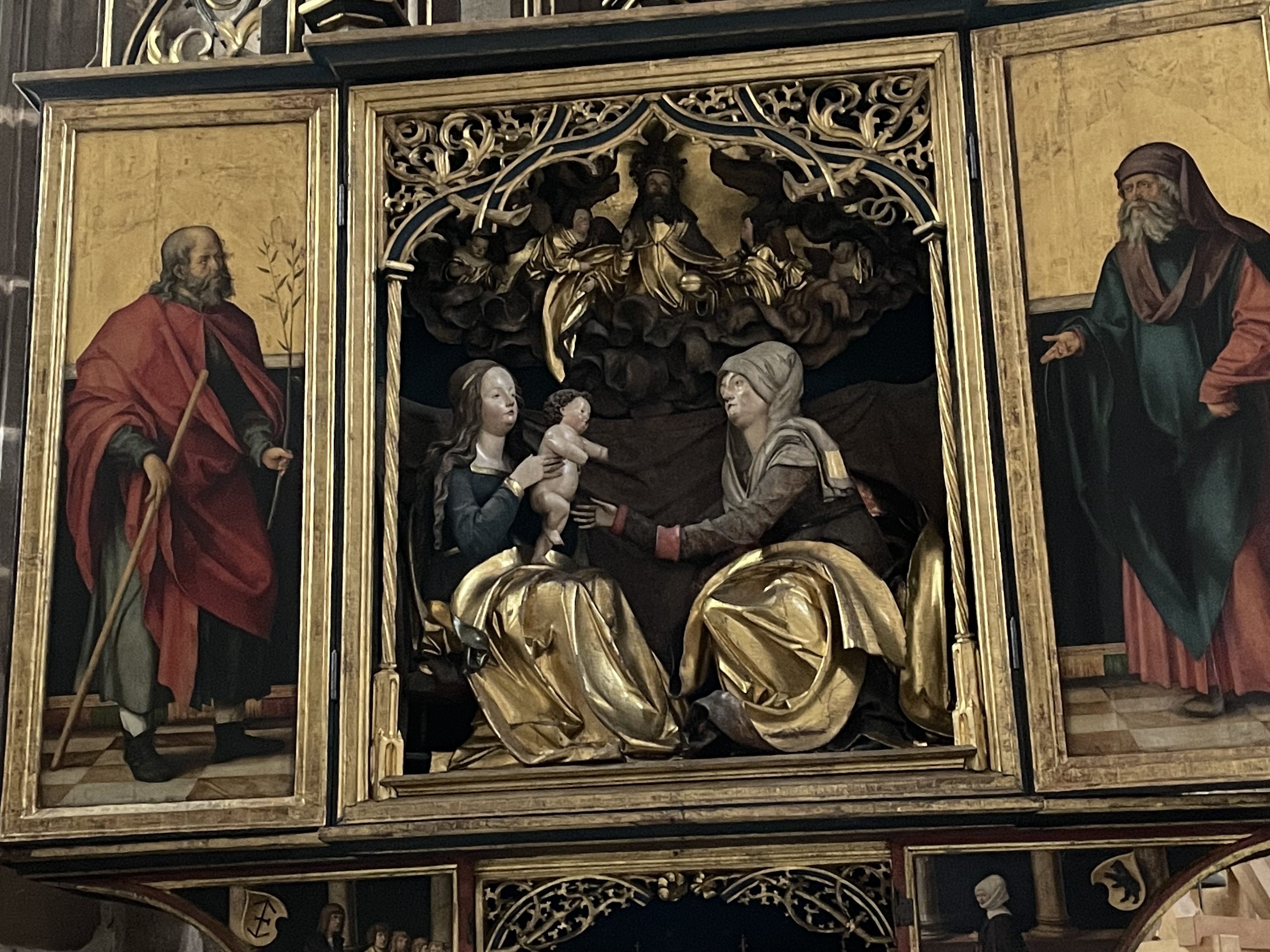

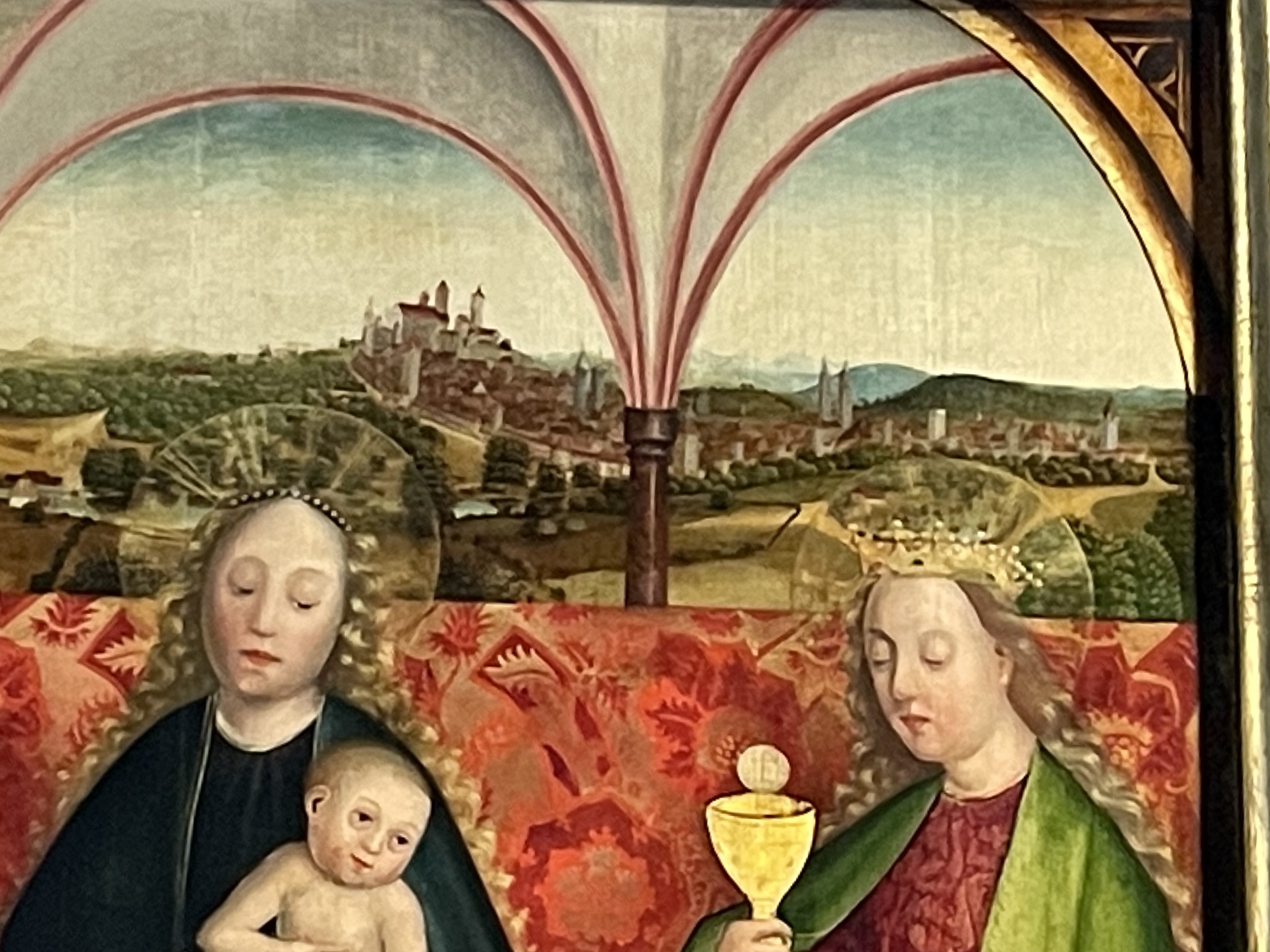
Demure – no direct sight from the picture, apart from Christ
One almost imagines them chatting together…. ‘Oh, he’s so sweet we call him ‘our little angel’
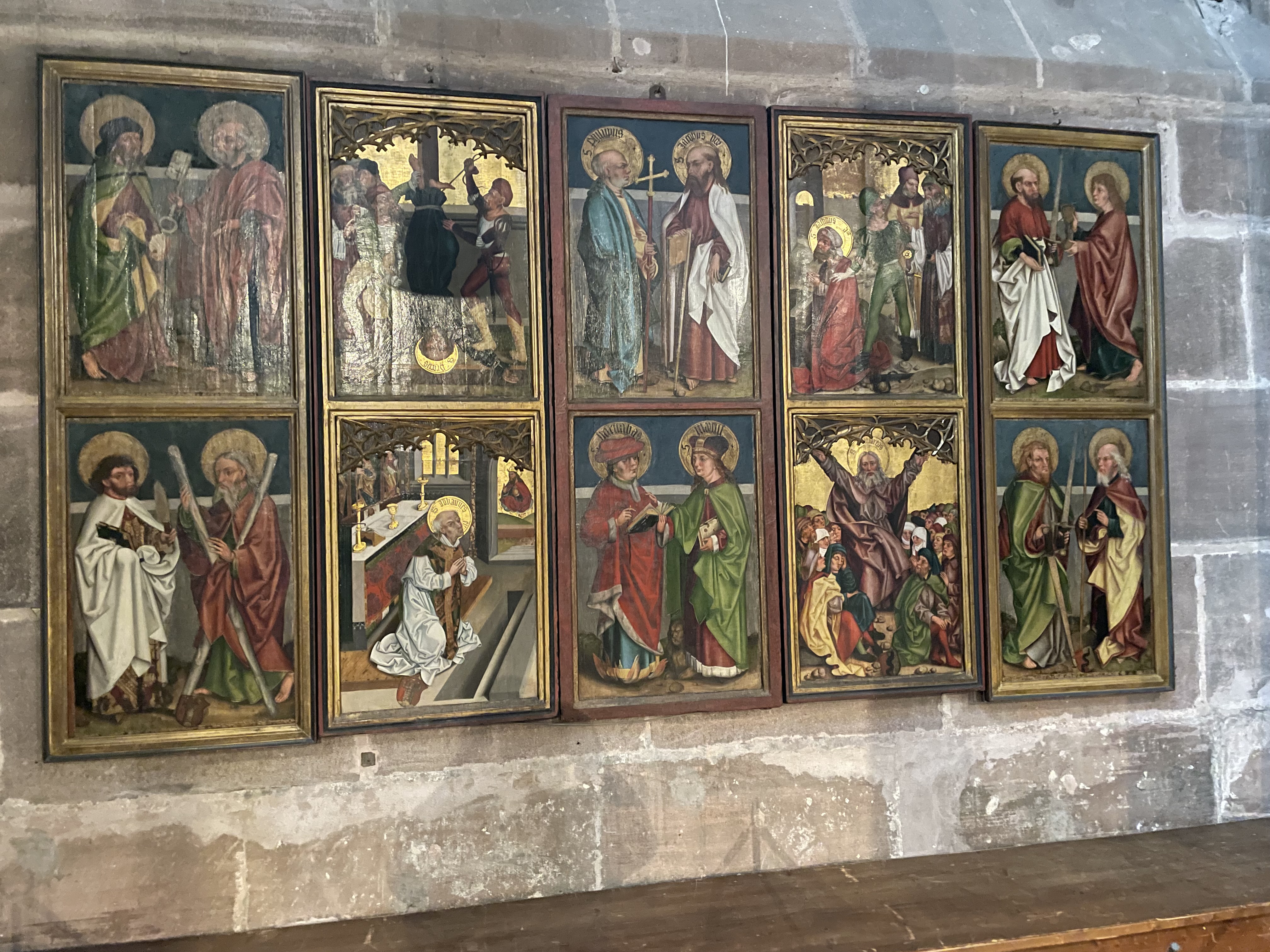
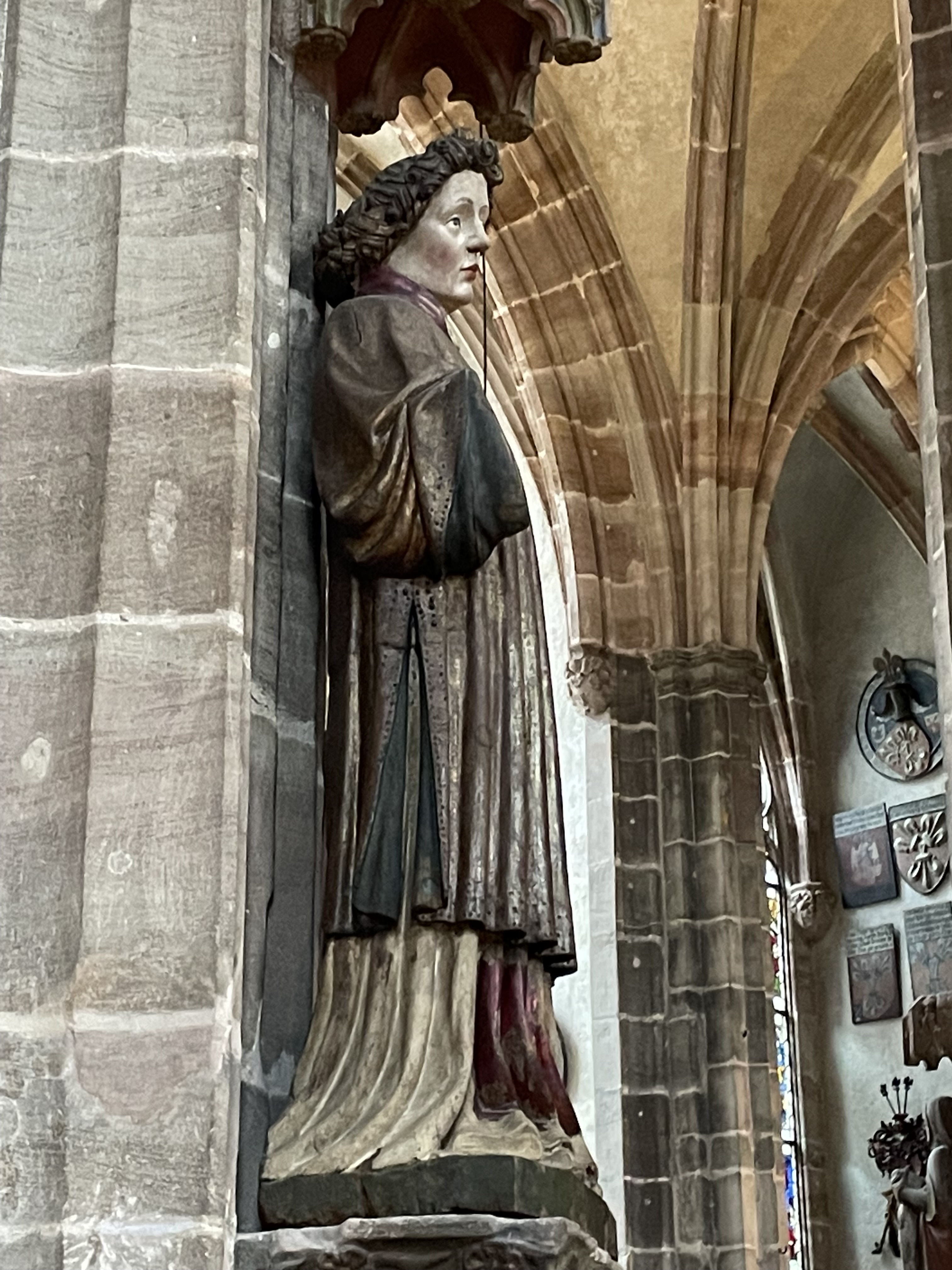
Ever hopeful…
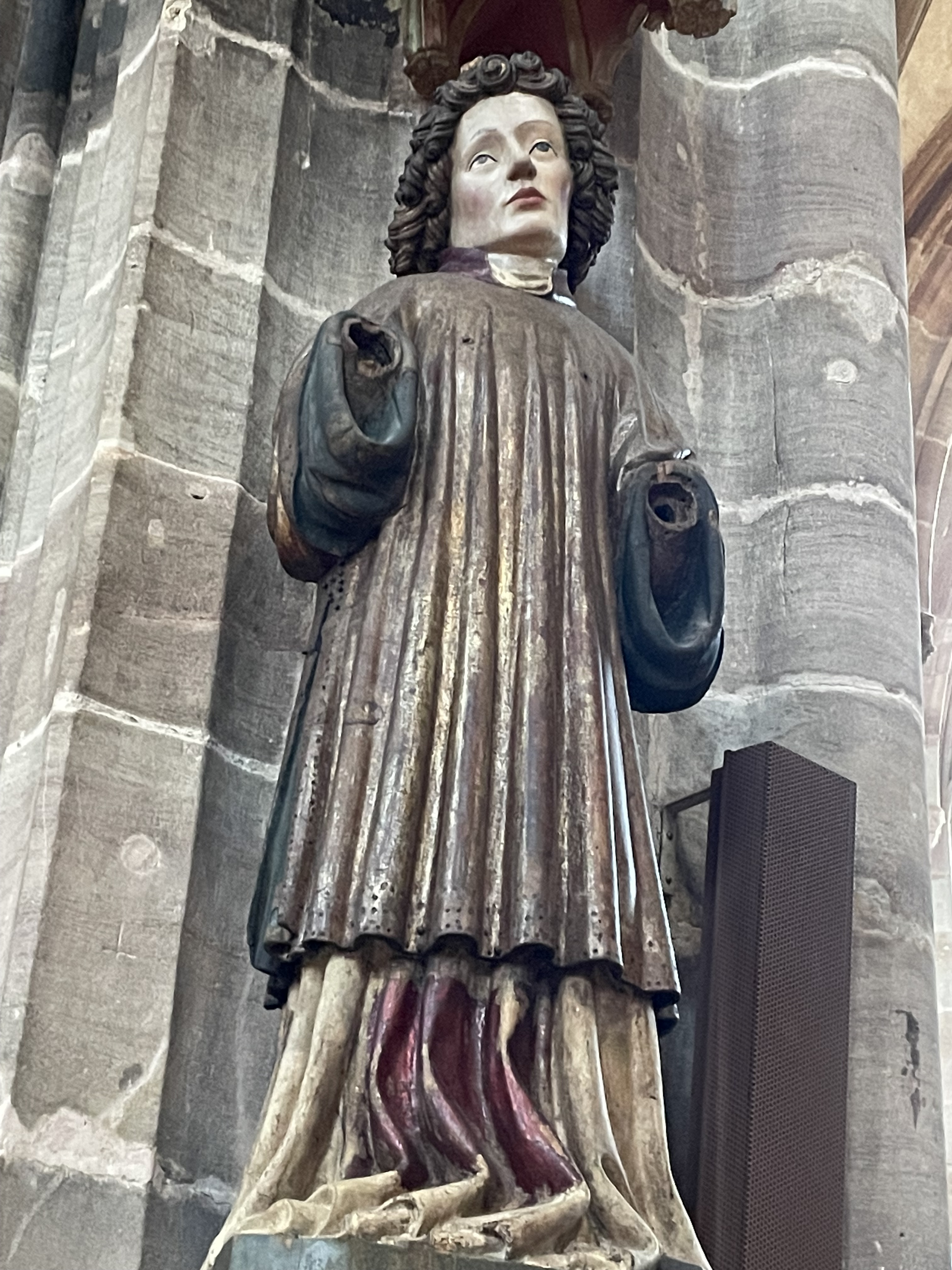
but forever, rather forlorn
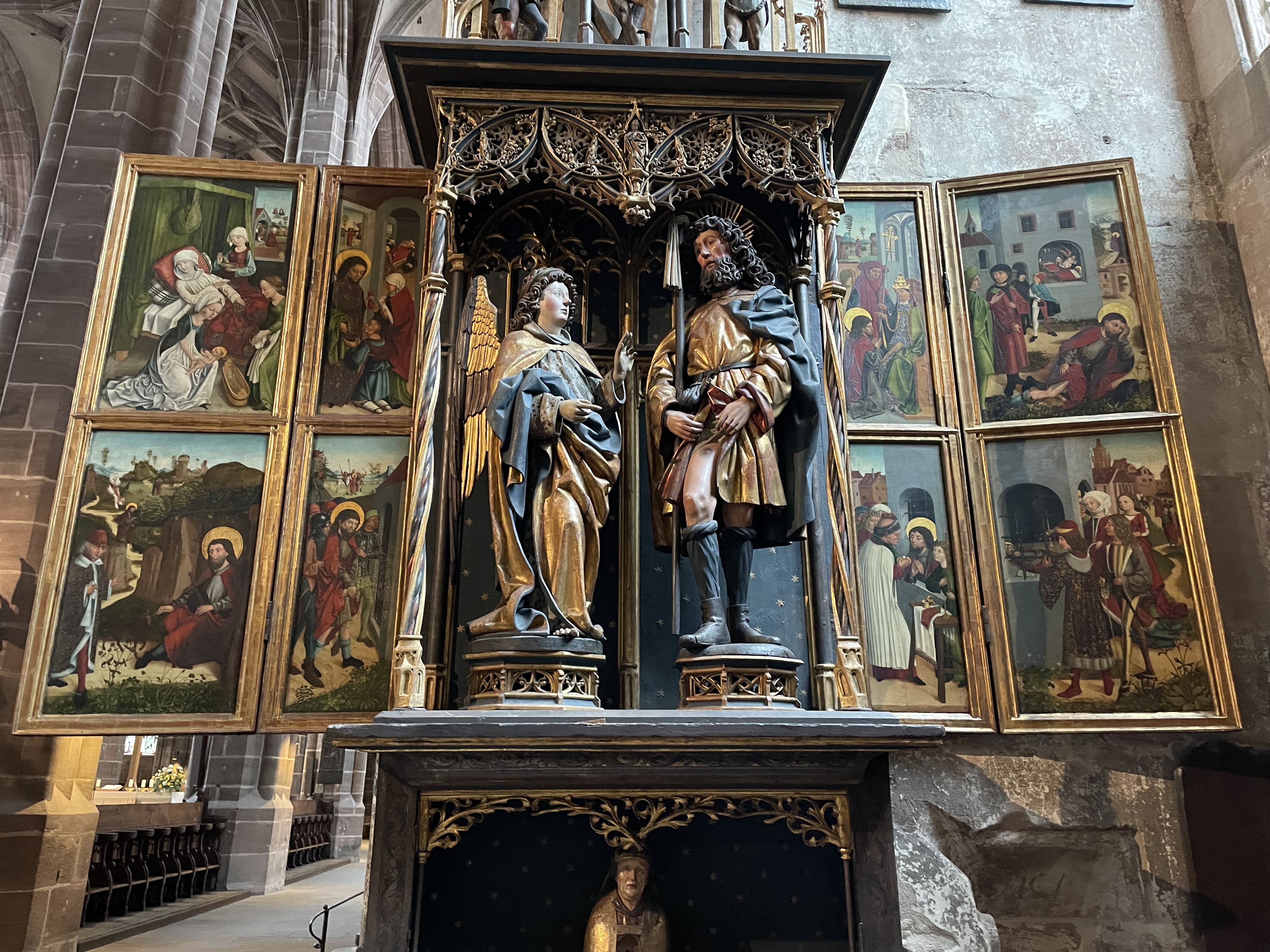
Excuse me Sir, but I think you’ve gone far enough – I’m not sure I’m qualified to deal with that sort of medical problem
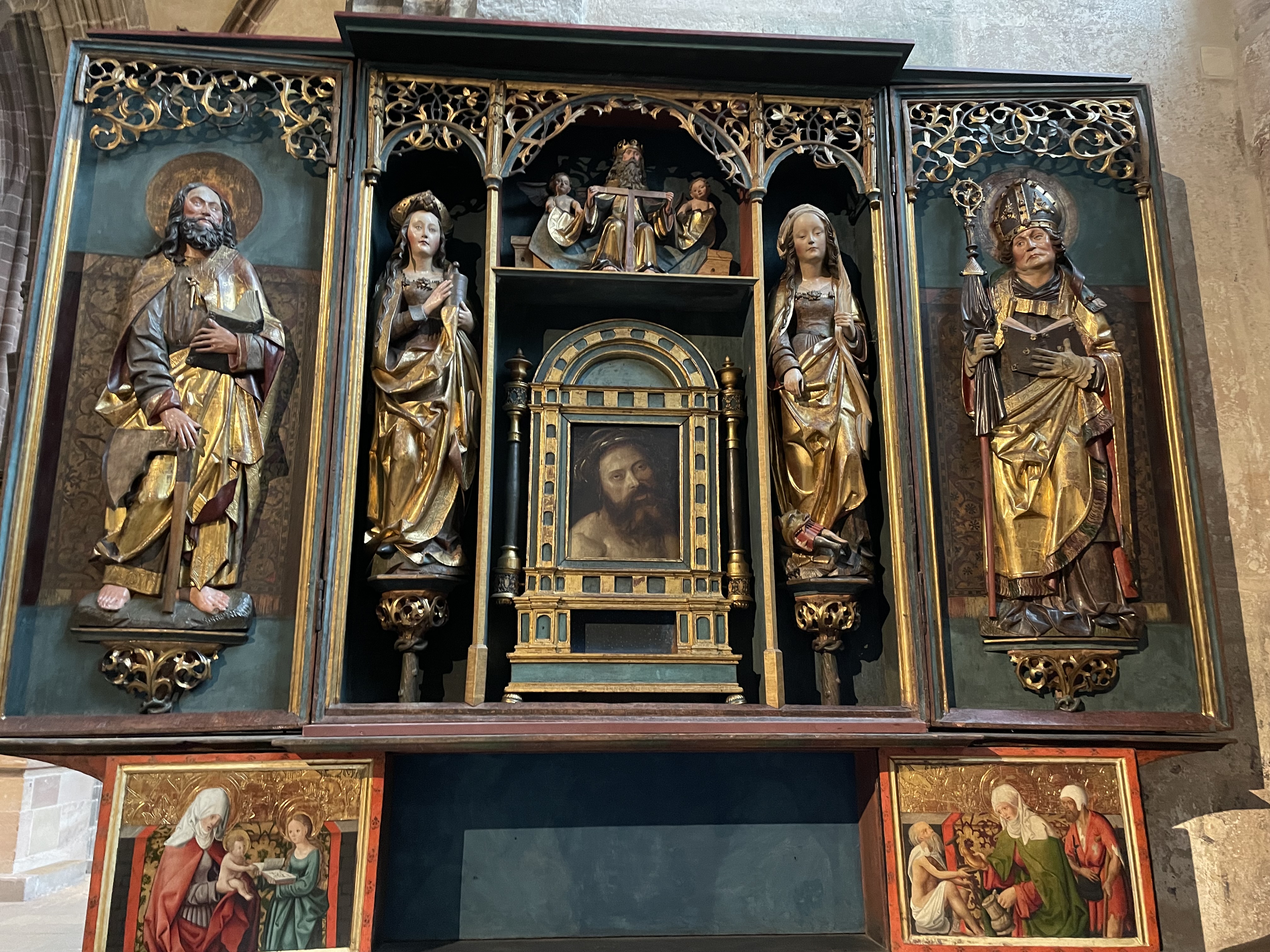

My favourite image:
It took some time to work out what was happening. Once I realised I then appreciated the clever way the sculptor had managed the story.
This is Margaret of Antioch: one of the Fourteen Holy Helpers, a collection of saints that probably became grouped as a ‘collective’ during plague times. 3 were Virgin martyrs
Margaretha mit dem Wurm,
Barbara mit dem Turm,
Katharina mit dem Radl
das sind die drei heiligen Madl.
The following is their basic potential (should ‘Holy Help’ be required)
Even at this simple level, by invoking them together using their collective name, they carry quite a powerful therapeutic kick.
St. Achatius: May 8th – Headaches
St. Barbara: Dec. 4th – Fever – Sudden death
St. Blaise (Blasé, Blasius): Feb. 3rd – Ills of the throat
St. Catherine of Alexandria: Nov. 25th – Sudden death
St. Christopher: July 25th – Plagues – Sudden death
St. Cyriacus (Cyriac): Aug. 8th – Temptations
St. Denis (Dionysius): Oct. 9th – Headaches
St. Erasmus (Elmo): June 2nd – Abdominal maladies
St. Eustachius (Eustace): Sep. 20th – Family trouble
St. George: Apr. 23rd – Protection of domestic animals
St. Giles (Aegidius): Sep.1st – Plagues – Good Confession
St. Margaret of Antioch: July 20th – Safe childbirth
St. Pantaleone: July 27th – Physicians
St. Vitus (St. Guy):June 15th – Epilepsy
Maybe by invoking, at the same time, 2 offering similar protection, would increase the overall efficacy:
eg Achatius & Denis being equivalent to taking 2 paracetamol ?
Here is a longer list of their attributes
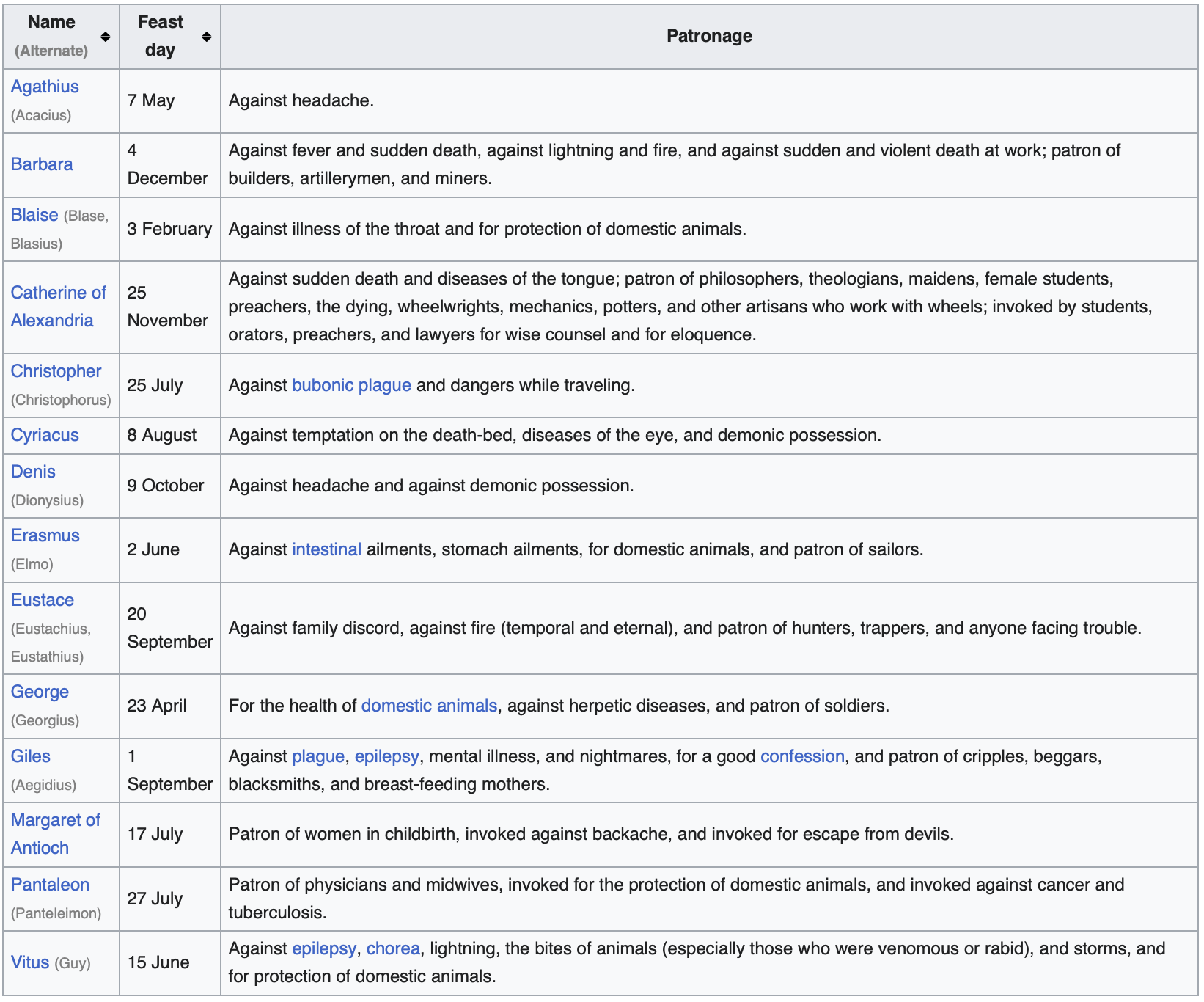
Curiously Margaret of Antioch is virginal but yet invoked to ensure safe childbirth….. There is a Good Reason!
The story: Margaret lived at an ill-defined ancient time (cAD 270?) became a Christian as a child and was offered marriage by the Provincial Prefect.
She refused to renounce her faith and was (as is normal in such stories)
‘cruelly scourged, placed on the rack, and torn with iron combs. Then she was cast into prison. There Margaret fervently thanked God for the victory she had achieved’.
Suddenly a furious dragon appeared & (some do say) began to swallow her. She made the sign of the Cross and the dragon burst, she came out whole & greatly improved…
‘her desolate prison cell became suffused with Heavenly light, and her heart was filled with Divine consolation. At the same time her terrible wounds were suddenly healed, and not the least scar was left.’
…. And seemingly, for our sculptor, fully clothed in fine raiment.
As next day she continued to expound her faith to the Prefect he became enraged – whereupon
‘He ordered lighted torches to be applied to Margaret’s body, and then had her cast into icy water to intensify her torture. But scarcely had this been done when a violent earthquake occurred. Her bonds were severed and she rose unscathed from the water, without a mark of the burns caused by the flaming torches. On witnessing this miracle, a great number of spectators were converted to the Faith.’
The stories then simply state that it was ordered that she be beheaded – along with the converts.
Though this may seem like failure – much torture and torment but no apparent result, no ‘happy ending’, the story was never intended to function as such. It was designed to encourage true devotion – and that encouraged individuals to be penitent, to engage in acts of ‘mortification of the flesh’, to prepare by faith and good deeds for a better existence beyond this earthly life. Margaret’s triumph over her sufferings allowed for a swift death – and future Everlasting Life & Glory.
As such it was the happiest ending possible!
Alleluia, Alleluia, Alleluia.
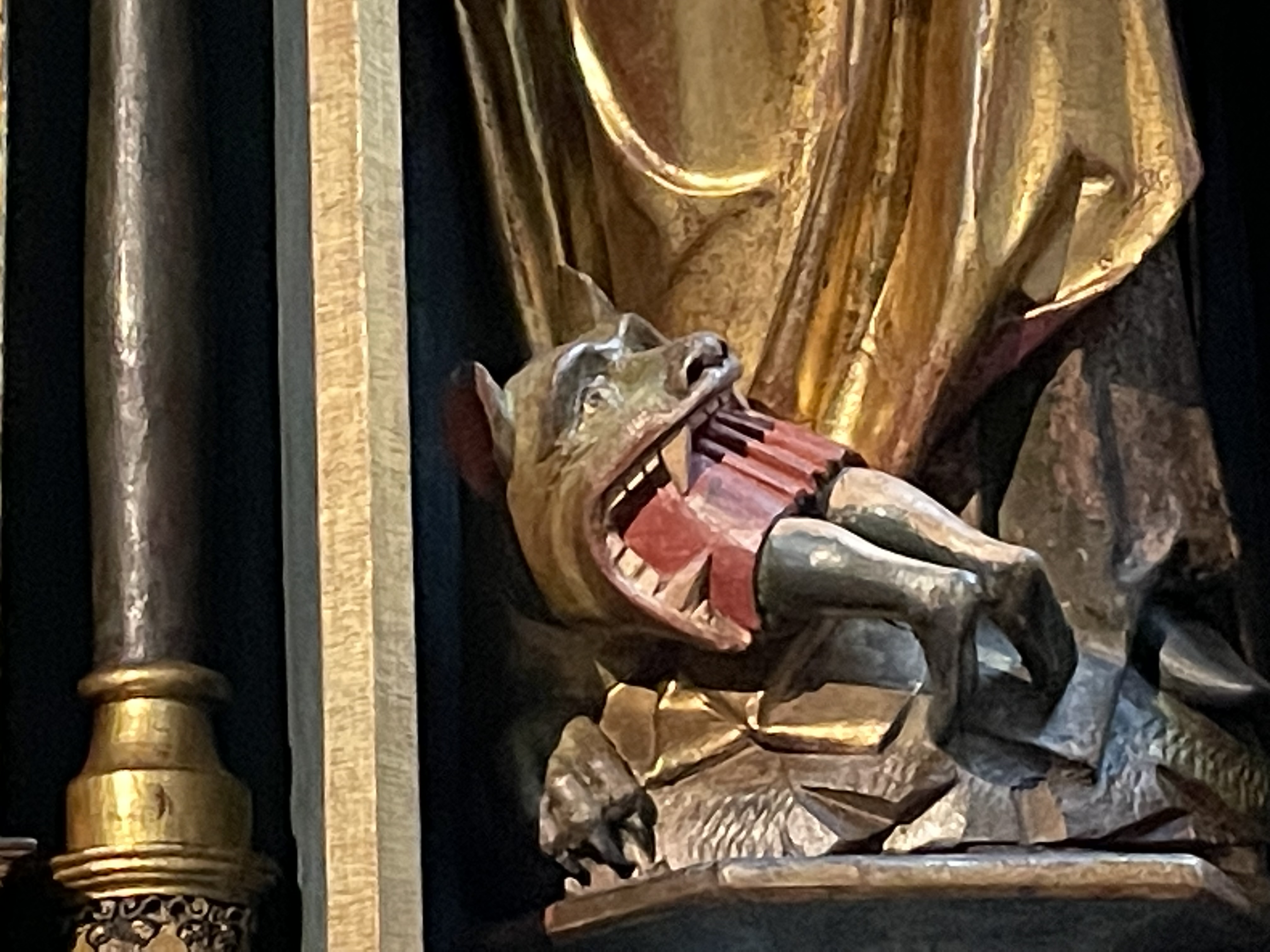
The dragon it was that died.
……………………………………
After this reasonably gentle day we, once again, realise that in simply ‘dropping-by’ we have missed many interesting aspects of and within the places we visited.
Each place deserves more time.
Maybe this is in part due to the desire to link with places less known… and accidentals, visited because they happen to be on the route of an unplanned, unstructured stroll (the classic examples being the church in Tampere, Pleven, a market in Ankara & the Halic cafe and district in Istanbul)
In Nürnberg there are many more sites and museums present & accessible cf with 1987 – but though such visiting was not part of our intention the opportunity to have extended our ambling beyond the city walls would have been valuable…. And in the case of Nürnberg some sites unvisited would have added benefits to the reflections that were occurring as a result of other encounters.
Unfortunately we fall foul of the very thing I’ve disliked about much tourism, the shallow ‘sight – seeing’ aspect where people seem to follow their cameras to the most obvious points of interest, ensure they have a record of the visit – but never examine what it is that they are recording.
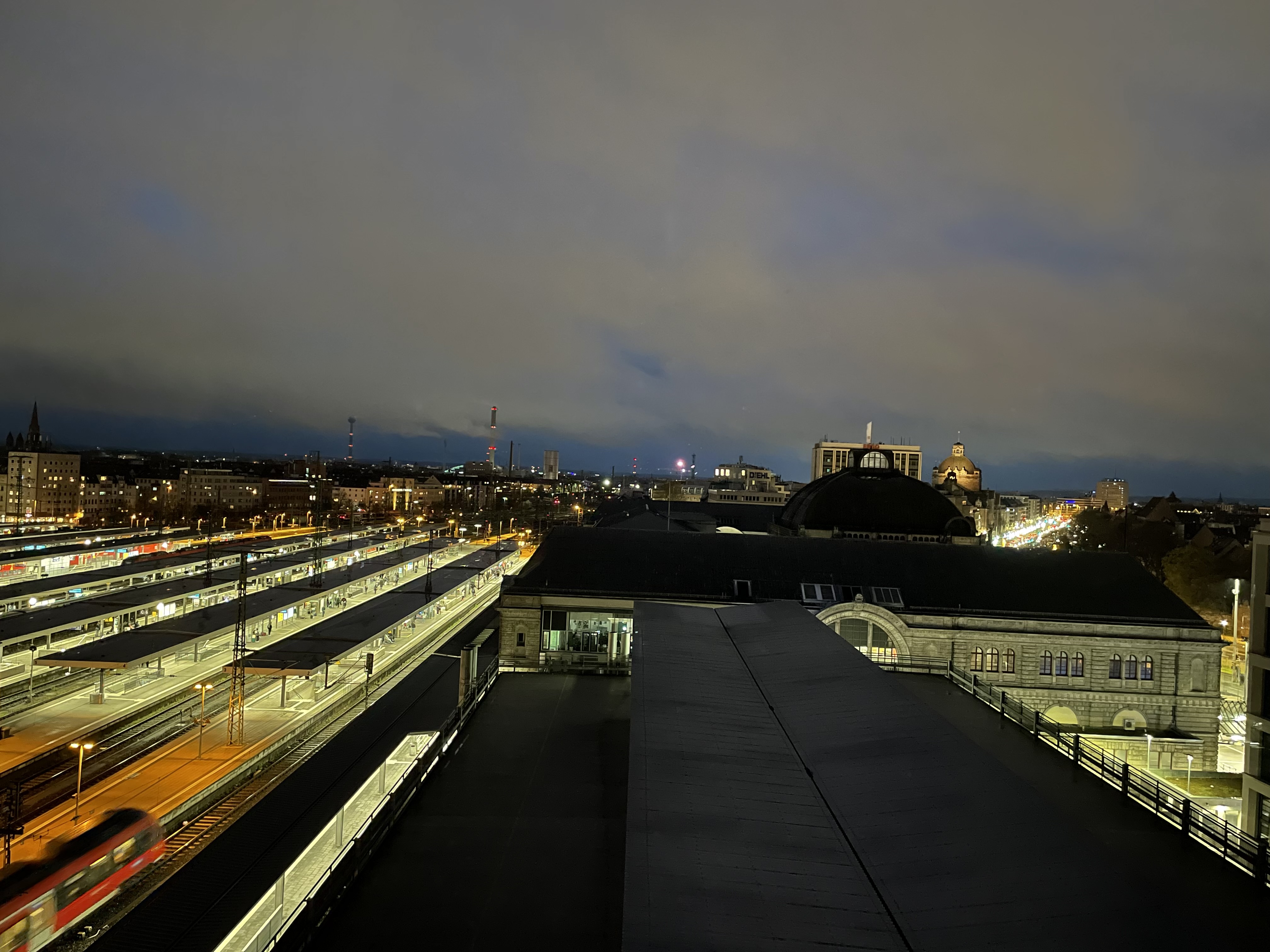
 Inspirational Pathways